Neonatal management and colostrum feeding of the calf
 Call Kai
 Learn
Learn Practice Test
 Spaced Repetition
 Match
Match Flashcards
 Knowt Play
1/23

There's no tags or description
Looks like no tags are added yet.
Name | Mastery | Learn | Test | Matching | Spaced | Call with Kai | Chat |
|---|
No analytics yet
Send a link to your students to track their progress
24 Terms
What type of placenta do cows have and how does it influence antibody transfer?
Syndesmochorial Placenta: The cow's placenta is thick, preventing most maternal antibodies (specifically IgG) from reaching the fetus during gestation.
Placenta is impermeable to antibodies
Calves and lambs are very susceptible to insult by pathogensd
What is a failure to transfer passive immunity (FTPI)?
• Calf born in immunocompromised state
• Needs to ingest quality colostrum (>50 mg/ml IgG) to develop passive immunity
• Colostral IgG molecules absorbed across neonatal intestinal epithelial cells
• Calves with FPT have higher morbidity and mortality rates and poorer reproductive and productive performance
What are the short term and long term effects of FTPI?
Short term effects:
• More death
• More sickness
Longer term effects:
•Production effects (growth and milk production)
• Animal Welfare implications
What are some reasons calves may not get effective passive immunity?
• Cows not getting to their feet (nerve damage, Low ca)
• Calves weak (Dytocia, twins)
• Poor quality (nutrition, lack of vaccination)
• Not enough produced (running milk, beef)
• High yielding cows (Dilution)
• Mis-mothering (heifers, c section)
Why is colostrum so important for calves?
Provides:
• Immediate humoral immunity i.e. antibodies
• Local (intestinal) immunity
• Energy
• If not adequate = Failure of passive transfer (FPT)
Describe when the high risk period is for calves, between passive transfer and active immunity (When calf synthesizes its own antibodies).
2-3 weeks old - high disease burden due to this gap

What are the five Q’s of colostrum management?
Quality - Amount of IgG present and coliform levels as they bind to colostrum, making it too large to pass through, or block channels through which it is absorbed, or increase rate at which neonatal enterocytes mature - causing them to close faster
Quantity - to prevent colic - limiting to 10% of BW, 200g IgG ideal
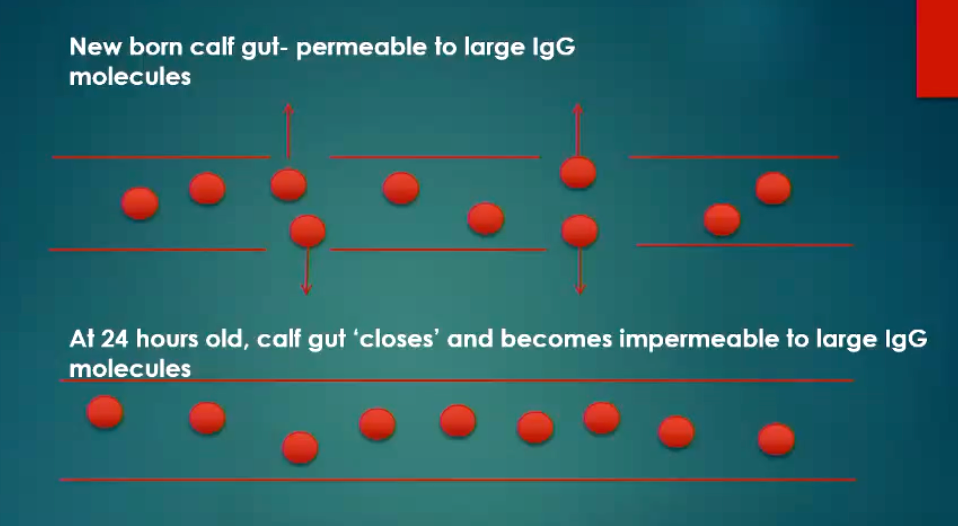
Quickly - first 6 hours of life -12, gut closes in first 24 hrs, the sooner the better
Quantify - minimum levels, refractometer to estimate levels of IgG in colostrum, 22% on refractometer
Aim for 15g/L, 10 is a minimum
Quietly - lower stress, as cortisol lowers absorptive capacity

Describe how the gut changes in the first 24 hours of a calves life.
What is the usual abomasal capacity of a calf?
2-3 L
What is the relationship between age at first feeding and serum IgG levels?
Sooner the better, the younger the calves, the higher the max IgG levels
The sooner you harvest milk after calving, the more…
The more IgG present in the milk, dilutes in the hours after calving as she comes into milk, important to harvest as quickly as possible
If you leave at room temperature, bacteria colonies also multiply very quickly
In fridge 4C: lasts for 2-3 days
Or freezer -22 C: will last 6-12 months
Or chemical preservatives
What is “gold colostrum”?
• Colostrum = 1st milking colostrum
Everything else is transition milk
Newborn should get 1st milking colostrum ONLY, not mixed with transition milk
• Lots of IGG
• Not contaminated with lots of bug.
Describe the difference in quantities between colostrum and milk.
Transition milk - shows gradual decline in values towards normal milk

What are the two main measures of colostrum quality?
High Antibody
Low Bacteria
• AIM 50g/L colostrum (>10g/L IgG in serum)
•AIM < 100 000 cfu/ml TPC
•and <10 000cfu/ml coliforms
How do we measure FTPI (IgG conc. in blood) to determine colostrum quality?
Using refractometer - indirect
Colostrometer - temp. sensitive and fragile - indirect
Total protein - indirect
Brix - refractometer that tests colostrum and serum levels
GGT - live enzyme age dependent to be accurate - direct
RID (Radial Immunodiffusion) - expensive labratory test - direct
Reminder** What impact does bacteria have on colostrum?
Bind to colostrum - making it larger and unable to pass through GIT
Block channels which colostrum usually uses to move
Increases rate of maturation of enterocytes to become impermeable
Describe how bacterial contamination of colostrum occurs and the impact it has.
• High bacteria counts in colostrum (particularly coliform bacteria) can interfere with absorption of IgG
• Warm ambient temperatures most rapidly increase bacteria count
• Bacterial contamination of colostrum occurs at harvest, and during storage and feeding
Important to use detergents to clean equipment
Important to clean teat
Can reduce lifespan in the fridge if contaminated
Does the method of feeding significantly affect colostrum absorption?
No - many methods but is best tailored to individual farm
• Bucket - but can increase risk of aspiration
• Oesophageal tube
• Bottle
• Gate rail teat feeders
• Mother? - many had lower antibodies levels
What are the main methods used to improve colostrum quality?
1. First Milking Only
2. Time calving to first milking (time in udder)
3. Time calving to first feed (age at first feed)
4. Time collection to first feed (time in bucket)
5. Selection of colostrum 'donor' cows
6. Pasteurisation
What are the main “cow factors” influencing colostrum quality?
Age
Breed
Volume of colostrum
Season
Nutrition pre-calving
Vaccinations
Pooling - frowned upon - due to reduced IgG and disease
Dry period length - need enough rest time, at LEAST 60 days
Mastitis / Sickness
Delayed collection

Can colostrum ever be bad?
• Can spread disease and bacteria can block IgG absorption
Johne's DIsease (See CP 4.21)
Salmonella
E. Coli
Mycoplasma
• Pasteurisation can reduce the risk $$$ cost benefit analysis
• 60°C for 30-60 minutes (too hot destroys IgG)
• Operator problems
• Main route is Faecal-oral i.e. dirty pens
• SORT THIS FIRST!!!- pasteurisation is NOT a silver bullet
What is the calf’s own mother’s colostrum is not available, what are the alternatives?
• 1. Fresh colostrum from another cow from same farm (Johnes neg)
Fridge within 1 hour, lasts 7 days
• 2. Frozen colostrum from another cow from same farm (Johnes neg)
Lasts 12 months in freezer, defrost SLOWLY, Not > 50 degrees
• 3. Artificial colostrum (supplement vs replacer)
• (4. Colostrum from another farm) - disease risk, avoid if you can
• ANYTHING BETTER THAN NO COLOSTRUM AT ALL!!!
What are the main aspects of proper colostrum management?
• Lidded drums
Animals or rats can get into containers
•Stir regularly
Since fats settle out on the top
•Hygiene!!
•Preservation
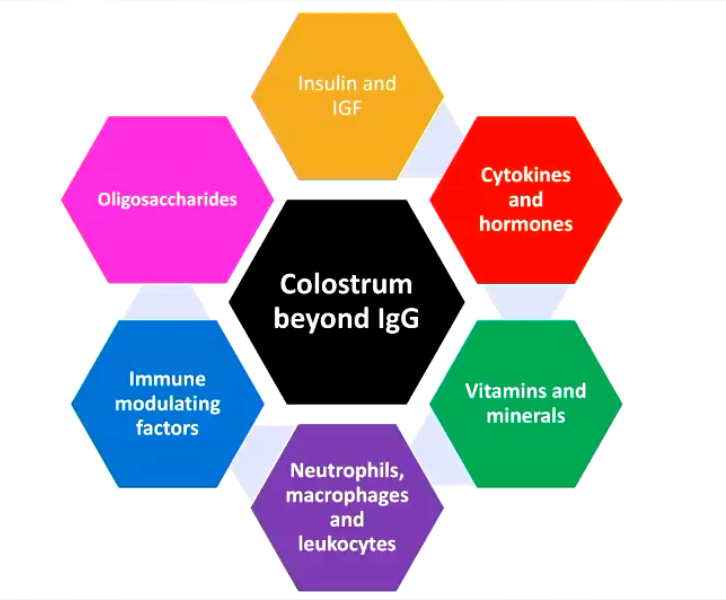
What are some other components of colostrum?