Testosterone
 Call Kai
 Learn
Learn Practice Test
 Spaced Repetition
 Match
Match Flashcards
 Knowt Play
1/44

There's no tags or description
Looks like no tags are added yet.
Name | Mastery | Learn | Test | Matching | Spaced | Call with Kai | Chat |
|---|
No analytics yet
Send a link to your students to track their progress
45 Terms
What secretes testosterone?
average level of testosterone in mens
do women need testosterone
Leydig cells (testes)
o.6 mcg/dL
women need testosterone for normal libido
sertoli cells
synthesize androgen-binding protein
process of testosterone production
hypothalamus → (GnRH) → anterior pituitary → (FSH, LH) → sertoli cells (ABP) and Leydig cells (testosterone)
testosterone negative feedback loop
feedback to
hypothalamus to decrease GnRH
pituitary to decrease LH
testosterone — with age (40+)
peaks in —
decrease
AM
testosterone is —bound
binds to — receptors
plasma bound
androgen receptors (nuclear)
what is testosterone metabolized to?
DHT → 5x more affinity for androgen receptor → more potent
primary hypogonadism
low testosterone w/ elevated gonadotropin (FSH, LH)
testicular defects
Klinefelter syndrome (XXY)
Undescended testicles
Mumps orchitis
Injury
Chemotherapy
Drugs (ketoconazole, spironolactone, marijuana)
secondary hypogonadism
low testosterone w/ low-normal gonadotropin
Kallman syndrome (abnormal hypothalamus development)
Pituitary disorders
Inflammatory diseases
Hemochromatosis (excessive iron)
HIV/AIDS
Obesity
Late onset hypogonadism due to normal aging (andropause)
Can have mixed gonadotropin levels
hypogonadism symptoms
Pre-puberty
Low muscle mass
Lack of voice deepening
Impaired growth of body hair, penis, and testicle size
Gynecomastia
Eunuchoid
Adulthood
Erectile dysfunction
Infertility
Low muscle mass
Gynecomastia
Osteoporosis
Decreased hemoglobin and hematocrit ← monitor CBC
dihydrotestosterone (DHT)
produced from skin and prostate
metabolized by 5a reductase
masculination of external genitalia + growth of hair follicles
estradiol
produced by adipose and bone
metabolized by aromatase (CYP19)
bone growth, libido
inactive metabolites of testosterone
etiocholanlone
androsterone
produced in liver
medchem of testosterone
ketone at carbon 3
hydroxyl at carbon 17

testosterone limitations
rapid oral absorption but extensive 1st pass → low systemic concentrations
17a methyl derivatives
alpha methyl group at carbon 17 position
PO due to less susceptible to hepatic metabolism
less 1st pass metabolism → hepatoxic
ester derivatives
parenteral/IM admin
high lipophilicity and long DOA
esterification of hydroxyl group at carbon 17
Testosterone undecanoate (Jatenzo, TLando) — PO bypass FPM
Testosterone cypionate
Testosterone enathate
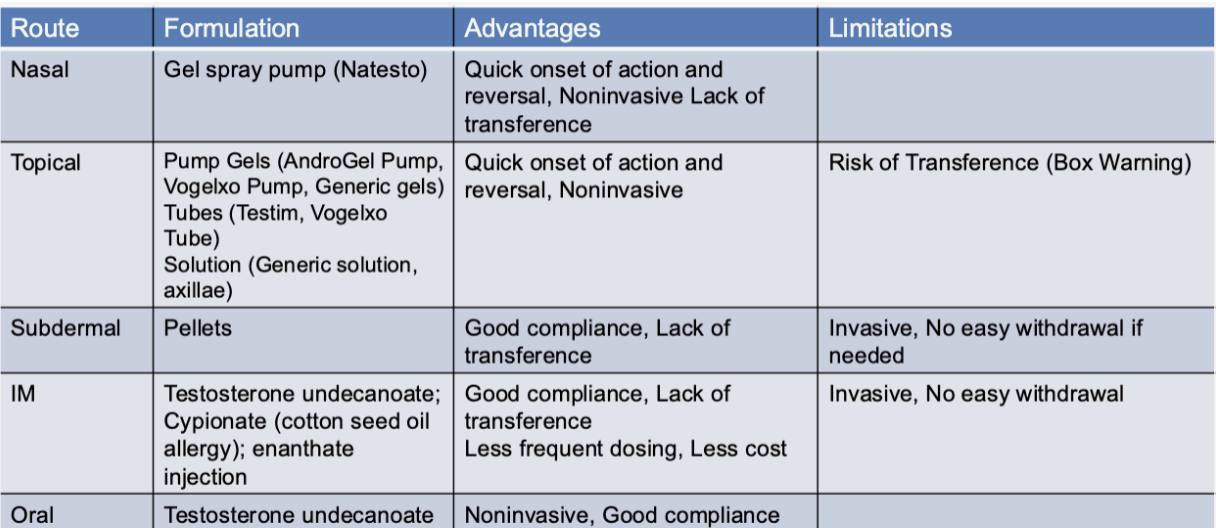
formulations
nasal
quick onset and reversal, noninvasive
topical
quick onset and reversal, noninvasive
risk of transference
subdermal
good compliance
invasive
IM
good compliance, less frequent dosing, less cost
invasive
oral
noninvasive, good compliance
Contraindications of testosterone replacement therapy
prostate/breast cancer
PSA > 4 (definite) OR PSA > 3 with risk of prostate cancer
severe LUTS (score > 19)
erythrocytosis (HCT > 48%)
untreated severe obstructive sleep apnea
uncontrolled HF
hypercoagulable state
recent MI/stroke (past 6 months)
begin replacement therapy and monitor within — for treatment modification
1 - 3 months
diagnosis of hypogonadism
sx + low testosterone
2 total levels on different days
drawn AM
< 300 ng/dL (normal = 250 - 800)
fasting not needed
monitoring for replacement therapy: baseline
Testosterone
PSA
CBC
Liver, lipids, BP
monitoring for replacement therapy: 3 months
T*
PSA
CBC (hematocrit)
BP
Symptoms of low-T
ADEs
Liver, lipids
monitoring for replacement therapy: 6 - 12 months once stable
T*
CBC (hematocrit)
PSA*
BP
Symptoms of low-T
ADEs
Liver, lipids
discontinue replacement therapy if
PSA
increase > 1.4
> 4 total count
worsening of LUTS
hematocrit
Hematocrit
> 54%
Can reinitiate if it lowers back to normal levels
Natesto, Tlando
d/c if total serum testosterone consistently outside normal range
oral testosterone therapy
testosterone undecanoate capsule
Kyzatrex
Jatenzo
Tlando
Undecatrex
Kyzatrex, Jatenzo, Undecatrex monitoring
monitor after 1 week, dose adjust
Tlando
cannot be adjusted
fixed dosing only
monitor after 3 - 4 weeks
how is testosterone undecanoate capsule aborbed by?
lypmphatic system = no FPE
testosterone undecanoate capsule dosing
BID dosing
IM testosterone therapy
75-100 mg Qweek
150-200 mg Q2weeks
50-400 mg Q2-4 weeks
Cypionate
Azmiro
Monitor T at the midpoint
Enanthate
Monitor T at the midpoint
Undecanoate
Aveed
Monitor T just prior to the next dose
Generics available
IM ADEs
Mood swings ← think puberty, teen hormones give you mood swings
BBW for pulmonary oil microembolism (POME) ← oil from formulation could get into lungs
Requires monitoring for ≥ 30 minutes after injection
SQ formulation
Enanthate
Xyosted → Qweek injection
Monitor T at trough, after 6 weeks, and 7 days after the most recent dose
Testopel → implant every 3-6 months (not recommended)
Monitor T at the end of the dosing interval
intranasal formulation
Natesto
TID
Monitor T periodically every month after starting
ADEs
Nasal irritation
topical formulation
Gel
AndroGel
Testim
Vogelxo
Generics
Pumps or tubes
1-2%
Solution
Applied to the armpit (axillae) ← better absorption + reduced transference
Recheck testosterone 2-8 hours after application in the AM after 2
Recheck after 4 weeks of starting therapy/changing dose
topical formulation: counseling
Applied in the AM
Cover the site of application
BBW to secondary exposure (virilization)
Avoid swimming, showering, or washing the site for 2-5 hours after application
Prime pump before using
T or F: testosterone is CII
false → CIII
testosterone CI
Men with breast or prostate cancer
Pregnancy ← women use testosterone
For oral medication
Asymptomatic low testosterone
For IM
Serious cardiac, hepatic, or renal disease (oils not good for that)
For intranasal or transdermal solution
Avoid in breastfeeding
testosterone BBW
Topical
Secondary exposure
Injection
POME
Oral
Increased BP
general warnings/precautions
Hypercalcemia, especially in cancer patients
Depression ← mood swings
Hepatic/renal impairment
Sleep apnea
Patients > 65
general ADEs
Low sperm count ← low gonadotropins from feedback
Increase prostate-specific antigen (PSA)
Increase BPH and worsen LUTS
Increased BP and worsened HF due to fluid retention
Hyperlipidemia
Increased LFTs
Polycythemia (increased hematocrit) → thicker blood
Gynecomastia
metabolic effects of testosterone

feminizing hormone therapy (for transgender women)
estrogen + androgen blocker
masculizing hormone therapy (for transgender men)
Testosterone
Any testosterone product may be used
All are used off-label for masculinizing therapy in transgender men
Dosing: use initial dosing for hypogonadism, but may increase dose to further suppress female traits
monitoring for masculinizing hormone therapy
CBC: hemoglobin and hematocrit based on the MALE reference range
Normal physiologic testosterone range (males): 300-1100 ng/dL