Genetics Exam 4
 Call Kai
 Learn
 Practice Test
 Spaced Repetition
 Match
 Flashcards
 Knowt Play
1/152

There's no tags or description
Looks like no tags are added yet.
153 Terms
genetic material requirements
effective transfer between generations (heritable)
ability to store vast amounts of information
effective replication/high fidelity
information can be changed/mutable
types of point mutations
substitutions
insertions/deletions
functional mutants
types of substitution
transition mutant
transversion mutant
transition mutant
type of substitution mutation
exchange of a purine for a purine or a pyrimidine for a pyrimidine
occurs more often due to switching for bases with similar structure

transversion mutation
type of substitution mutation
exchange nucleotides outside of nucleotide family; exchange a purine for a pyrimidine

types of insertions/deletions
silent mutations
missense mutations
nonsense mutations
silent mutation
type of insertion/deletion
changing one codon to a synonymous codon causing no change in the amino acid sequence of the protein
“degeneracy of the genetic code”
generally, a change in the third nucleotide of a codon causes no change in the amino acid coded for; “a change in genotype causes no change in phenotype”

missense mutation
type of insertion/deletion
changing one codon to a different codon resulting in a change in amino acid sequence of the protein
first position change of a codon will most likely cause a change in the amino acid
ex: sickle cell anemia- caused by a single base mutation

nonsense mutation
type of insertion/deletion
changing one codon to a “STOP” codon resulting in premature stoppage of translation
stop codons: UAG, UGA, UAA
products become abnormal → sometimes lethal
ex: cystic fibrosis
duchenne muscular dystrophy
cystic fibrosis
caused by a type of nonsense mutation
approximately 10% of all cases worldwide is caused by a nonsense mutation in the CFTR protein resulting in nmCF
duchenne muscular dystrophy
caused by a type of nonsense mutation
approximately 15% of cases are the result of the absence or very low levels of the dystrophin protein caused by a premature STOP codon
frameshift mutation
gain or loss of a nucleotide (or nucleotides) that result in change in the reading frame of the codon
everything downstream of deletion will be changed
ex: Chrons Disease
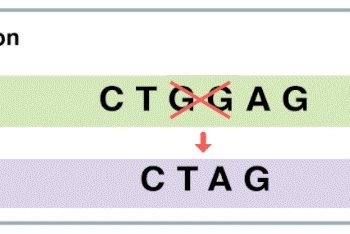
Crohns disease
caused by a frameshift mutation
a form of inflammatory bowel disease. symptoms include abdominal pain, fever, and weight loss. affects .3% of people in Europe and North America
insertion of the NOD2 gene at Cytosine 3020
insertion that causes a nonsense mutation
in-frame mutation
type of insertion/deletion mutation
gain or loss of a nucleotide or trinucleotide set that does not change the reading frame of the codon
ex: a missense mutation
types of general mutants
loss of function mutation
gain of function mutation
lethal mutation
loss of function mutation
results in a gene product with little or no functionality
amorphic- complete loss of gene function
most of the time, these phenotypes are recessive
gain of function mutation
results in a gene product that has gained a new and abnormal function
neomorphic- a new or different function from normal
these mutations are typically dominant
lethal mutation
mutation that leads to the death of the organism carrying the mutation
somatic cells
non-sex cells
mutations range from mild to severe
not passed to next generation (cannot be inherited)
germ cells
sex cells/gametes
typically, more severe manifestation passed along to offspring
ex: CF, Sickle Cell Anemia
present in sperm and eg
cause cancer family syndrome
can be inherited
mechanisms of mutations
spontaneous
induced
spontaneous mutations types
replication errors
chemical changes
spontaneous mutations
any mutation where no artificial factor or external regulator causes the mutation
you will only see the mutation when it occurs on a gene
120,000 mistakes
spontaneous mutation types
replication errors
chemical changes
replication errors
type of spontaneous mutation type
includes:
wobble
slipped strand mispairings
wobble
type of spontaneous mutation
non-complimentary bases can pair due to the flexibility of DNA double helix which can accommodate slightly misshaped pairings
typically, are fixed with exonuclease activity → but when they are not, incorporated in genome

slipped strand mispairing
type of spontaneous mutation
involves denaturation and displacement of DNA strands that results in mispairing of complimentary bases

chemical changes
type of spontaneous mutation
mutations caused by normal chemical reactions that occur in the cell
includes:
depurination
deamination
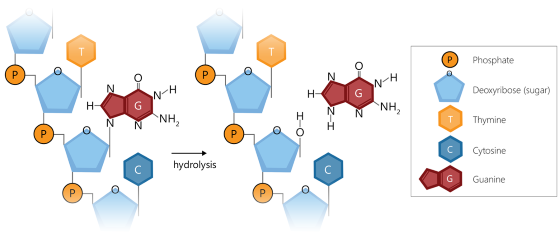
depurination
type of chemical change
a chemical reaction in which a beta-n-glycosidic bond is cleaved by hydrolysis causing the release of an adenine or guanine from a DNA strand
losing a purine
the “A-rule” — will typically add an A to the apurinic site (can sometimes add C, G, T)
deamination
type of chemical change
the hydrolytic removal of an amine group from a nucleotide releasing ammonia and converting the nucleotide to another molecule
most common: 5-methylcytosine → thymine

environmental factors
type of mechanism of induced mutations
free radicals
free radicals
very unstable and quick reacting molecule that “steals” electrons from nearby stable molecules
can occur due to: UV light, metabolism, ionizing radiation, smoking, air pollution, inflammation
antioxidants
help reduce free radicals
very electron rich (can donate electron to free radical) turns free radicals to normal
ex: vitamin C and vitamin E (work with uric acid in our blood)

UV light
causes pyrimidine dimers by the formation of covalent linkages localized on cysteine double bonds
causes a bulge in DNA (DNA polymerase cant read over it)
pyrimidine dimers are the primary cause of melanomas in humans
types of non-point mutations
chromosome mutations
transposable elements
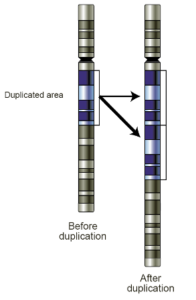
chromosome duplication
type of chromosome mutation
duplication of a region of DNA that contains a gene
causes: recombination
can be homologous or non-homologous
chromosome deletion
type of chromosome mutation
small deletions- less likely to be deleterious
medium deletions- responsible for a number of genetic disease
large deletions- often fatal
can be inframe or frame shift

in-frame deletion
type of deletion
downstream is not affected

frame shift deletion
type of deletion
downstream is affected
worse affect

transposable elements
“jumping genes” or transposons
sequences of DNA that move (or jump) from location in the genome to another
originally thoughts of as “junk DNA,” not believed to make up close to 40% of the human genome
widely believed to carry out some biological function, most likely a regulatory gene
often generate some type of mutation when they move from one location to another on a chromosome and in evolutionary, can increase the size of the genome
their impact depends on where it lands: gene (can result in mutation); non-coding region (not much impact)

Barbara McClintock
1950: discovered the concept of transposition using maize. initially her work was met with skepticism
1960: with the description of the lac operon system, her work was finally accepted
1983: Nobel Prize in Medicine and Physiology for the discovery of the “mobile genetic element”
discovery:
studied 4 genes
C’/C’- dominant colorless/color
Bz/bz- dominant purple/brown
Ds- dissociator (breakage of DNA- allows for transposon to cleave itself and move) actual transposon
Ac- activator (impacts of expression of Ds)- needs to be active to allow dissociator to move)
phenotype was dependent on when transposon actually moved
types of transposons
class 1
class 2
class 2 transposons
do NOT require transcriptase in order to transpose [DNA transposons]
all DNA transposons encode
move throughout the genome in a “cut and paste” mechanism
less than 2% of the human genome is composed of DNA transposons [much more prevalent in prokaryotes/viruses]
include
terminal inverted repeats
flanking direct repeats
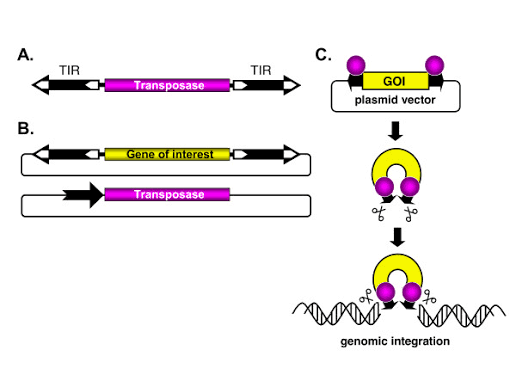
terminal inverted repeats
part of class 2 TEs
inverted compliments of 9-40 base pairs located at the both ends of the TE
recognized by the transposase (help us to identify the end of the TE)

flanking direct repeats
adjacent to class 2 TEs
not a direct part of the TE but play a role in insertion that the TE back in the genome
provides a marker for the excision site once a TE has moved
not a part of the transposon

class 2 transposon mechanism
the transposan is removed form the DNA sequence by transposase
TE/transposase
staggered cuts are made in the target DNA by transposase
the TE inserts itself into another location in the DNA
staggered cuts leave short, ssDNA pieces
replication of the ssDNA creates the flanking DR
DNA where TE was located is ligated together

class 1 transposon
require reverse transcriptase (the transcription of RNA into DNA) in order to transpose [RETROTRANSPOSONS]
function through the action of RNA intermediates
DO NOT encode transposase
produce RNA transcripts and rely on reverse transcriptase to reverse transcribe the RNA into DNA sequences prior to insertion into target DNA
move throughout the genome in a “copy and paste” mechanism
includes: long terminal repeats and non-long terminal repeats

long terminal repeat transposon
type of class 1 transposon
characterized by the presence of LTR on each end of the transposon

non-long terminal repeat transposons
type of class 1 transoson
no LTR present
the ONLY active class of transposons in humans
types:
autonomous
non-autonomous

autonomous non-LTR
class 1 TE type of non-LTR
capable of moving on their own as they make their own
reverse transcriptase required to move
Long Interspersed Elements
DNA sequences that range in length from a few hundred to as many as 9,000 base pairs
function L1 elements are about 6,500 bp in length and encode proteins, including an endonuclease that cuts DNA and a reverse transcriptase that makes a DNA copy of an RNA transcript
most L1 elements are not functional, they may play a role in regulating the efficiency of transcritpion of the gene in which they reside
non-autonomous non-LTR
short interspersed elements
short DNA sequence (100-400 base pairs) that represent reverse-transcribed RNA molecules originally transcribed by RNA polymerase 2
represent some 10% of our total DNA
the most abundant SINEs are the Alu elements consisting of a sequence that contains a site that is recognized by the restriction enzyme Alu1
retrotransposition mechanism
reverse transcriptase made in the cell by normal machinery
the retrotransposon sequence is transcribed to RNA
retrotransposon sequence undergoes reverse transcriptase to produce dsDNA
staggered cuts are made in the target DNA
the retrotransposon integrates into the new site in the host DNA
replication fills in the gaps at the site of insertion creating FDR
COPY and PASTE
