Types of selection
 Call Kai
 Learn
 Practice Test
 Spaced Repetition
 Match
 Flashcards
 Knowt Play
1/5

There's no tags or description
Looks like no tags are added yet.
6 Terms
Stabilising selection
‣ Occurs when environmental conditions are stable.
‣ Individuals with phenotypes closest to the mean are favoured.
‣ Over time, extremes of phenotype are lost.
‣ Mean phenotype stays the same.
‣ Standard deviation decreases
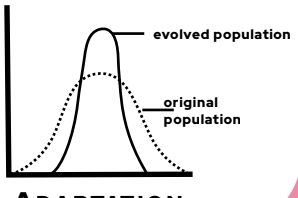
Stabilising selection: human birth weight
‣ Very small AND very large babies are less likely to survive (and so less likely to reproduce).
‣ So babies with either extreme of birth weight are less likely to pass on their alleles for extreme birth weight.
‣ Extreme mass at birth decreases in frequency over time.
‣ Babies with birth weights around the mean are selected for.
Directional selection
‣ Occurs when there is a change in the environment (i.e. a change in selection pressures).
‣ One of the extremes of phenotype has a selective advantage.
‣ Mean shifts in the direction of the individuals with the selective advantage.

Directional selection: antibiotic resistance
‣ Random mutation produces allele that gives one bacterium resistance to an antibiotic.
‣ If the population is exposed to the antibiotic (= selection pressure), any bacteria without the resistance allele are killed.
‣ Resistant bacteria survive and reproduce, passing on the resistance allele to offspring.
‣ After many generations, most of the organisms in the population have the antibiotic resistance allele.
Genetic bottleneck
‣ An event that causes a big reduction in a population’s size.
‣ Many alleles lost.
‣ Leads to a reduction in the gene pool as modern population descended from few survivors.
Founder effect
‣ When a few individuals of a species start a new population.
‣ Therefore there are only a small number of alleles in the initial gene
pool (low genetic diversity).
‣ If carried to the new population, alleles that were rare in the original
population can become much more common in the new population