biochem - 8 - membranes
 Call Kai
 Learn
 Practice Test
 Spaced Repetition
 Match
 Flashcards
 Knowt Play
1/25

There's no tags or description
Looks like no tags are added yet.
26 Terms
what are the primary functions of the cell membrane?
separate the interior and exterior of the cell
facilitate cell-cell interactions
exclusion of toxic molecules and ions
accumulation of cell nutrients; energy transduction and signal transduction
cell locomotion; cell division (flexible)
what types of lipids may be found in a cell membrane?
glycerophospholipids
sphingolipids
terpenes
cholesterol
what type of lipid is not found in a cell membrane?
triacylglycerol
what type of lipid forms the majority of the cell membrane?
glycerophospoholipid
what function does cholesterol serve in cell membranes?
increases strength and flexibility of cell membrane
which types of membrane structures form spontaneously?
monolayers
micelles
bilayers
vesicles
liposomes
what types of molecules produce monolayers?
amphipathic lipid molecules (when interacting with water)
what types of molecules produce bilayers?
lipids, such as membrane lipids (glycerophospholipids)
categorize each as a monolayer or bilayer:
micelle
vesicle
liposome
micelle: monolayer
vesicle: bilayer
liposome: bilayer
what is a mcelle?
spherical lipid aggregates which have long hydrophobic chains in the center and the charged carboxyl groups on the outside
what is a vesicle?
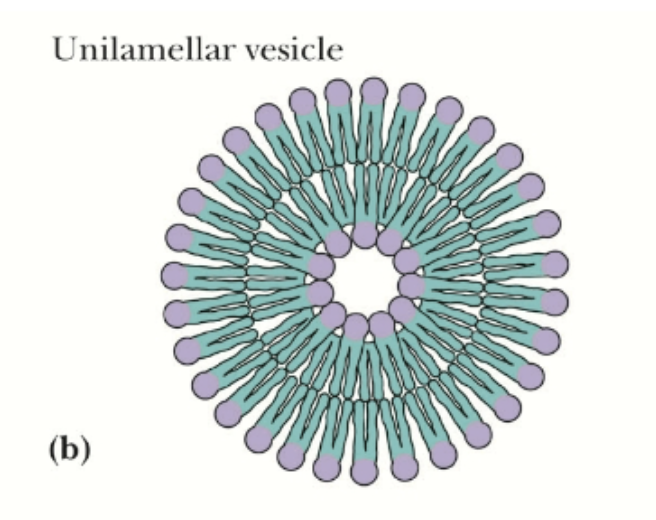
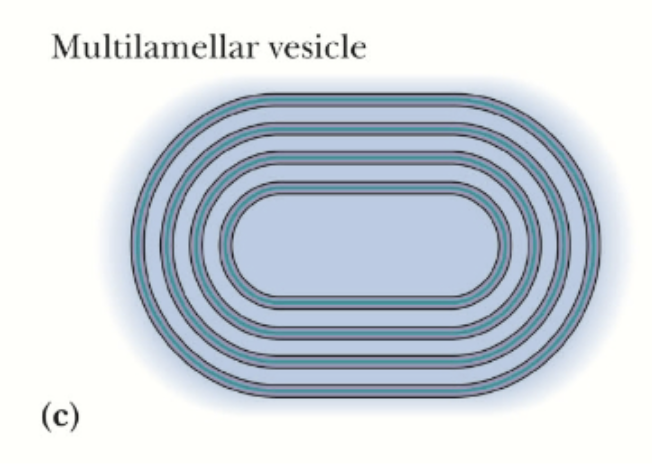
naturally occuring; spherical bilayer structures that can consist of multiple bilayers
what is a liposome?
made in a laboratory; artificially prepared vesicles used in laboratory experiements
draw a micelle - inside-out and normal

draw a monolayer and bilayer - formed on water

draw a unilamellar vesicle (or liposome)
bilayer structure
draw a multimellar vesicle
bilayer structure
describe the fluid mosaic model of membrane structure
considers that the lipids bilayer is a fluid supporting matrix for membrane proteins
biological membranes are dynamic structures, and both liquids and proteins are capable of movement within the bilayer
what are the two classes of membrane proteins?
integral membrane protein (intrinsic)
extended into or through the bilayer
peripheral membrane proteins (extrinsic)
external to the lipid bilayer
in membranes, list the types of
lipids,
proteins, and
carbohydrates
that may be found
lipids
glycerophospholipids
cholesterol, other lipids
proteins
integral
α-helical proteins
β-barrel proteins
carbohydrates
glycoproteins
glycolipids
describe the structure of integral proteins
largely contained within the lipid bilayer, or
attached to the membrane by only a small hydrophobic segment

describe the structure of peripheral proteins
loosely associated with the outside of the membrane; bind to the membrane through non-covalent interactions 9hydrophobic, ionic, hydrogen-bonding) with integral proteins

describe the structure of lipid-anchored proteins
membrane proteins (integral or peripheral) that are covalently linked to lipid molecules in the membrane
includes proteins bound to fatty acids such as myristric acid and palmitic acid

what type of structure is the protein bacteriorhodopsin?
α-helical integral membrane protein
what type of structure is the protein OmpX of E. coli?
β-barrel integral membrane protein
what type of structure is the protein glycophorin A?
integral membrane protein
attached to the membrane by only a small hydrophobic segment
the carbohydrates are antigenic determinants for the MN blood group system
(ABO blood group system is due to carbohydrates attached to membrane proteins or membrane sphingolipids - the carbohydrates are the antigenic determinants)

