Unit processes
 Call Kai
 Learn
 Practice Test
 Spaced Repetition
 Match
 Flashcards
 Knowt Play
1/254

There's no tags or description
Looks like no tags are added yet.
255 Terms
What are the reasons for reducing particle size?
Manufacturing progress
Controls properties of final products
Pharmaceutical formulation includes API: Good mix homogenous distribution (uniformity of content, dissolution rate and flow properties
Initial powder size : can be larger then the pharmaceutical requirements or aggregates
What are the aims of particle reduction?
Has a direct link with many physiochemical properties
Can improve mixing , size distribution or increase SA, flow properties and dissolution rate
To improve quality and stability
The impact of particle size on organoleptic properties is clearer with semi solid such as pastes
Affects the of the sizes of the powdered material
What does toughness mean?
Is the ability of a material to absorb the applied energy and deform without fracturing or the strength with which the material opposes rupture
Tough materials undergo plastic deformation and absorb a lot of energy before breaking
What are brittle materials?
Experience breakage easily, they breakage easily.
Little elasticity and don’t stretch easily
Crack propagation
They experience little elastic or plastic deformation they break through crack propagation rather than stretch
What is hardness?
Resistance to surface wear, scratches, cuts and permanent deformation
Can be hard and not actually tough
The ability of a material to resist deformation which is standard test where the surface resistance to indentation is measured
What is Mohs scale?
Help to identify materials and is characterizinf
What is elasticity?
The property of a solid material that allows it to restore after an external load is removed
Elastic materials such as rubber are extremely soft yet difficult to size reduce
What is plasticity?
The property of a solid substance that allows it to keep its deformed shape even when and external load is removed
What are ductile materials?
They are easily stretched materials and shoe plastic deformation under pressure
What process causes size reduction of solid materials?
Crack propagation - localised stresses produce strains large enough to rupture bonds and grow the crack
Why are tough materials hard to size-reduce?
They resist crack initiation and propagation, so breaking them is difficult.
Why are hard materials hard to size-reduce?
Their structure resists the strain needed to rupture bonds and propagate cracks
Which materials absorb large amounts of energy through elastic and plastic deformation without cracking?
Soft materials - rubber, waxy substances (e.g. stearic acid), and sticky materials like gums.
Why do soft materials resist size reduction at ambient temperature?
They deform elastically and plastically, absorbing energy without starting or propagating cracks.
How can soft materials be made easier to size-reduce?
Cool them below the glass transition point.
What happens to a soft material below its glass transition point?
It shifts from plastic to brittle behaviour, so crack propagation is facilitated.
Define the glass transition point.
The temperature at which a material changes properties: below it the material is brittle, above it the material is rubbery.
Fill in the blank: Size reduction occurs when localized stresses produce ______ large enough to cause bond rupture.
Strains
Fill in the blank: Below the glass transition point, a material behaves as a ______ material.
Brittle
Fill in the blank: Above the glass transition point, a material behaves as a ______ material.
Rubbery
True or false: Soft materials are easiest to size-reduce at room temperature.
False - they are easier to reduce at low temperatures, below the glass transition point.
What are cutter mills
Size reduction method - Cutting
Particles are fractured between two sets of knives. A stationary set on the mills casing and set attached to to the motor
The size reduction range is 500 to 50,000 microns

What are roller mill?
Uses compression
A form of compression mill uses two cylindrical rollers mounted horizontally and rotated about their long axes
The size reduction range is 1,000 to 100,000 microns

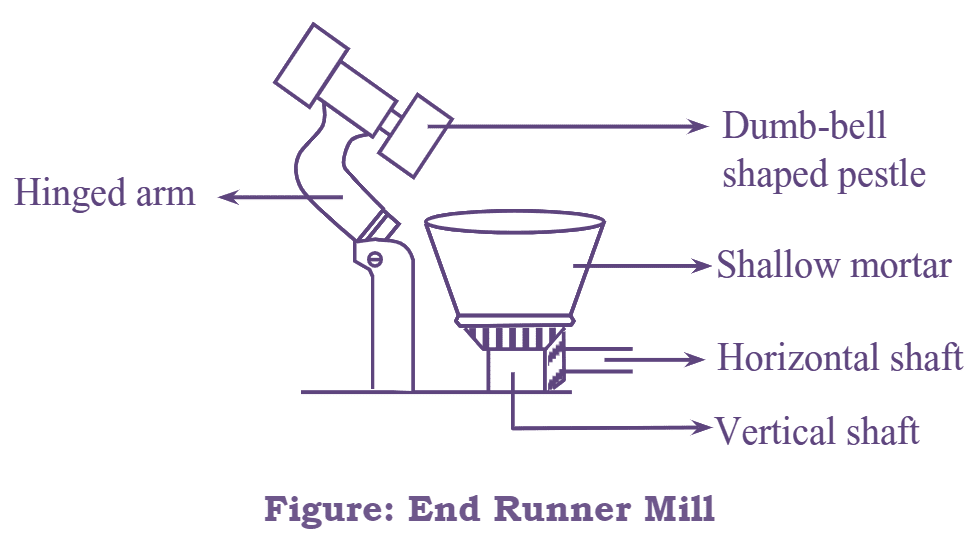
What are end-runner mill?
Compression
Powder is compressed using mortar and pestle
The size reduction range is 50 to 10,000 microns
What are hammer mill?
Uses impact
Particle size is reduced upon impact driven by 4 (or more) rotating hammers, hinged on a central shaft and enclosed within a rigid metal case
The size reduction range is 50 to 10,000 microns

What are vibration mill?
Uses impact
The size reduction range is 50 to 10,000 microns
A cylinder filled to 80% with porcelain or stainless-steel balls. Particle size is reduced upon repeat impact driven by vibration of the whole body of the mill.

What are ball mills?
Uses both impact and attrition
A rotating cylinder filled to 30-50% with balls. The mill can be filled with a variety of ball sizes to improve the size reduction process.
The size reduction range is 1 to 100 micron

What are fluid energy mill?
Uses both impact and attrition
Air is injected at a high-pressure, creating turbulence which will lead particles to collide with other particles and with the wall of the mill
the size reduction range is 1 to 50,000 microns

What are pin mills ?
Uses impact and attrition
Two metal discs with closely spaced pins rotate against one another at high speeds
Particle size reduction occurs by impaction with the pins and by attrition between pins as the particles travel outwards under the influence of centrifugal force
The size reduction range is 10 to 10,000 microns
What should be considered when choosing the best method for size reduction ?
• The purpose of size reduction
• The required particle size range
• Fine particles, size distribution
• Costs of the process
• Particle properties (i.e. toughness and hardness)
• Special requirements…costs!
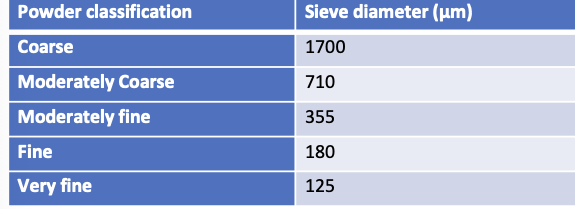
What is size separation?
An integral part of a production process and results in a product powder of a given particle size range that is available for separate handling or subsequent processing.
What is size analysis?
Information on the size characteristics of a powder
What does size separation aim to do ?
• Separate particles based on sizes
• Remove powder particles from other gases and liquids
How does size separation work ?
Based on mechanical disturbances of the powder bed and include methods such as agitation, brushing and centrifugation
What is size separation by sedimentation?
Separating particles based on the differences in settling velocities of particles with different diameters
What is size separation by elutriation?
There is a fluid flow in the opposite direction to the sedimentation movement so that in gravitational elutriators particles move vertically downwards while the fluid travels vertically upwards.

What is mixing?
It is the unit process which aims to treat two or more components so that the density of each type of particle is constant throughout the entire volume. The previous state is called either ideal mixing or the perfect mix
What is positive mixtures?
They are formed from materials such as gasses or miscible liquids which mix spontaneously and irreversibly by diffusion and tend to approach a perfect mix
No input of energy as if you did it would shorten the time re queried to obtain the desired degree
Energy will require ti separate a component out of the mix
No present problems during product manufacture
What is a negative mixture?
Components will tend to separate out spontaneously
Slowly like emulsions, creams and viscous suspensions
More difficult to form and to maintain and require a higher degree of mixing efficiency than do positive mixtures
What is a neutral mixtures ?
Tendency to mix spontaneously or segregate spontaneously once work has been input to mix the
Are capable of remixing but requires energy input
Neither mixing nor remixing happens spontaneously
What are the three types of powder mixing?
Convection , shear and diffusion
What are the type of mixing for liquids?
Bulk transport , turbulent mixing and molecular diffusion
What is convection mixing?
When a large group of particles moves from one part of the powder bed to another, e.g. when a mixer blade or paddle moves through the mix.
Which mixer uses the convection mixing method?
Planetary mixer

What are the advantages of convection mixing?
It is a quick process and provides good mixing to powders with poor-flow properties.
What type of mixing does convection contribute to?
Macroscopic mixing of powder mixtures.
What are the key benefits of convection mixing regarding demixing ?
Reduces the possibility of de-mixing
Which mixer uses the shear mixing principle?
Tumbling mixers

What type of mixing does shear mixing contribute to?
Semi-microscopic mixing
What is a key drawback of shear mixing?
High chance of de-mixing
What type of mixture does diffusion mixing provide?
Good random mixtures
What type of mixing does diffusion mixing contribute to?
Microscopic mixing
What is diffusion mixing the main mechanism for?
Fluidised bed mixers
What are fluidised bed mixers used for?
Drying, mixing, and granule preparation.