Test #1, Econ 4001.02
 Call Kai
 Learn
Learn Practice Test
 Spaced Repetition
 Match
Match Flashcards
 Knowt Play
1/44

There's no tags or description
Looks like no tags are added yet.
Name | Mastery | Learn | Test | Matching | Spaced | Call with Kai | Chat |
|---|
No analytics yet
Send a link to your students to track their progress
45 Terms

Steps:
1 - Isolate k
2 - Must be a or c because of the nature of an indifference curve
3 - Plug in sets, see which k is higher
ANSWER: a

Steps
1 - Define Terms
Monotonic: more is always better than less
Convex: idea that you would settle for less quantity of x if it were mixed with y rather than stand alone. (Why indifference curves are bent)
ANSWER: C

1 - Find derivative to find slope
2 - Plug in X1; (X2 is like finding dy in calc)
ANSWER: A

1 - Define Terms
Completeness: A consumer can rank bundles based on preference
Reflexity: Any bundle is as good as itself
Transivity: A > B and B > C, So A > C
Substituitivity: Not a standard word; the degree to which one good can replace another and maintain utility
ANSWER: C
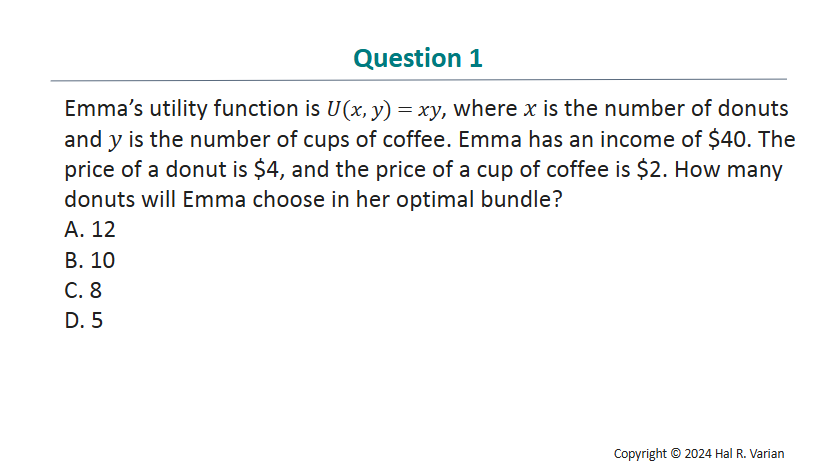
1- Find MRS (MUx/MUy)
2 - Set MRS = Price Ratio. (Because it is where the slopes are equal - for well behaved only)
3 - Solve for y = ax
4 - Plug ax into budget constraint for y
5 - Plug in numbers
ANSWER: D
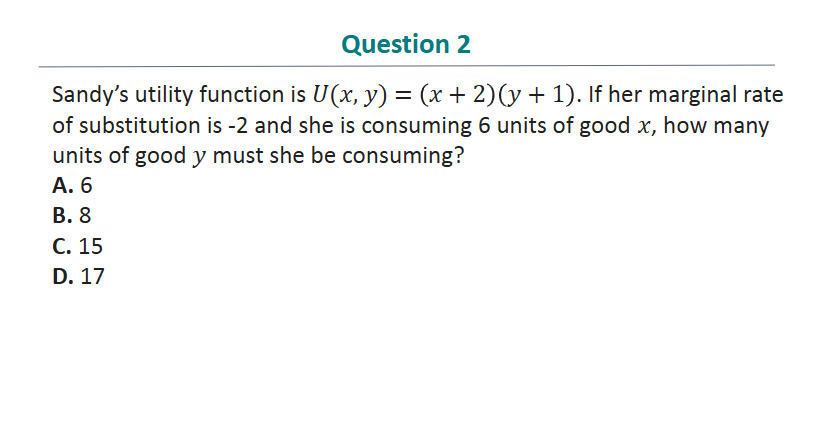
1 - Find MRS (MUx/MUy)
2 - Plug in given values
3 - Do some algebra and solve. Assume the MRS is negative here
ANSWER: C

1 - Take out a divisible number so that the values are equal
2 - Identify that the equations are now the same with the only difference being the factor of U
3 - Identify that this is a perfect complement, so factor of U does not matter, instead only the kink points do
ANSWER: A
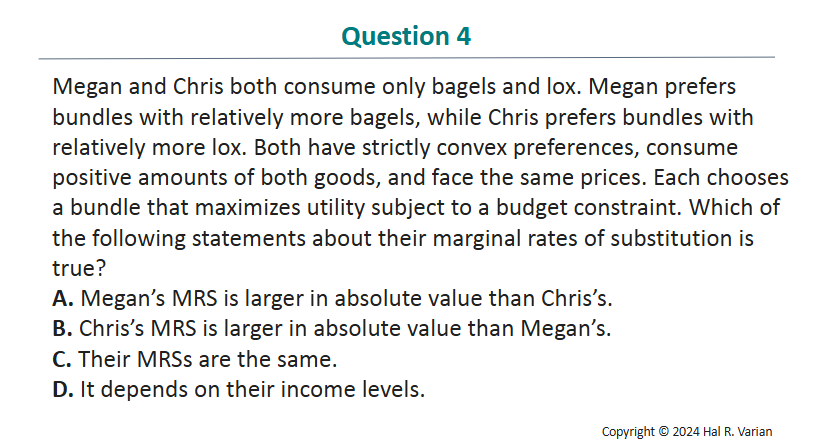
1 - Identify that the question is about MRS at the optimal point
2 - MRS at optimal point = price ratio
3 - SAME PRICES, Even if income is different, slope will be the same

Layup

1 - Solve for initial utility through substitution
2 - New price for x, set equal to new U
3 - Solve for y

Plug in each person’s values to the other equations and compare

1 - Solve for the square
2 - ²indicates monotonic
3 - The (x + 4y) is perfect substitute
4 - perfect substitute is straight like
ANSWER: B

1 - Must simplify to (x^a)(Y^a)
2 - work inversely with log functions to solve
ANSWER: D
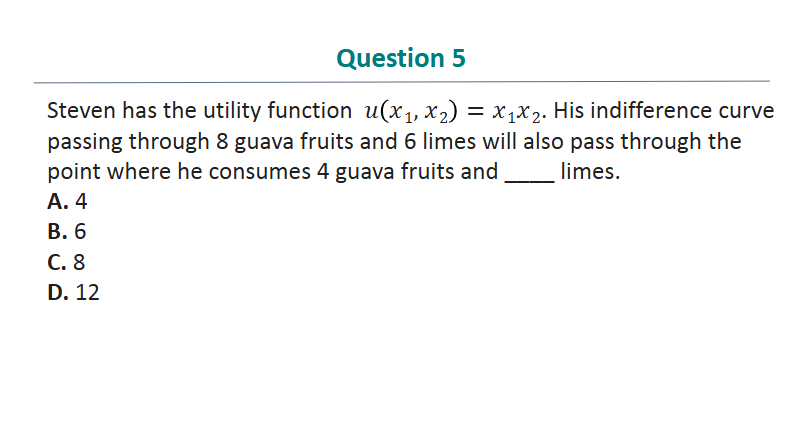
1 - Plug in initial numbers and find U
2 - Divide U by x and find y
ANSWER: D
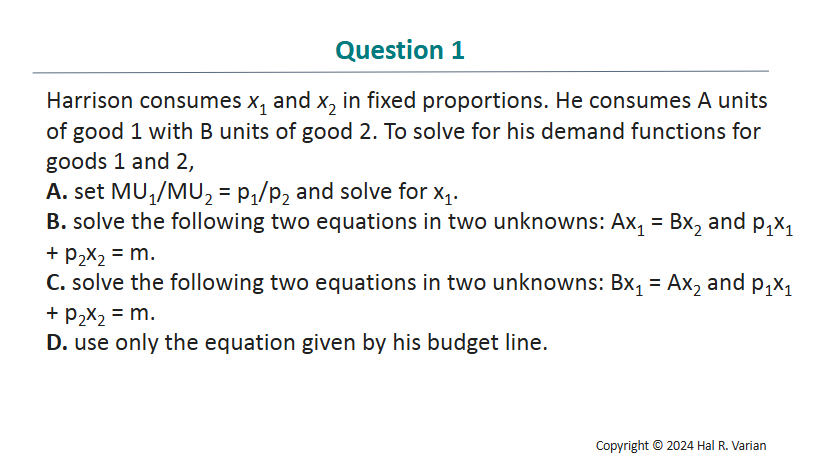
1 - Identify “Fixed Propoirtions”; these means perfect substitutes.
2 - Bc of this, Ax = Bx
ANSWER: C

1 - Homothetic; MRS stays constant / consumption of all goods stays proportional
2 - Multiply goods bought by correct factor
ANSWER: A

1 - Identify “Income Offer Curve”, when m increases what happens to consumption of X2 and X1
2 - Evaluate each function:
X2, value is just the price ratio, which does not change
X1, as long as m > 2 (which it specifies), it will increase
3 - graph it out
ANSWER: B

1 - A cannot be correct because perfect substitutes are “all-or-nothing” whatever is the highest U/$ would have 100% allocation
2 - B cannot be correct, he will buy more if his income increases
3 - C cannot be correct, that is indicative of a perfect compliments
4 - Cobbs-Douglass has everything purchased in fixed percentages. Depicted by the exponents
ANSWER: D

1 - Identify function is Quasilinear
2 - Recall Engel Graph properties; once X1 is saturated, the remaining will be directed towards X2
ANSWER: 10

1 - Identify that this is a perfect compliment function
2 - Calculate U currently by plugging in numbers
3 - Find lower of the 2 values
4 - Solve for what x and y could be to = 20
5 - Multiply those values by the price
ANSWER: C

1 - Find where q = 0 (price on y axis)
2 - Graph p1 and p2
3 - Find q with current price
4 - graph out, use ½ (b)(h) to find CS

1 - Find where q = 0 (for top price) and plug in p to see what q1 is equal to
2 - Do the same for q2
3 - Use triangle graph and solve

1 - Find derivative of the function
2 - Rearrange so it is x = ___ (A demand function)
3 - continue with surplus graphing
ANSWER: A

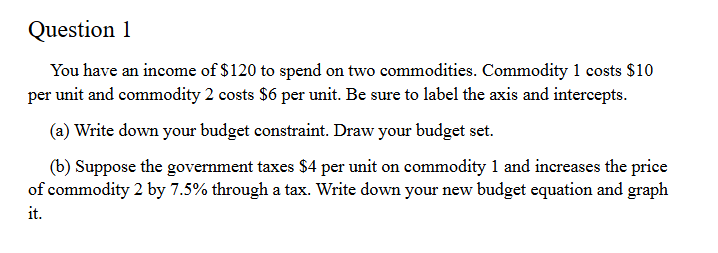
A
1 - PxX1 + PxX2 = M
ANSWER: (10)(q1) + (6)(q2) = 120
Graph out as well, with x2 on y and x1 on x
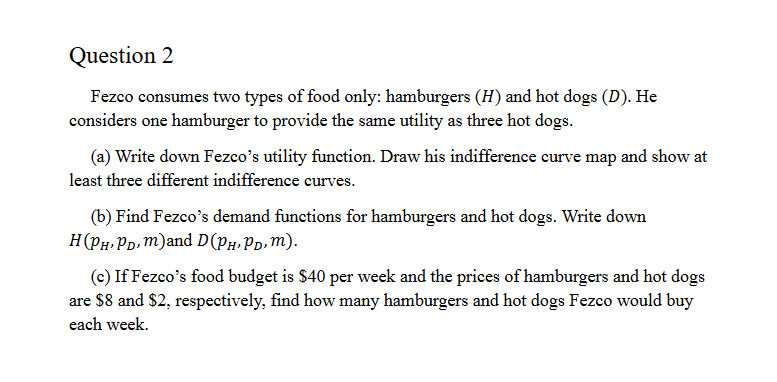
B
1 - Adjust original budget constraint
ANSWER: (14)(q1) + 6(1.0175q2)
Graph out as well
A
1 - IDENTIFY THAT THIS IS PERFECT SUBSTITUTES
2 - Write a standard utility function:
ANSWER: U(H,D) = H + 3D
3 - Graph out perfect substitutes:
ANSWER: Straight line, (x2 = 9, x1= 3) (x2 = 6, x1 = 2) (x2 = 3, x1 = 1)

B
1 - perfect substitute demand function: MU/P
ANSWER: 3/Ph, 1/Pd

C
1 - Because it is perfect compliment, find item with highest U/$
2 - Buy only that item
ANSWER: 20 hot dogs, 0 hamburgers

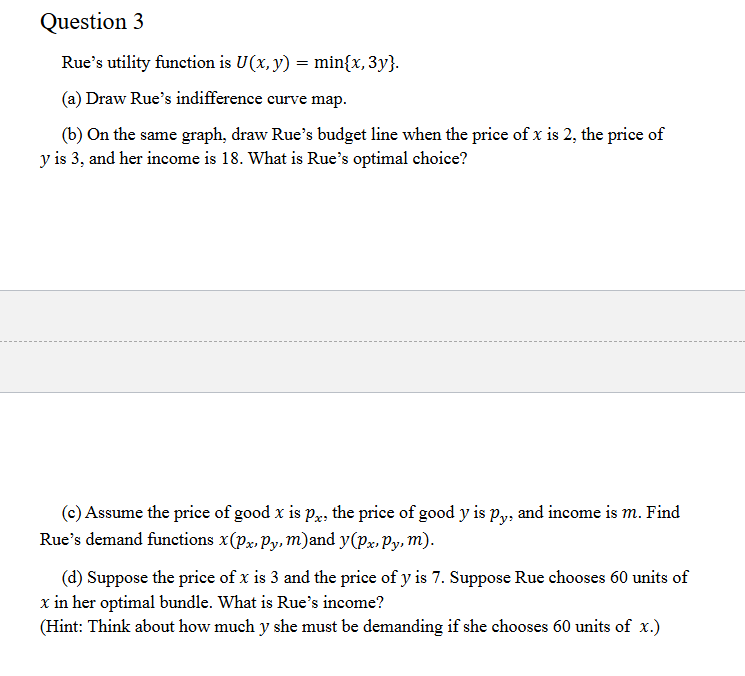
A
1 - IDENTIFY THAT THESE ARE PERFECT COMPLIMENTS
2 - Draw the 90-degree indifference curves

B
1 - Draw the budget line; divide 18 by 2 and 3, respectively
2 - Solve for the optimal point by putting x in terms of y (can do this because the two goods are bought in pairs
3 - Plug that value into the budget constraint formula. Solve for y
4 - use y to solve for x
ANSWER: (6,2)
C
1 - Demand functions for perfect compliments: m / (p1 + p1)
2 - must need 3 times are much x to get same utility as y; so bottom is 3px + py
3 - For y keep m alone
4 - For x, multiply bundle by 3 to find the true quantity of x
ANSWER: y = m / 3px + 3py, x = 3m / 3px + 3py

D
1 - 60 units of x means 20 units of y
2 - plug into budget constraint to find total m
ANWER: 320

A
1 - find the partial derivatives of R and M
ANSWER: R = 4M^-1/2, M = 4
2 - Divide MUR/MUM
ANSWER: Simplifies to -1/R^1/2

B
1 - Set MRS = Price Ratio
2 - Solve for R
3 - Plug R back into budger constraint and solve for M
ANSWR: M = 8

C
1 - Plug in 36 for R
2 - Price ratio = 1/6

A
1 - Solve Partial derivatives for both (remember multiplication rule)
2 - Use the Cobb-Douglas simplifier (-ay/bx) to find MRS
3 - Simplify MRS
ANSWER: C/2B

B
1 - Set MRS = Price Ratio
2 - Put the value into terms of B
3 - Plug into Budget Constraint
4 - solve for B, then once you have that value, solve for C
ANSWER: B = 4, C = 6

A
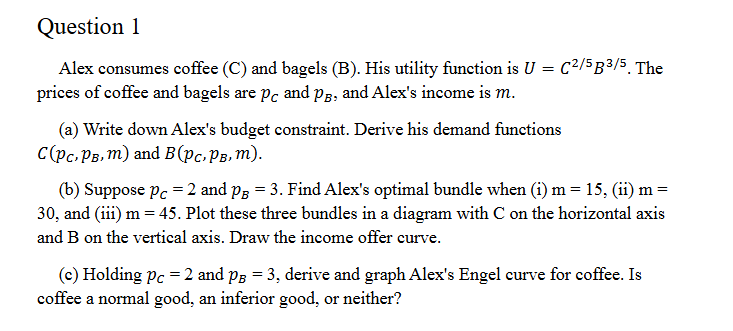
1 - Budget Constraint: pxX + pyY = m
2 - Find demand function for C and B: put one into terms of the other
Start by finding the MRS (use the Cobb-Douglas trick)
Set equal to price ratio of Pc/Pb
Plug PbB (now in terms of C) back into budget constraint to find C’s function
Do the inverse but with PcC in terms of B
Add both terms in ratio together; divide by 5Pb/3
ANSWER: B = 3m/5Pb
C = 2m/5Pc

B
1 - Chug and Plug
2 - Values here should be (3,3) (6,6) (9,9)
ANSWER: graph values with simple x=y
C
1 - plug in pc to demand function and simplify
2 - move m to other side, m = 5C
3 - That is your engel curve function
ANSWER: Normal good

All parts
Simple

A

B

C

D