chp. 11: catabolism
 Call Kai
 Learn
 Practice Test
 Spaced Repetition
 Match
 Flashcards
 Knowt Play
1/55

There's no tags or description
Looks like no tags are added yet.
56 Terms
substrate level phosphorylation
The synthesis of ATP from ADP by phosphorylation coupled with the exergonic breakdown of a high-energy organic substrate molecule.
oxidative phosphorylation
The synthesis of ATP from ADP using energy made available during electron transport initiated by the oxidation of a chemical energy source.
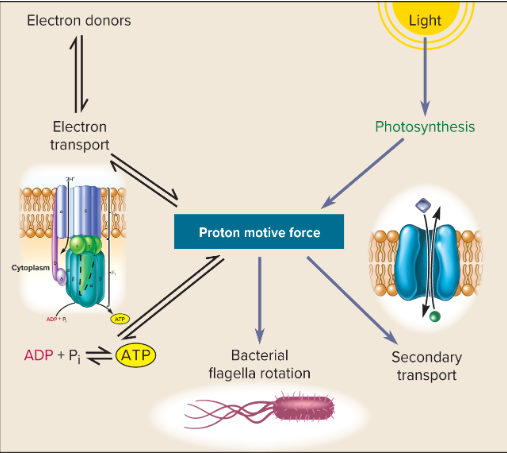
proton motive force
The potential energy arising from a gradient of protons and a membrane potential that powers ATP synthesis and other processes.
used to perform work when protons flow back across the membrane, down the concentration and charge gradients, and into the cytoplasm (exergonic and used to phosphorylate ADP → ADP)
also used in flagella motor rotation and secondary active transport systems
what r the 6 elements required for survival?
CHONPS → often satisfied together
some organisms have great metabolic flexibility depending on env.
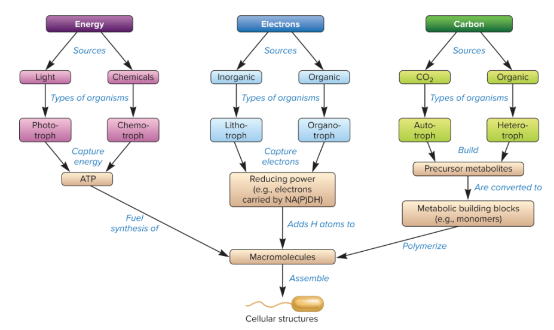
when describing a type of organism, what part of the word is the energy source?
1st pt of word → phototrophs or chemotrophs
when describing a type of organism, what part of the word is the electron source?
2nd pt. of word → lithotrophs or organotrophs
when describing a type of organism, what part of the word is the carbon source?
3rd pt. → heterotrophs or autotrophs
what r the 2 energy sources of diff types of organisms?
phototrophs → use light
chemotrophs → obtain energy from oxidation of organic compounds
what r the 2 electron sources of diff types of organisms?
organotrophs → use organic compounds
lithotrophs → use reduced inorganic substances
what r the 2 carbon sources of diff types of organisms?
heterotrophs → use organic molecules, which often also serve as energy source
autotrophs → use CO2
phototrophs
use light as energy source
chemotrophs
obtain energy from oxidation of chemical compounds
organotrophs
use organic compounds as electron source
lithotrophs
use reduced inorganic compounds as electron source
heterotrophs
use organic molecules, which often also serve as energy source for carbon source
autotrophs
use CO2 as carbon source
photolithotroph
energy source: light
electron source: inorganic compounds
carbon source: CO2
aka photolithoautotrophs aka photoautotrophs, known as primary producers
photoorganoheterotroph
energy source: light
electron source: organic compounds
carbon source: organic compounds
chemolithoautotroph
energy source: chemical/inorganic compounds
electron source: inorganic molecules
carbon source: CO2
oldest microbes, known as primary producers
chemolithoheterotroph
energy source: chemical/inorganic compounds
electron source: inorganic compounds
carbon source: organic carbon
chemoorganoheterotroph
energy source: chemical/organic compounds
electron source: organic compounds
carbon source: organic carbon
aka chemoheterotrophs aka chemoorganotrophs (what we are and majority of pathogens)
what 2 microogranism classes are primary producers?
photolithotrophs/photoautotrophs and chemolithoautotrophs (oldest) cuz their waste is everyone else’s food. Take inorganic stuff (CO2) to produce waste that is everyones food.
what microbe class are we and most pathogens?
chemoorganoheterotrophs/chemoheterotrophs/chemoorganotrophs
single organic nutrient can satisfy all 3 requirements
can organisms change their microbe classification?
YES! some can depending on their environment. (mostly bacteria, we cannot cuz they need to adapt or will die)
ex: if growing in the dark, change from photo- → chemo
what r the fueling rxns all organisms need?
1) ATP as energy currency
2) reducing power (NADPH + NADH) to supply electrons for chemical rxns
3) precursor metabolites for biosynthesis (12 carbon skeletons that we put together to build diff things)
what types of metabolism can chemoorganotrophs do?
fermentation
aerobic respiration (if e- acceptor is exogenous O2)
anaerobic respiration (If e- acceptor is exogenous but not O2)
electron donor is organic compound!

is anaerobic respiration based on the presence of oxygen?
its based on what the terminal electron acceptor is! If the terminal e- acceptor is oxygen then its aerobic resp. If the terminal e- acceptor is a diff organic compound thats NOT oxygen like NO3, SO3, S, then its anaerobic resp.

what metabolism can chemolithotrophs do?
aerobic respiration
anaerobic respiration
NO fermentation!!
use inorganic electron donor

chemoheterotrophs are also known as?
chemoorganotrophs and chemoorganoheterotrophs
what happens to the energy source for chemoorganotrophs?
the energy source is either fully or partially oxidized and releases energy for catabolism and provides the carbon and electrons for anabolism.
the oxidized organic energy source releases e- accepted by NADH and FADH2
if e- are donated to ETC → respiration (either aerobic or anaerobic depending on if O2 is terminal e- acceptor)
if e- are donated to an endogenous acceptor (pyruvate or product of pyruvate) → fermentation
what differentiates respiration and fermentation?
the presence of an Electron Transport Chain (ETC) and a membrane potential (pmf and OP) NOT oxygen!!
also if electron acceptor is endogenous like a product of pyruvate (fermentation) vs exogenous (respiration)
respiration
involves the use of an ETC and has external/exogenous electron acceptor. PMF is generated and then oxidative phosphorylation is used to generate ATP! Can also use SLP
aerobic
oxygen is terminal e- acceptor
anaerobic
a diff exogenous organic e- acceptor (NO3, SO4, CO2, Fe3+, SeO4)

how does respiration produce ATP?
mainly through oxidative phosphorylation (OP) within ETC using pmf, but can also use SLP

fermentation
does NOT include the use of an ETC or the generation of pmf, so no OP!!! Instead uses substrate lvl phosphorylation to make ATP
depends on the oxidation of organic compounds
endogenous electron acceptors → pyruvate or products of pyruvate

what metabolism can ONLY use substrate level phosphorylation to make ATP and only uses endogeous e- acceptors?
fermentation! it doesnt have ETC

where does respiration occur in eukaryotes vs prokaryotes?
euk: mitochondria + cytoplasm
prok: cytoplasm + cell membrane
what r the energy sources for these metabolic pathways?
mainly polysaccharides but also proteins and phospholipids! All r being dumped into central pathway to make 12 carbon skeletons. They generate glucose or glucose intermediates. must still synthesize glycolytic intermediates!
proteins → broken down into a.a then amino group is removed → dumped into glycolysis or CAC
polysaccharides → broken into monosaccharides → go into glycolysis and CAC
phospholipids → broken into glycerol + fatty acids → glycerol can go into glycolysis, fatty acids undergo Beta-oxidation to go into CAC

aerobic respiration
exogenous oxygen is final e- acceptor. Completely catabolizes an organic energy source to CO2 via
glycolysis to produce pyruvate
also produces NADH + FADH2
TCA cycle (where pyruvate gets completely oxidized → CO2)
produces GTP, NADH, FADH2
ETC w/ oxygen as final e- acceptor
produces ATP and high energy electron carriers (NAD+ → NADH)
in aerobic/anaerobic respiration, is the energy source (glucose) fully oxidized?
YES! the 6 carbons in glucose give us 6 CO2
glucose is made up of how many carbons, hydrogens, and oxygens??
C6H12O6
what r the 3 glycolysis routes?
STEP 1: glucose → pyruvate (provides precursor metabolites to all other pathways)
Embden-Meyerhof pathway (EMP)
Entner-Duodoroff pathway (ED)
Pentose Phosphate Pathway (PPP)
all 3 pathways convert glucose → glyceraldehyde 3-P (G3P). G3P is then oxidized → pyruvate the same way in all 3 pathways
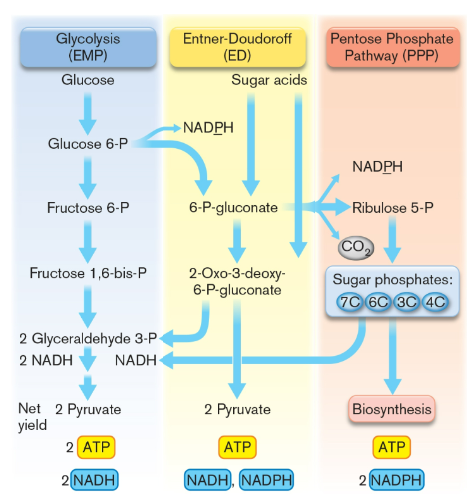
what is the same in all 3 glycolysis pathways?
all 3 pathways convert glucose → glyceraldehyde 3-P (G3P).
G3P is then oxidized → pyruvate the same way in all 3 pathways

Embden-Meyerhof Pathway (EMP)
the most common pathway for glucose → pyruvate. can work amphibolic (catabolically and anabolically) can run in reverse to make 2 pyruvate → glucose in gluconeogenesis
provides precursor metabolites (12 carbon skeletons), NADH, and ATP
functions in absence or presence of O2!! (aerobic, anaerobic, and fermentation)
has 2 phases:
6 carbon phase (uses 2 ATP)
3 carbon phase (makes 4 ATP, 2 NADH, 2 pyruvate)
does EMP work in the absence of O2?
It doesnt matter! works in anaerobic/aerobic respiration and fermentation
6 carbon phase
this is the 1st phase in EMP glycolysis. It uses 2 ATP

3 carbon phase
this is the 2nd phase in EMP glycolysis. It makes 4 ATP, 2 NADH, and 2 pyruvate
2 ATP was used in 6-carbon phase, so net ATP is only 2

what are the net products of EMP per glucose?
2 ATP, 2 pyruvate, 2 NADH
how many carbon skeletons are made in EMP? Which ones?
Glucose 6-phosphate
fructose 6-phosphate
glyceraldehyde 3-phosphate (G3P)
3-phosphoglycerate
phosphoenolpyruvate
pyruvate
6

glucose 6-phosphate
the 1st carbon skeleton produced in EMP. its formed by glucose getting phosphorylated
it is also the precursor metabolite/starting molecule for PPP
has 6 carbons and a phosphate on 6th C

fructose 6-phosphate
the 2nd carbon skeleton made in EMP.
made by the isomerization of glucose 6-phosphate
has 6 carbons and phosphate on 6th carbon

glyceraldehyde 3-phosphate (G3P)
the 3rd carbon skeleton made in EMP.
it is made from the splitting of fructose 1,6-bisphosphate. It immediately creates 1 G3P and then the 2nd G3P is made from DHAP.
has 3 carbons and a phosphate on 3rd carbon. Initiates 3-carbon phase of EMP

3-phosphoglycerate
the 4th carbon skeleton made in EMP
made when one of the phosphates from 1,3-bisphosphoglycerate is transferred to make ATP (SLP).
has 3 carbons with a phosphate on 3rd carbon

phosphoenolpyruvate (PEP)
5th carbon skeleton made from EMP
made when a water is removed from 2-phosphoglycerate
3 carbon molecule w/ a phosphate on 2nd carbon. VERY high energy!! will transfer its P to ADP to make pyruvate

pyruvate
the 6th carbon skeleton made from EMP and will go into TCA
made when the phosphate from phosphoenolpyruvate is transferred to ADP → ATP (SLP)
3 carbon molecule. 2 of these are produced from EMP!!!
