Calcium & Phosphate
 Call Kai
 Learn
Learn Practice Test
 Spaced Repetition
 Match
Match Flashcards
 Knowt Play
1/85

There's no tags or description
Looks like no tags are added yet.
Name | Mastery | Learn | Test | Matching | Spaced | Call with Kai | Chat |
|---|
No analytics yet
Send a link to your students to track their progress
86 Terms
Connection between calcium & phosphate
They are generally absorbed together
Why do calcium levels need to be so well regulated but not other things like glucose levels
Blood sugar levels can go from 80 to 280 and it won't do any damage
If calcium levels go too high or too low it can be fatal
When would calcium levels be measured
Calcium levels are measured for seizures, low mood, muscle spasms, etc.
Function of Bone
•Structural support
•Protection of internal organs and soft tissues from damage
•Locomotion
•Mineral storage
•Production of blood cells
•Endocrine regulation
What percentage of bone is liquid - why?
1% liquid bone - able to exchange freely with blood
Composition of bone (organic, inorganic, water)
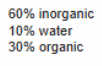
what is the inorganic part of bone made up of
Hydroxyapatite Crystals Ca10(PO4)6(OH)2 embedded in collagen matrix
Purpose for crystals in bone
Crystals make it easier to dissolve - increase solubility of bone
Role of the inorganic part of bone
Provides structural strength
Facilitates bone regeneration
What other ions are present in inorganic bone
Na⁺, K⁺, Mg²⁺, CO₃²⁻, Ba²⁺, and Zn²⁺
Role of other ions present in inorganic bone
Reduce the crystallinity of bone minerals
Alter solubility Facilitating bone adaptation
What makes up the organic portion of bone
Collagenous Proteins - mostly Type I collagen
what other structures are also made of type1 collagen
Ligaments and Tendons
Structure of collagen
Triple helix structure
What other non-collagen structural proteins make up the organic portion of bone
Proteoglycans - Macromolecules with core polypeptide and glycosaminoglycan (e.g. Hyaluronic acid)
Sialoproteins - highly glycosylated and sulphated phosphoprotein
Bone specific proteins - osteocalcin, osteonectin, osteopontin, RANKL
Proteoglycans function
Organisation of Bone Extracellular Matrix, Collagen Fibrillogenesis
Sialoproteins function
Mineralization and Bone Formation
Osteocalcin function
Bone Formation and Osteoclasts Activity
Osteonectin function
Modulate GF Activity, Cell adhesion, Mineralization
Osteopontin function
Regulates Bone Formation, Migration, Adhesion, & Mineralization
RANKL (Receptor Activator of Nuclear Factor κ-B Ligand) function
Regulation of Bone Resorption
RANKL activates RANK
RANK aids in differentiation of osteoclasts
What is found in trace amounts in organic bone
Growth factors & cytokines
Functions of organic portion of bone
Provides structural support
Contributes to mechanical properties of bone
Flexibility
Resistance to tensile forces
3 types of bone cells
Osteoblasts, osteoclasts, osteocytes
Osteoclasts structure
Large multinucleated giant cells
Have ruffled ends for dissolving bone
Osteoclasts function
Bone Resorption
• Degradation of proteins by enzymes
• Acidification
Osteoblasts function
Bone formation - synthesis of matrix proteins (type 1 collagen, osteocalcin, etc.)
Mineralisation
Activation of osteoclasts via RANKL production
How do osteoblasts stimulate osteoclasts
Parathyroid hormone is found on the osteoblast - it stimulates the osteoclast
Osteoblasts they have a Rank Ligand (RANKL). When RANKL binds with RANK it stimulates the osteoclasts short term
What becomes encased to produce osteocytes
Osteoblasts become encased in bone
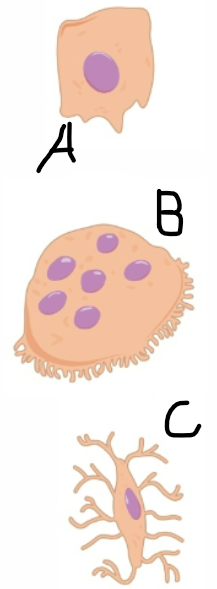
A = Osteoblast
B = Osteoclast
C = Osteocyte
How does the body maintain a constant level of calcium
When calcium is low, bone is broken down to release calcium.
When calcium is high, bone is produced to release calcium.
Calcium levels need to be monitored in immobile/paralysed patients as bones are being dissolved and not replaced
What will you see on the bone of someone who has a lack of calcium
If a person has a lack of calcium they will have lots of little pits that are acidic as the osteoclasts work best in that pH - they make acid that will dissolve the bone
what do osteoclasts use to dissolve bone
Osteoclasts have lots of CA. They use it on H2O and CO2 to produced H+
Bicarbonate ions are pumped out of osteoclasts in exchange for chloride ions
Hydrogen ions and chloride ions combine to form HCl - dissolves bone
CA = carbonic anhydrase
Bone remodelling diagram
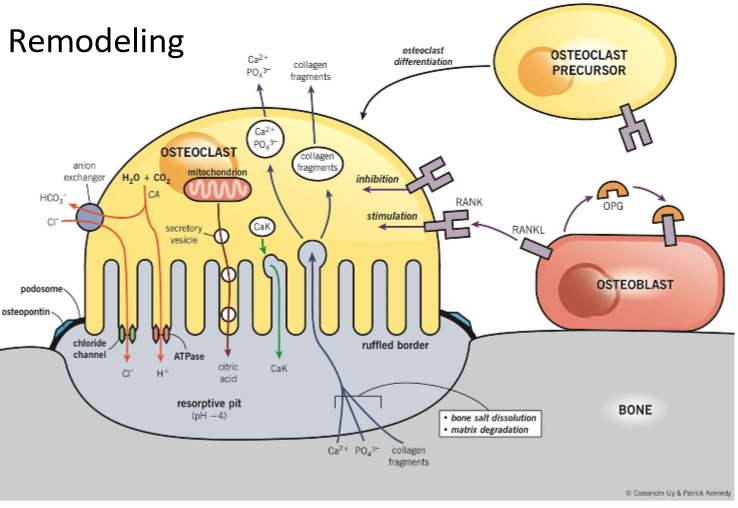
What is released when bones are broken
Calcium, phosphates & collagen fragments
Wolff’s Law
Bone grows or remodels in response to the forces or stresses placed on it
What type of bone growth occurs in response to stress
Appositional growth - Growth in diameter
Heavy use of bones leads to …
heavy bones
Non use of bones leads to …
Atrophy
How does Wolff’s Law work
Bone Generates an Electric Charge in Response to Applied Mechanical Stress
Action potential Generated
Osteocytes Release Factors that Stimulate Osteoblastic Activity
Bone growth and Increased Density to Withstand Forces Placed on it
(Piezoelectrical property of bone)
How is the Natural Mechanical Stress Applied to Femur Altered after Total Hip Replacement and why does that matter
Metal Implant Carries Some of the Load Reducing Stress on Femur
Phenomenon is known as Stress Shielding
Loss of Bone Mass Through Resorption After Hip Transplant
Occur Around the Implant Resulting in a Loosening of the Prosthetic Implant
Wolff’s Laws Law On Bone Explained
What hormones determine whether and when bone remodelling occurs
PTH and Calcitonin
where is phosphate found
Bone, ATP, cAMP, proteins etc
Function of phosphate
Regulate cell function
How many grams of phosphate in the body
500-800g
Normal level of plasma phosphate
0.9 -1.3mM
What does phosphate circulate as
Orthophosphate (PO4)
When free phosphate is filtered by the kidney what percentage of it is reabsorbed and what percentage is excreted
85% reabsorbed
15% excreted as urinary buffer
Where is phosphate reabsorbed & by what
Absorbed in intestine by Na+ transporter
How many grams of calcium are in the human body
1100g
Normal plasma calcium levels
2.2-2.6mmol/L
Calcium function
Nerve and muscle excitability, Neurotransmission
Excitation-contraction coupling in muscle
Enzyme co-factor, Bone
Second Messenger, Fertilisation, Mitosis
During what stages 2 in life is most calcium required
9-18 (1300mg)
51+ (post menopausal women) (1500)
Free ionised calcium is tightly regulated (±5%). what happens if it goes too low / too high
Too low = Neuronal hyper-excitability
Too high = Neuronal depression
What causes low albumin
malnutrition, liver disease, or nephrotic syndrome
Effect of low albumin on calcium levels
Total calcium levels might appear falsely low, however the levels of ionized calcium remain unchanged
What measurement provides an accurate reading of calcium
Corrected calcium provides a more accurate reflection of calcium status by adjusting for albumin levels (it measures free ionised calcium - not total calcium)
Corrected calcium (mg/dL) = measured total Ca (mg/dL) + 0.8 (4.0 - serum albumin [g/dL])
4.0 = average albumin level
0.8 = correction factor
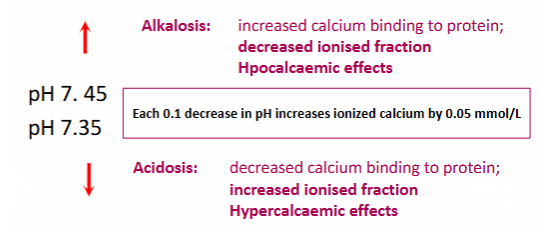
How is the ionised fraction of calcium affected by pH
Protein binding decreases as pH decreases
Who is more likely to have hypercalcaemia
People with COPD
(inefficient breathing can increase CO2 levels in blood which decreases pH leading to hypercalcaemic effects)
Who is more likely to have hypocalcaemia
People who get panic attacks
Three primary systems involved in the regulation and homeostasis of calcium in the body
bone, kidney, intestine
Three primary hormones involved in the regulation and homeostasis of calcium in the body
parathyroid hormone, calcitonin, vitamin D
Amount of calcium in the ICF & ECF
ICF = 10-7M
ECF = 10-3M
Ratio between ICF & ECF = 1: 10,000
Where in the ICF is calcium stored
Mitochondria and ER
Location of parathyroid gland
Under thyroid
How many parathyroid glands are there generally
4
Role of chief glands in parathyroid gland
Responsible for the synthesis, storage, and secretion of parathyroid hormone (PTH).
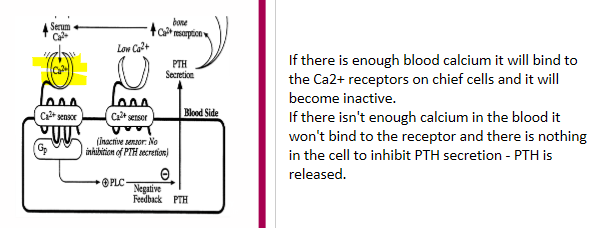
They have Ca2+ sensing receptors
How do chief cells regulate PTH secretion
Normal or Increased ECF [Ca2+] – Inhibition of PTH
Decreased ECF [Ca2+] – Rapid increase in PTH
Effect of long term Ca2+ levels being too high or too low
alter gene transcription, synthesis, storage of PTH
Primary function of PTH
Regulate Ca2+ in ECF
Where does PTH act
bone, kidney and intestine
How does PTH act
Low Ca2+ → increases secretion of PTH
PTH increases plasma [Ca2+]
PTH structure
polypeptide hormone consisting of 84 amino acid residues.
When PTH is released it breaks up into fragments. How long can these fragments remain active for
Peptide fragments can be active for hours
PTH acts via what messenger
cAMP second messenger
Do osteoblasts and osteoclasts both have PTH receptors
Osteoblasts do
Osteoclasts don’t
Why can PTH be used to short term treat ___________ but not long term
Treat osteoporosis
Long-lasting effect to increase bone resorption…
- increases osteoclast activity indirectly via cytokines release from osteoblast
- increases the no. of osteoclasts; decreases the no. of osteoblasts
Increase Ca2+ and Phosphate to ECF
Where is calcium filtered in the blood
Glomerulus of kidney
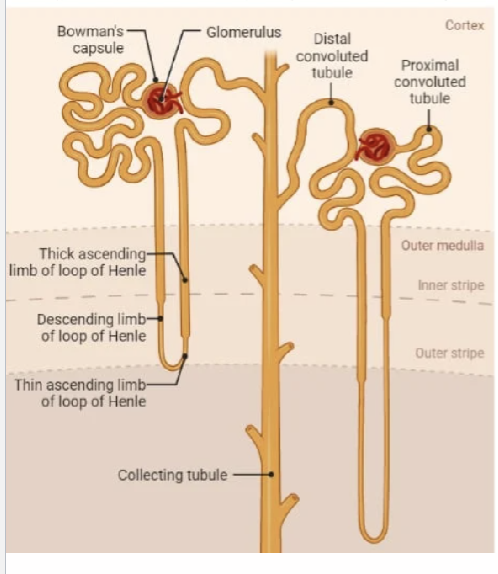
Path of calcium around glomerulus & process of filtration
Calcium enters the proximal tubule
60%–70% of the filtered calcium is reabsorbed in the Proximal Convoluted & Proximal Straight Tubule
20% of the filtered calcium is reabsorbed in the cortical segments of the loop of Henle
Approx. 10% of the filtered calcium is reabsorbed in the distal convoluted tubule (PTH sensitive reabsorption)
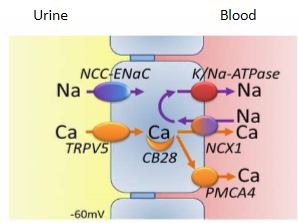
Through what does calcium enter the distal convoluted tubule
TRPV5 channels
Once the CA2+ in in the distal convoluted tubule, what does it do
Calcium binds to calbindin D-28k, an intracellular calcium-binding protein (facilitates transport)
Through what 2 pathways can calcium leave the distal convoluted tubule
Sodium/calcium exchanger (NCX1)
Calcium (ATPase PMCA4)
How does PTH stimulate calcium absorption
Via activation of TRPV5, NCX1
PTH increases the calcium pump to the cell
Interlinking of plasma calcium, bone kidney & liver
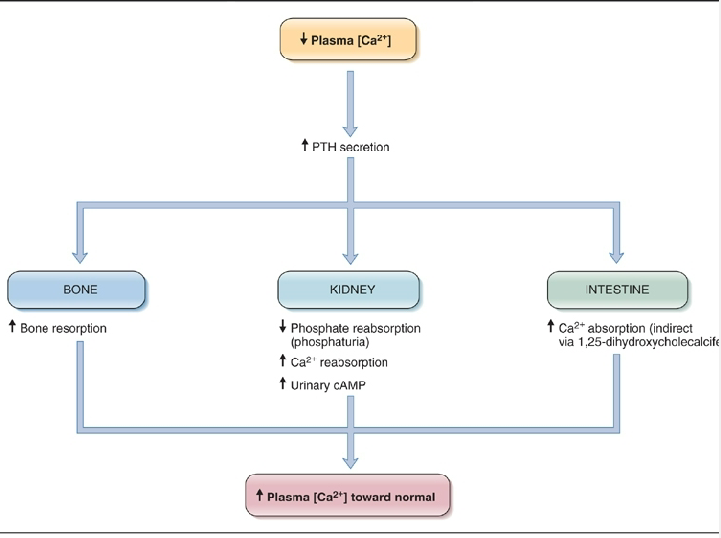
Effect of calcium on the intestine
Indirect action to stimulate Ca2+ absorption via activation of Vitamin D
Stimulates 1α-hydroxylase and conversion of 25-hydroxycholecalciferol to 1,25-hydroxycholecalciferol
How does the blood calcium receptor have an effect on PTH release