1) Introduction to Hormones and Behaviour
 Call Kai
 Learn
Learn Practice Test
 Spaced Repetition
 Match
Match Flashcards
 Knowt Play
1/22

Earn XP
Description and Tags
Sexual Selection vs Natural Selection
Name | Mastery | Learn | Test | Matching | Spaced | Call with Kai | Chat |
|---|
No analytics yet
Send a link to your students to track their progress
23 Terms

BACK
Phenotypic sex: females
Chromosomal sex: XY karyotype

Chromosomal femaleness is more about not having Y chromosome rather than having two Xs. Why?
Name the gene necessary for male characteristics. Where is it found?
What do SRY KO male mice develop as?
What type of process is X-inactivation?
Why are females mosaics? What does this in turn mean for each cell?
What causes one X chromosome to be inactivated? Describe this process.
Females are mosaics because each cell randomly inactivates one X chromosome, so some cells use the maternal X and others use the paternal X.
The Xist gene produces a long non-coding RNA (lncRNA) called Xist, and this RNA causes one X chromosome to be inactivated.
Read diagram and last paragraph about birds.


>95% of mammalian species are polygynous. Define polygynous.
For polygynous species (like the one seen in the image), the males are described as intense - why?
Why has this competition led to the evolution of weapons?
Dimorphic behaviour driven by sex steroids - Define dimorphic. What does this sentence actually mean?
Name one other trait polygynous males exhibit.
Greater sexual selection (selection for traits that increase mating success) in polygynous males
Poly: One male mates with multiple females.
Males compete for females, so males with better weapons (e.g. antlers, horns, or large canine teeth) are more likely to win mates and have offspring.
Dimorphic = having two different forms (in this case, male and female). It means males and females show different behaviours because of the effects of sex hormones (e.g. testosterone and oestrogen).


Look at diagram. Define monogamous.
What do males and female share?
Do they have weapons?
Is dimorphic behaviour high or minimal for mono species? What does this actually mean?
Furthermore, what do both sexes share? (2)
Mono: One male mates with one female.
It means males and females behave more similarly.


Read diagram.
What does increased / high sexual dimorphism correlate to?
Testosterone drives sexual dimorphism in polygynous males which causes the difference vs monogamous


Read diagram.
For mammals, what does the evolution of pregnancy and lactation mean in terms of reproductive costs?
What have differences in reproductive costs led to?
What do males have less opportunity to do? What has this opened up?
What is the limiting resource in intense male-male competition? This competition has led to dimorphism in what? (3)
Males compete between themselves for the females which leads to the evolution of males vs females divide in child bearing

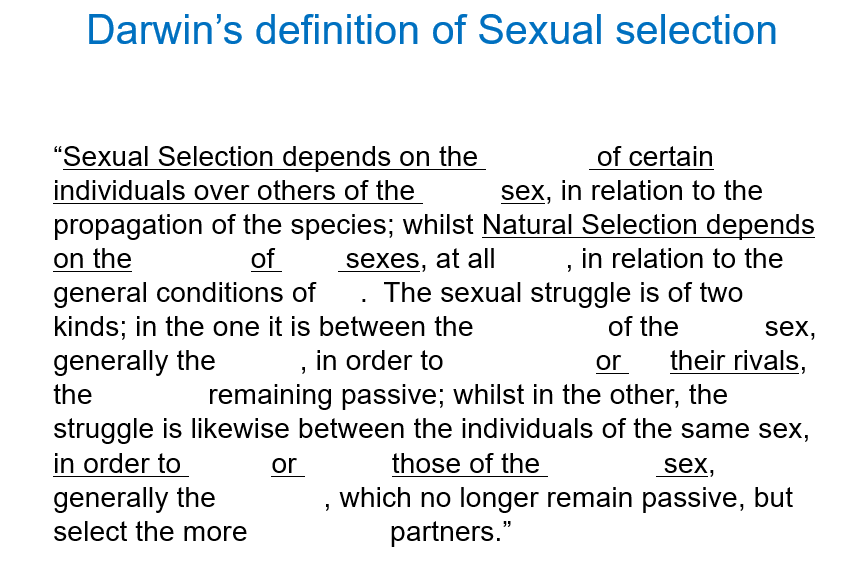
What is sexual dimorphism driven by?
This was first formally defined by Darwin, who drew our attention to the sharp distinction with Natural selection. Fill in the gaps for Darwin’s definition of sexual selection.
In simple terms, sexual selection is when XXX evolve because they help an individual get XXX and have XXX.
Darwin said there are two ways this happens - what are they?
Sexual selection.
Sexual selection is when traits evolve because they help an individual get mates and have offspring.
Competition between members of the same sex (usually males)
Fighting rivals for access to females.
Example: deer using antlers to fight.
Choice by the opposite sex (usually females)
Individuals with attractive traits are chosen as mates.
Example: peacocks with large, colourful tails.


Male mammals tend to be more fighters than showmen. The development of physiological and behavioural traits required for this competition is dependent on…
Read diagram FRONT & BACK.
…the neuroendocrine system.
Rostral – front
Caudal – back


Increased development of cortical processing structures in primates, but not of the hypothalamus - what does this mean?
Look at the diagram. While there are dramatic differences in brain size, what remains relatively constant?
The size of the cortex increased accordingly - why?
Cortex important in processing sensory information.
Number of cells in hypo doesn’t need to be high but function is very critical.
It means in primates, more control of behaviour comes from the cerebral cortex (thinking part of the brain) and less from the hypothalamus (instinct/hormone control centre).
The size of the hypothalamus.
Because the need to process more sensory information increased.
Read diagram (basically repeating what card already says).


BACK


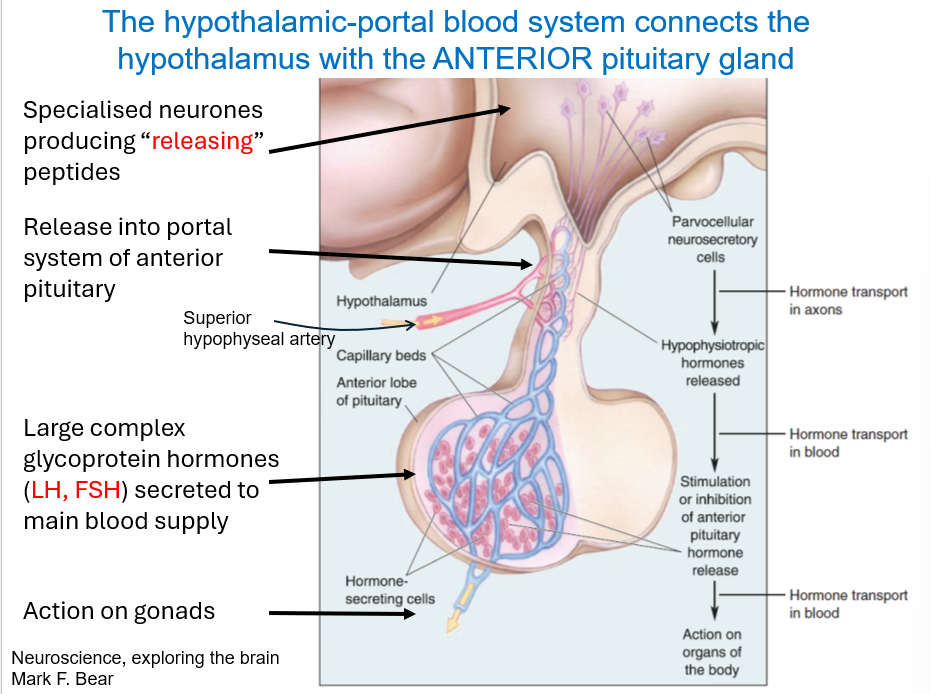
What does the hypothalamic-portal blood system connect? (2)
Use diagram (not words) to help with answering these questions. What is the name of the cells found in the hypo? (2 words; PXXX NXXX)
What do these specialised neurones produce?
Name one example of a hormone produced here.
Where are these releasing peptides / hormones released into? (2)
The portal veins deliver the hormones directly to the anterior pituitary. The anterior pituitary cells respond by releasing their own hormones into the bloodstream. Name 2 of these hormones and describe them (3 words).
What happens after FSH and LH are secreted into the main blood supply?
GnRH is produced from the specialised neurones.
Make sure to read entire diagram as certain parts (like in the RHS) where not included as questions and may be better to visualise like this. Important for exam.

BACK


Fill in the blanks in the diagram.
Small peptide, 10 amino acids.
Changing the structure of GnRH can alter how it binds to its receptor, which can increase, decrease, or block its biological effects.


BACK


BACK
Each GnRH pulse elicits a LH pulse.
Bottom graph is quantification of the experiment with the hormones.
After peak of GnRH (bottom line in graph), LH continues to rise.


What are GnRH neurons regulated by?
GnRH neurons do not work alone. Other interneurons regulate them by…(3)
These 3 points are examples of things those interneurons do to control GnRH. Describe how they actually work.
Study diagram.
Other interneurons.
…conveying environmental information, controlling the onset of puberty via kisspeptin, and contributing to male-female differences in reproductive function.


No intermediate step in stalk between hypo and PG.
BACK
Oxytocin released from magnocellular neurons.
Sparsely distributed between SON and PVN.

Looking at the basic principles of the neuroendocrine system, starting with the brain, what does it produce? (XXX XXX XXX peptides) Where do these peptides act on? To do what?
What are posterior pituitary hormones made by? What do the hormones travel down? What are they released from? (2)
The hormones in the PPG don’t just enter the bloodstream. Many of them are also released where? What do they influence / regulate?
Looking at the gonads, they produce sex steroids. What are their 3 main actions / functions?
Produces low molecular weight peptide hormones (e.g. GnRH), which act on the anterior pituitary to stimulate the release of the larger glycoprotein hormones FSH and LH.
Made by neurons whose cell bodies are in the hypothalamus. They travel down the axons and are released from nerve terminals in the posterior pituitary.
Released within the brain itself. Behaviour.
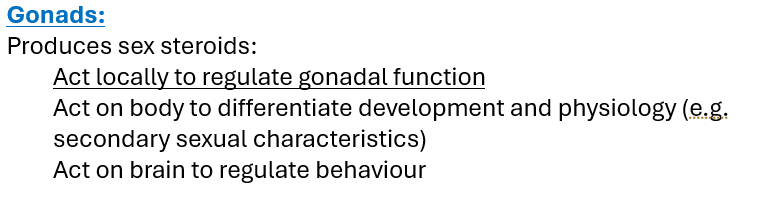

Fill in the blanks in the diagram.

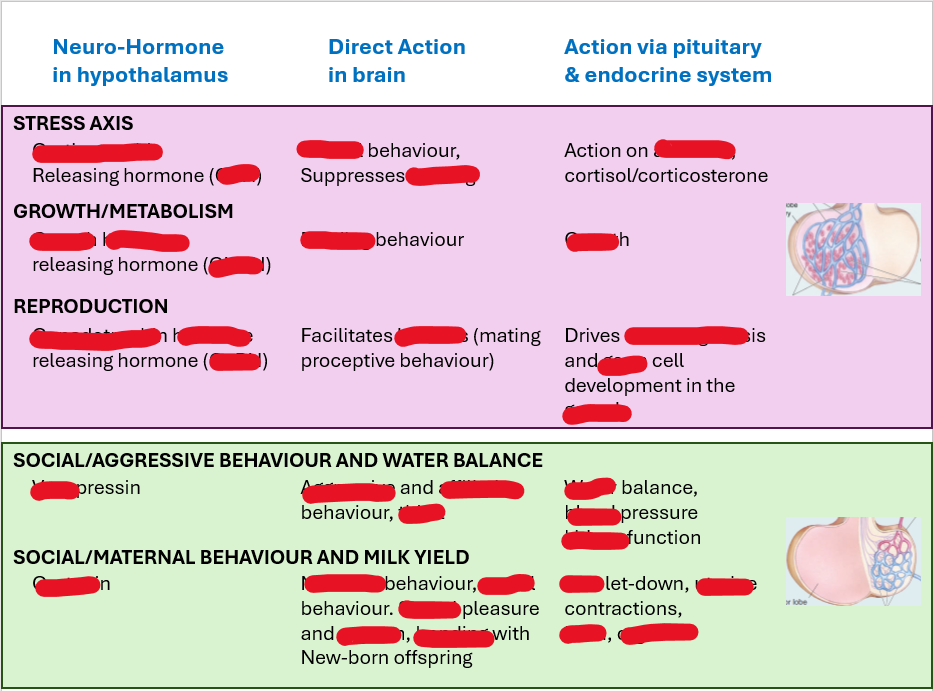
Fill in the blanks in the diagram.
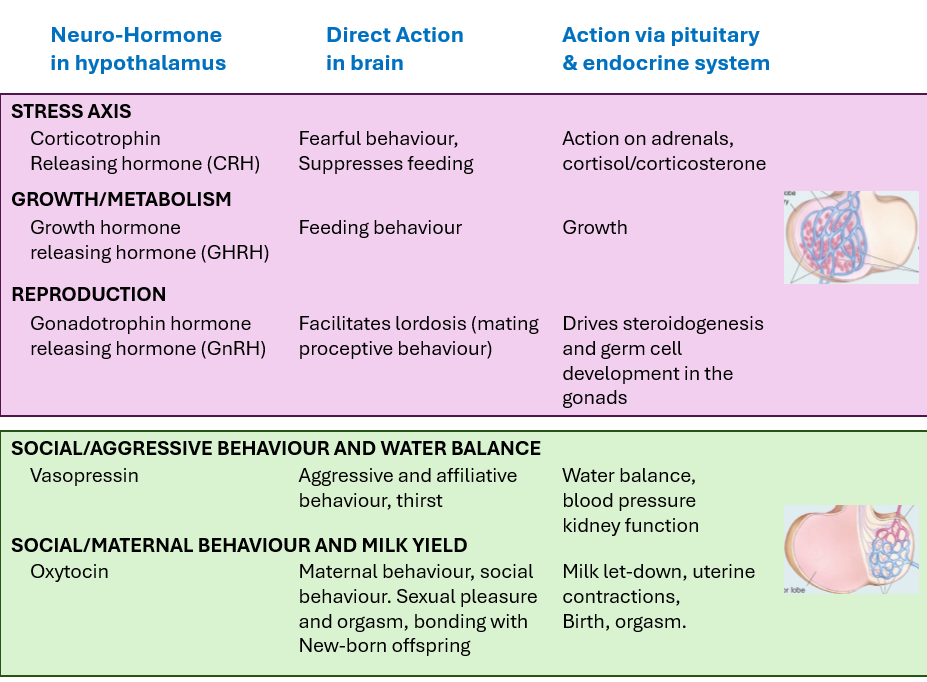
Does the pink box correspond to the anterior or posterior PG? What about the green box?
These all found in mammals, like humans and chimpanzees.
Pink is anterior PG. Green is posterior PG.
Lordosis = mating posture where the female arches her back to allow mating.
Proceptive behaviour = behaviours that show sexual interest and attract a mate.
Affiliative behaviour = friendly, social bonding behaviour between individuals

Circadian clock also in hypothalamus.
BACK
