S1 M1 National Institute of Standards and Technology Frameworks
 Call Kai
 Learn
 Practice Test
 Spaced Repetition
 Match
 Flashcards
 Knowt Play
1/59

There's no tags or description
Looks like no tags are added yet.
60 Terms
information technology (IT) application
is the systematic implementation of hardware and software so that data can be transmitted, modified, accessed, and stored both securely and efficiently; the speed of these devices performing tasks has rapidly increased and organizations must reevaluate their technology on a regular basis
technology use in an organization
is used to enhance or support business operations, protect digital records and assets, and safeguard physical assets; selection and deployment of management information systems (IS) in critical success of any organization
national institute of standards and technology (NIST)
was established in 1901 t remove harriers to industrial competitiveness and improve access to resources to promote US research capabilities; in 1995 it branched out into the cybersecurity field with Special Publications 800-2, “An Introduction to Information Security”; include 3 prolific sets of standardized frameworks such as cybersecurity framework (CSF), privacy framework, and SP 800-53 security and privacy controls for IS and organizations
NIST cybersecurity framework (CSF)
it is a voluntary framework that helps organizations manage and reduce cybersecurity risk, can help organizations of all sizes and sectors; it includes the core, tiers, and organizational profiles
NIST CSF core
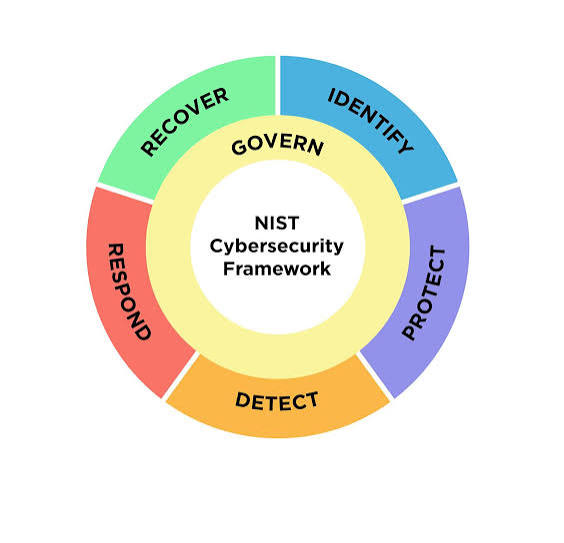
described cybersecurity outcomes that can be used by an organization of any size to reduce cybersecurity risks; these outcomes create a taxonomy and structure to help organizations understand, assess, prioritize, and communicate critical cybersecurity risks; it includes 6 elements and are not ordered steps and should be performed concurrently, these are govern, identify (ID), protect, detect, respond, and recover
govern (CSF & privacy)
means establishing and overseeing an organization’s cybersecurity strategies, policies, roles, responsibilities, and risk-management processes and making sure these strategies comply with legal and regulatory requirements; works simultaneously with these other 5 elements, touches all of theme in the circle diagram
identify, ID (CSF & privacy)
this function focuses on understanding the assets and suppliers of an organization and the cybersecurity risks related to those components; also emphasizes the improvement of the plans and processes in place for managing cybersecurity risks
protect (CSF & privacy)
means implementing safeguards to ensure the delivery of critical services and to limit or contain the impact of potential cybersecurity event; focuses on organization’s ability to secure its assets to prevent those risks; some examples include authentication, access controls, awareness and training, etc.
detect (CSF & privacy)
focuses on the timely discovery of cybersecurity attacks and incidents by analyzing indicators of compromise, anomalies, and other potentially adverse events that may indicate an attack or incident is occurring
anomaly
is an unusual or unexpected activity that differs from the normal system behavior; an example includes an employee logging in at an unusual time
respond (CSF & privacy)
focuses on a company’s ability to contain the effects of cybersecurity incidents; means taking action to manage the incidents by emphasizing incident management, analysis, mitigation, reporting, and communication
recover (CSF & privacy)
means restoring normal operations after a cybersecurity incident and reducing the attack’s impact; includes restoring affects systems & data, making improvements to prevent similar incidents, etc.
NIST diagram
detective measure
an example of this is a webcam aimed at a locked door because this camera can alert the owner if someone is breaking in as well as the police and discourage criminals from robbing because they know they are being monitored, not considered a preventive control
preventive measure
an example of this is a locked door because it helps stop an unauthorized person from entering; some more examples include passwords, firewalls, multifactor authentication, etc.
CSF and privacy tiers
are benchmarks used to assess how well and organization’s cybersecurity and data practices are integrated and managed; focuses on the organization’s information security infrastructure sophistication; they do not serve to implement the 6 elements and should complement an organization’s existing cybersecurity risk management methodology
benchmark
is a standard point of comparison used to evaluate performance, quality, or progress
tier 1
is partial and the lowest on the totem pole of the tiers; this means the organization addresses cybersecurity problems as they arise, rather than using a formal, coordinated program; practices are generally informal, reactive (rather than proactive), not considered organization-wide risk management (usually) and supported with limited awareness; an example could be a small retail store online
tier 2
is risk-informed, which means management recognizes cybersecurity risks and takes some steps to manage them, but cybersecurity practices are not yet consistently applied across an organization; based on organizational risk and management approves these cybersecurity efforts; an example could be a medium-size construction company where policies are written and occasional performs risk assessments
tier 3
is repeatable, which means an organization has formally approved, documented, and consistently implemented cybersecurity practices across the organization; practices are based on identified risks, consistently applied across departments, and are regularly reviewed & updated; a well-known bank could be an example when they have formal policies that are established organization-wide
tier 4
is adaptive and the highest on the totem pole of the tiers; it means cybersecurity is part of the organization’s culture, and senior executives treat these risks are seriously as financial and other business risks; practices continuously improve, advanced technologies are used, and adapts quickly to changing threats; an example could be a nation-wide construction company, where a cybersecurity attach could affect the state or nation
CSF and privacy organizational profiles
describe an organization’s current cybersecurity practices and its desired future cybersecurity outcomes, want to minimize such risks; should include a current profile and a target profile, these should factor organizational mission objectives, stakeholder expectations, threat landscape, and risk management priorities
current profile
specifies the outcome that an organization is achieving (or is attempting to achieve) based on the current cybersecurity posture; answers the question of , “Where are we now?”
target profile
specifies the desired outcomes (wants to achieve in the future) that an organization has priortized achieving, and that considers anticipated changes to the organization’s cybersecurity posture; answers the question of, “Where do we want to be?”
community profile
are baseline outcomes developed among a number of organizations due to the shared interest and goals of a particular industry sector, topic, or use case; these profiles can be used by organizations to develop their own target profile
NIST 5 step approach for organizational profiles
Scope the organizational profile (which department will this profile refer to, could be organization-wide)
Gather the information needed to prepare organizational profile (collect cyber-security goals)
Create organizational profile (document current or desired outcomes)
Analyze gaps between the current and target profiles and create an action plan
Implement action plan and update organizational profile (make improvements and updates for changes)
(Some Guy Created A I)
NIST privacy framework
was published in early 2020 to protect individuals’ data as used in data processing applications; provides a common language for understanding, managing, and communicating privacy risk with internal and external stakeholders; it is voluntary and can be adaptable to organizations in any industry; its 8 core functions are govern, identify (ID), control, communicate, protect, detect, respond, and recover, also used tiers and sophistication measures in profiles
control (privacy)
means establishing how the organization will manage individuals’ data and their privacy choices during data-processing activities; asks the question of, “What is the best management structure for privacy risks related to data processing?”
communicate (privacy)
means creating an ongoing dialogue about privacy risks related to the organization’s data-processing activities; asks the question of, “How should the organization communicate privacy risks to stakeholders?”
gap analysis
is the process of comparing an organization’s current profile with its target profile to identify what cybersecurity or privacy practices are missing or need improvement
difference in CSF and privacy tiers
the privacy tiers measure how sophisticated an organization’s privacy practices are and progression of the tiers is sequential, another key difference is that it includes a workforce consideration which means the organization is evaluated and whether the organization has personnel dedicated to privacy and whether privacy training is provided; CSF tiers are based on how the CSF core is executed
NIST SP 800-53 security and privacy controls for IS and organizations
has evolved into a set of security and privacy controls applicable to all IS and has become the standard for federal information security systems (not voluntary) and is a stricter standard which is designed for protecting IS against sophisticated threats and organizations must carefully evaluate adopting the framework because it can be burdensome given the over 1,200 controls; applies to organizations that process, store, and transmit information, especially federal IS
office management and budget (OMB) circular A-130
is a relevant requirement in accordance with NIST SP 800-53; it require security and privacy controls for federal IS
federal information security modernization act (FISMA)
is in connection with NIST SP 800053 and requires the implementation of minimum controls to protect federal information and IS
NIST SP 800-53 target audience
for anyone involved in an organization’s IS: including those who manage security, privacy, & risk, develop or acquire systems, operate & administer systems, implementation security & privacy controls, assess, audit, or monitor controls, and provide related products or services (such as contractors or vendors)
NIST SP 800-53 organizational responsibilities
must define security & privacy requirements, use trustworthy hardware & structure, build security and privacy into system development life cycle (as well as applying engineering principles), document & integrate security practices into normal business operations, and continuously monitor systems & controls, as well as identifying weaknesses & changes
AC
access control; How does the organization manage application and resource access?
AT
awareness and training; How should the company deliver training on information security risk?
AU
audit and accountability; How does the company evaluate information security controls?
CA
assessment, authorization, and monitoring; How does the organization collect information security telemetry and use it to hunt for threats?
CM
configuration management; How are assets and software configured securely?
CP
contingency planning; How is the company prepared for downtime and outages?
IA
identity and authentication; How is identification and authentication managed?
IR
incident response; How is the organization prepared for information security and events?
MA
maintenance; How does the company ensure secure maintenance of infrastructure?
MP
media protection; How is information on physical media managed?
PE
physical and environmental protection; How are facilities secured from intrusion or harm?
PL
planning; How does the organization manage information security planning?
PM
program management; How does the organization securely manage its information security program?
PS
personnel security; How are employees evaluated for potential compromise?
PT
PII processing and transparency; How is personally identifiable information (PPI) managed?
RA
risk assessment; How is environmental risk evaluated?
SA
system and services acquisition; How are systems securely evaluated and acquired?
SC
system and communication protection; How is data securely transmitted digitally?
SI
system and information integrity; How is the integrity of data in company systems maintained and evaluated?
SR
supply chain risk management; How does the company secure its supply chain?
control (inheritable)
is securely or privacy control implemented at the organization level and inherited by multiple IS; an example could be an organization establishes an enterprise-wide password policy
system-specific
is a security or privacy control implemented within one particular IS; an example could be a payroll system uses its own role-based access restrictions (apply specifically to payroll data)
hybrid
most common and it is where some parts of the control are implemented organization-wide and the remaining parts are implemented within a specific IS