ansc314 - ribo niacin B6
 Call Kai
 Learn
 Practice Test
 Spaced Repetition
 Match
 Flashcards
 Knowt Play
1/41

There's no tags or description
Looks like no tags are added yet.
42 Terms
vitamin classifications
fat soluble
A, D, E, K
water soluble
ascorbic acid (C)
riboflavin (B2)
pyridoxine (B6)
niacin (B3)
thiamin (B1)
water soluble
Ascorbic acid (C)
Thiamin (B1)
Riboflavin (B2)
Niacin (B3)
Pyrodoxine (B6)
Pantothenic acid (B5)
Biotin (B7, H)
Folacin (B9)
Cyanocobalamin (B12)
Choline
Inositol
riboflavin
found as one of body’s co-enzymes
flavin mononucleotides (FMN) & flavin adenine dinucleotide (FAD)
riboflavin in food can be its free form, bound to protein, or co-enzyme
only free riboflavin can be absorbed
riboflavin pathway

riboflavin sources
green leafy crops
bacterial synthesis (ruminants)
eggs, milk, liver
↓ grains (corn, barley)
riboflavin functions
riboflavin (FMN, FAD)
co-enzyme in oxidation-reduction rxns
pyruvate dehydrogenase complex (& TCA cycle)
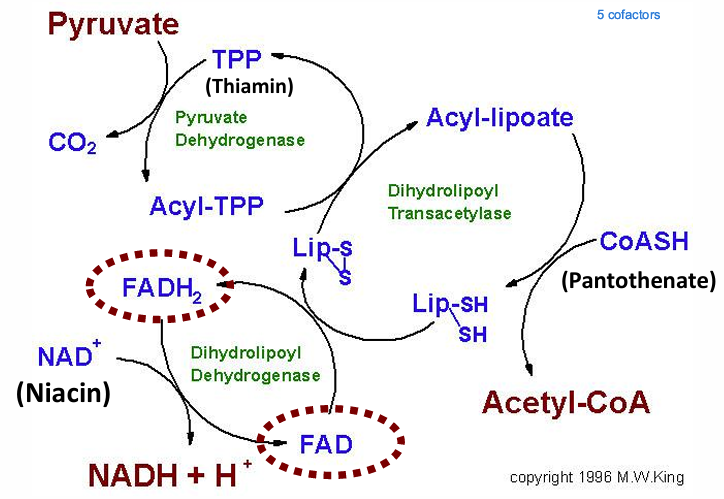
substrate channeling
intermediate of multistep sequence never leave complex
substrate channeling prevents theft of activated acetyl group by other enzymes
use this group as substrate
pyruvate dehydrogenase complex

pyruvate dehydrogenase cofactors
5 co-enzymes
thiamine pyrophosphate (TPP)
flavin adenine dinucleotide (FAD)
co-enzyme A (CoA)
nicotinamide adenine dinucleotide (NAD)
lipoate

pyruvate dehydrogenase vitamins
4 vital vitamins
thiamine (TTP)
riboflavin (FAD)
niacin (NAD)
pantothenate (CoA)

FAD function
in TCA (krebs) cycle & energy generation
FAD forms prosthetic groups of enzyme succinate dehydrogenase
riboflavin reducing equivalent
FADH2 is reduced → produce 2 ATP

FADH2
cofactor to product 2 ATP
reduced by riboflavin
riboflavin FA metabolism
role of riboflavin (FMN, FAD) in FA metabolism
FAD is co-enzyme for Acyl-CoA dehydrogenase
break down of lipids → energy
pyruvate dehydrogenatase glycolysis glucose breaks down (krebs cycle)

riboflavin complex locations

purine catabolism
DNA/RNA
uric acid synthesis (birds & reptiles)
xanthine oxidase needs FAD
converts hypoxanthine → xanthine → uric acid
amino acid transaminase (FMN, FAD) - nitrogen disposal
glutathionine reductase - keeps FAD in reduced form of FADH2

riboflavin requirements
requirements ↓ w/ animal maturity (slow/no growth)
↑ requirement for repro states
ruminants
mature - rumen microbial synthesis
slowly fermented substrates in rumen ↑ riboflavin synth. by bacteria
pre-ruminant - milk & supplements
horses
microbe synth in cecum & colon provide some riboflavin
monogastric
gut bcateria provides little unless coprophagy
based on E intake
riboflavin deficiency symptoms

niacin (B3)
synthesized by animals & bacteria
important coenzymes:
nicotinamide adenine dinucleotide (NAD)
nicotinamide adenine dinucleotide phosphate (NADP)
FAD - enzyme
FADH2 - reduced form → generate 2 ATP

niacin (B3) sources
sunflower meal
peanuts
meat, fish, liver
yeast (distillers grain)
niacin synthesis

niacin synthesis species differences
humans
60 mg Trp → 1 mg niacin
rats
35-60 mg Trp → 1 mg niacin
cats & ducks
almost no conversion

nicotinamide co-enzyme forms

NADH
produced in catabolic rxns
used in e- transport chain to obtain energy by converting NADH → NAD+
primarily produced in oxidative part of pentose phosphate pathway
glycolysis & krebs cycle

pentose phosphate pathway NADPH generation

FA synthesis
need niacin
NADH2 → e- transport chain
serve as E currency to build lipids
synthesis of macronutrient uses up currency

niacin biochemical reactions

niacin pathway locations

niacin requirements
variation due to: Trip → niacin
niacin requirement factors
genetics - faster growing animals
↑ production lvls
ability to synthesize niacin from tryptophan
exposures to feces (coprophagy, bacteria in feces)
AA imbalances → reduce Trp use/absorption
e.g. branched chain AA antagonize
tryptophan absorption & uptake by tissues
diet
e.g. corn protein
↓ tryptophan & niacin is bound/unavailable
niacin deficiency
severe metabolic disorders of skin & digestive tract
pellagra - Casal’s necklace
black tongue - dogs w/ tongue & mouth inflammation
4 Ds
dermatitis
diarrhea
dementia
death
glossitis
gingivitis
milkd
high blood lipids
LDL-cholesterol
tongue glossitis
tongue is smooth, inflamed
sore and hard to swallow.

pellagra (casal’s necklace)

pyridoxine (B6)
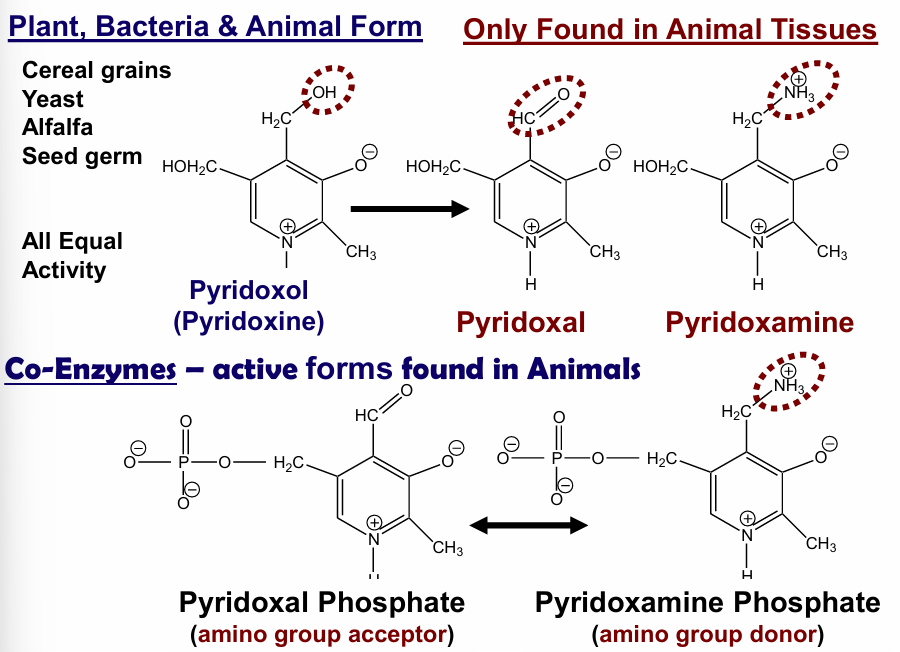
plant/bacteria synthesis only
pyridoxol → pyridoxal → pyridoxamine
coenzymes:
pyridoxal phosphate (amino group acceptor) → pyridoxamine phosphate (amino group donor)
B6 functions
essential role as coenzyme (pyridoxal phosphate PLP)
over 50 enzymes rely on PLP, most associated w/ AA metabolism
transamination
exhcnage of amino (-NH3) group of AA
decarboxylation
tyrosine → dopamine
-OH tryptophan to serotonin
deaminiation
remove amino (-NH3) group
desulfuration
needed for glycogen break down → glucose units
AA transamination
transaminase → B6
thyroid - glucose metabolism

B6 desulfuration
1-carbon metabolism delivers 1-carbon moiety (methyl group) to many biologic reactions
nucleotide synthesis
biological methylation
needed to synthesize essential components of cells & tissues
maintain body homeostasis
vit B6 is cofactor in carbon metabolism
take 1 sulfur → smth else

pyridoxyl phosphate niacin synthesis

pyridoxine complex locations
AA metabolism
carbon metabolism
glucose metabolism

B6 requirements
↑ protein diet → ↑ B6 requirement
ruminants
microbial synthesis adequate
horses
synthesis in cecum but adequacy questionable
rabbits & rats/mice
coprophagy provides enough
humans
female contraceptives
antagonize conversion → PLP
other species
dietary requirement
all species
↑ requirement w/ ↑ protein diets
B6 deficiency
General symptoms – some related to Niacin synthesis
reduced growth
dermatitis
anemia – microcytic hypochromic
partial alopecia
epileptic-like fits/ hyperexcitable
Symptoms due to role in AA Metabolism
↓ nitrogen retention
↓ feed protein utilization
excessive nitrogen excretion
impaired Tryptophan metabolism
Vitamin B6 Deficiency & Cardiovascular Disease in Humans
↓ metabolism of Homocysteine to Cysteine → elevated lvls of Homocysteine in blood
pyruvate dehydrogenase complex (PDH or PDC)
key regulatory site in cellular metabolism
by linking citric acid cycle & subsequent oxidative phosphorylation w/ glycolysis & gluconeogenesis
both lipid & AA metabolism
carbohydrate stores reduced in mammals
PDH activity is regulated downward to limit use of glucose by oxidative phosphorylation in tissues
can use FA or ketone bodies (heart & skeletal muscle)
important exception: neuronal tissue - processes glucose almost exclusively for ATP production
activation of PDH both facilitates use of carbohydrate to meet energy demands
converts surplus dietary carbohydrates to FA for longer term energy storage
perturbation of regulation of this choice of glucose or FA as energy source is key part of:
diabetes
metabolic syndrome and obesity
while metabolic substrate switching from oxidative phosphorylation to glycolysis defines the cancer phenotype, hence recent renewed interest in PDH activity and regulation
PDH under tight & complex regulation
regulation by reversible phosphorylation in response to the availability of glucose