Fluid therapy and critical care nutrition
 Call Kai
 Learn
Learn Practice Test
 Spaced Repetition
 Match
Match Flashcards
 Knowt Play
1/61

There's no tags or description
Looks like no tags are added yet.
Name | Mastery | Learn | Test | Matching | Spaced | Call with Kai | Chat |
|---|
No analytics yet
Send a link to your students to track their progress
62 Terms
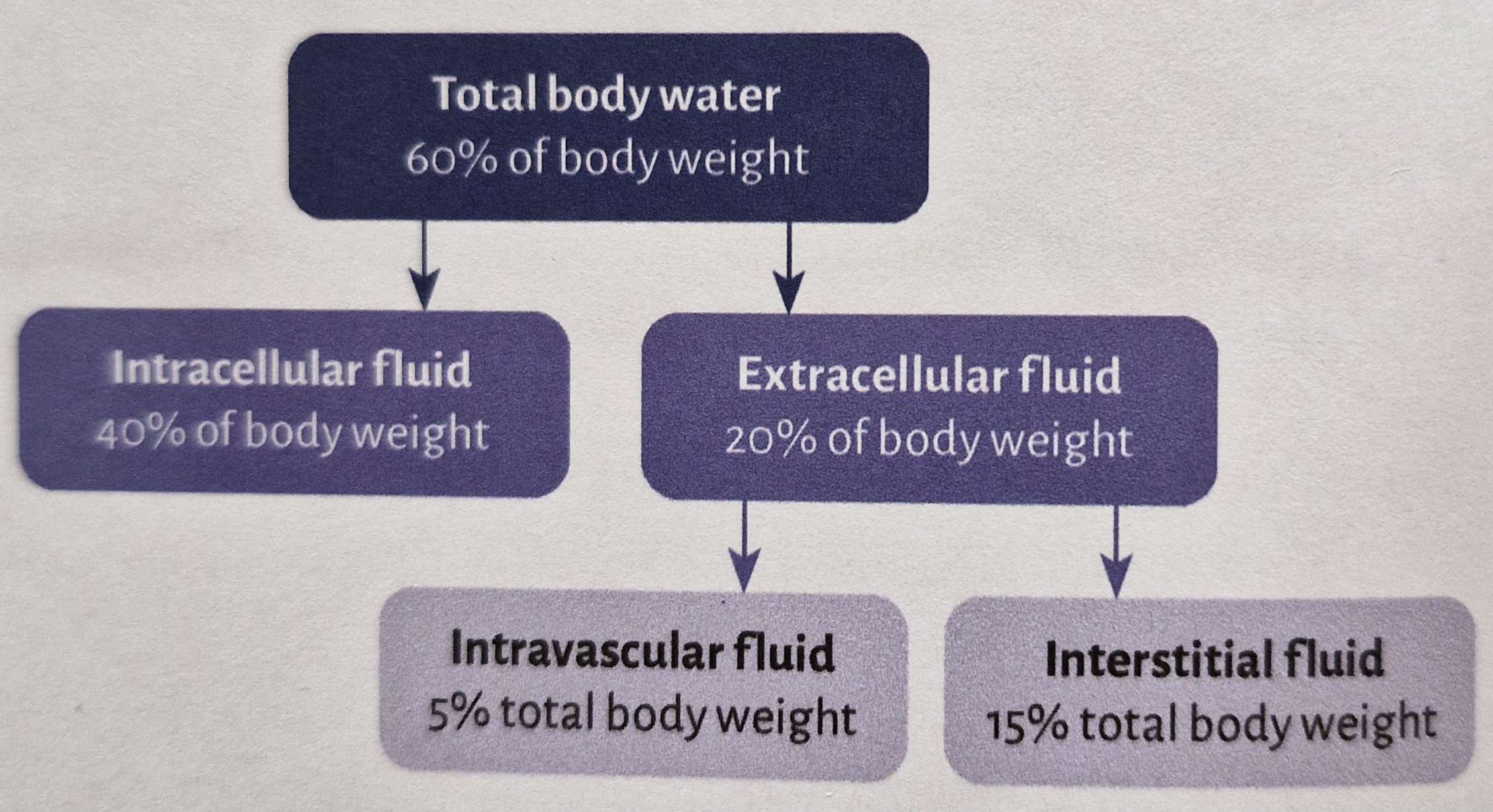
How much % of the body is water and how is it dividend?
60% of total weight of adult body is water.
Divided into:
Extracellular fluid (ECF) (20%): further subdivided into: » plasma (5%)(intravascular volume)
» interstitial fluid (15%)(which bathes the body's cells)
Intracellular fluid (40%)
(There is a separate category called transcellular fluid (synovial and CSF fluid) which only comprises a small precentage of total body water)
Clinical signs of dehydration with %

What types of fluid losses are there and what are there causes?
Whole blood loss:
Possible causes > severed superficial arteries or large veins.
Compartment lost from > intravascular compartment (plasma)
Components of fluid lost > water, colloidal particles, red cells and electeolytes, platelets, clotting factors
Extracellular fluid loss
Possible causes > vomiting, diarrhoea, diuresis
Compartment lost from > interstitial compartment and intravascular compartment
Components in fluid lost > Na+, Cl-, and water
Protein rich extracellular fluid loss
Possible causes > some pleural/peritoneal effusions, protein losing enteropathies, burns
Compartment lost from > interstitial compartment and intravascular compartment
Components in fluid lost > Na+,Cl-, water and proteins
Pure water loss
Possible causes > high respiratory rate or primary water deprivation
Compartments lost from > as pure water loss as water moves freelance from all compartments, water is lost from all compartments
What needs to be considered making a fluid therapy plan
Type of fluid that has been lost
How much of this fluid has been lost
Over how long a timeframe the fluid has been lost
VB: pure water losses are best replaced with crystalloids (hypotonic crystalloids may be indicated but infused slowly so to avoid rapid changes in plasma sodium concentrations)
Extracellular fluid losses from conditions such as vomiting and diarrhoea where water, sodium and chloride are lost; these are best replaced by isotonic crystalloids (containing water and electrolytes incl sodium and chloride)
What is tonicity of a solution?
It refers to the concentration of solutes (such as sodium and other electrolytes) in a solution, compared to another solution.
What is a hypertonic, isotonic and hypotonic fluid?
Fluid is termed hypertonic, isotonic or hypotonic based on higher, equal or lower concentrations of electrolytes compared to normal plasma.
Hypertonic: Na+ concentration is higher than plasma (7,2%NaCl)
Isotonic: Na+ concentration is similar to plasma (Hartmann's solution or 0,09%NaCl)
Hypotonic: Na+ concentration is lower than plasma (0,18% NaCl with 4% glucose)
These solutes or electrolytes cannot pass through semipermeavle membranes whereas water can. Therefor water tries to follow solutes to even out concentrations. For example, infusing hypotonic (7,2%) saline IV pullsnwater from the interstitial space into the intravascular space, which then increases the blood volume and blood pressure. This is because water from the interstitial space follows the solute to try and even out the concentrations between the intravascular and interstitial fluid compartments.
What is a crystalloid fluid?
Are any solution of crystalline solids(the solute) dissolved in water (the solvent).
Crystaline substance can be sodium based or glucose based. If the electrolyte composition of the solution is similar to extra cellular fluid, it is known as a balanced electrolyte solution.
Crystalloids are divided into extracellular fluid volume replacers and maintenance solutions
What can be said about extracelullar fluid volume replacers?
When sodium concentration is similar to ECF sodium concentration these fluids stay in the extracellular compartment. Therfor these fluids are good at replacing extracellular fluid loss
These fluids can be infused rapidly as they do not induce changes in electrolyt compositons especially sodium ions. It is omportant to not change serum concentrations too quickly, with the rate of change being no faster than 1mmol/hr
After IV adminstration the fluid redistributes between the intravascular and interstitial compartments; thus, for every 1 liter of fluid administered IV only about 250-300ml remains in the intravascular space aftrr 1-2hrs
Extracellular fluid volume replacers - (lactated ringers) what is in Hartmann's solution and normal saline?
Hartmann's
131 mmol Na+
4 mmol K+
111 mmol Cl-
1,4 mmol Ca2+
29 mmol Lactate
Normal Saline (0,9% NaCl)
150 mmol Na+
150 mmol Cl-
Lactate in Hartmann's is a precursor to bicarbonate > this fluid is alkalinising
Normal saline is acidifying
What is a Maintenance solution?
In addition to supplying water, maintenance fluid should replace electrolytes
In order to meet specific daily requirements, maintenance solution have lower sodium and chloride concentrations when compared to ECF.
A potassium supplement is often required because animals treated with maintenance solutions are often inappetant and all potassium is diet derived. Maximum rate of potassium supplementation is 0,5mmol/kg/hr
Maintenance solutions are isotonic; due to dextrose +/- Small.amoutn of sodium. Dextrose is metabolised and no longer osmotically active, only water remains which distributes freelance throighout the free fluid compartments (amount of dextrose is provides negligible energy)
Examples: 4% glucose with 0,18% sodium chloride (supplemented with 20-30mEq/l of potassium for maintenance) or
5% dextrose (supplemented with 20-30 mEq/l of potassium for maintenance)
Why are hypotonic fluid not suitable for maintenance?
Because the sodium concentration is very different to that of the ECF. (Na+ concentration is lower then plasma)
These fluids should not be given at fast rates, but slowly infused over 24hrs or red blood cell lysis may result.
These fluids are of no use for restoring circulating volume but are ideal for treating primary water loss
When is hypertonic saline used?
In cases of shock.
It causes an increase in blood pressure by several mechanisms, the main one being it draws water from the interstitial space. The effect of hypertonic saline is transient and should be followed by the administration of isotonic crystalloids to replace borrowed water. The use of hypertonic saline also carries some potential side effects: hypernatraemia/hypokalaemia, haemolysis, ventricular arrhythmias and potential for rehaemorrhage
What are colloids?
Colloids are fluids in which large molecular weight particles are suspended but not visible. Colloids contain large molecules that cannot pass through the vascular endothelium.
Also called plasma volume expanders (when rapid improvement of circulating volume is necesary).
No more than 25% (usually 20ml/kg dog) or circulating volume of an animal should be given as colloid at one time(usually within 24hr frame) > otherwise haemodilution dilutes out clotting factors.
Can be used intraoperatively to help maintain blood pressure of if animal has total protein of less than 35g/litre in order to prevent extravasation of fluid.
They increase the colloid osmotic pressure of the pasma in addition to each liter of fluid staying in the intra vascular compartment, they also pull water from the interstitial space into the intra vascular space.
To avoid dehydrating the interstitium, use concurrently or just after colloids to pay back the fluid borrowed from the interstitial space.
Colloids remain in the intravascular space for several hours compared to the hour that crystalloids remain in the intravascular space
Name 3 kinds of colloids and how long to they last?

What are disadvantages of colloid use?
Volume overload
Anaphylactic reactions
Clotting problems
Analyses in 2013 showed increased risk kidney dysfuntction and mortality in septic/ critically ill human patients > restrictions of starch use. No evidence in veterinary patients for similar risks
What is an animal maintenance requirement of fluid? (Definition and formulae dog/cat)
It is defined as the amount of water and electrolytes required to replace those lost through normal physiological processes (through respiration, perspiration, and excretion via alimentary (faeces) and urinary tracts).
Cat > for 24hrs 80⋅bodyweight(kg)0.75
Rule of thumb = 2-3ml/kg/hr
Dog > for 24 hrs 132⋅bodyweight(kg)0.75
Rule of thumb = 2-6ml/kg/hr
(In rekenmachine eerst gewicht ^0,75 doen met x^y knop en dat getal x 80 doen. Dus van achter naar voor rekenen)
How do you calculate an animals fluid deficit
The percentage of dehydration multiplied by the animals body weight = the amount of fluid deficits (5% x 15kg x 10 = 750ml dehydrated)(0,05% x 15kg = 0,75liter)
How fast can you replace the deficit when dehydrated?
Depending on the severity : given over 12- 24hrs.
In more acute situations, deficits are adressed in a shorter time frame, with 30% front loaded in the first few hours and the rest administered over the rest of the 24hr period.
If in shock, full fluid deficit is administered in shorter time frame > 1-4hrs.
Rapid loss replaced more quickly
Chronic losses replaced more slowly
If an animal is not eating/drinking maintenance needs must also be provided over the same time frame that the deficit is being corrected.
If dehydrated due to vomiting / diarrhoea, how to correct these additional losses?
Suggestion is 4ml/kg per episode of vomit/ diarrhoea.
Which type of fluid should be used if rapid restoration of fluid deficit is required?
A balanced ECF volume replace such as Hartmann's (ringer). = more similar to plasma than a maintenance crystalloid.
Maintenance crystalloids should be considered for primary water deprivation cases when the fluid deficit is repaid over longer period of time (24hrs)
Why do you need fluid therapy during anaesthesia? At what rate?
Anaesthetic agents tend to produce hypotension via vasodilation or decreasing myocardial contractility. To support blood pressure, on top of maintenance rates, additional fluids are given.
AAHA suggests: normal healthy dog 5ml/kg/hr and cats 3ml/kg/hr and then every hour rate should be reduced with 25% until maintenance is reaches
If hypotension under anaesthesia occurs (<60mmHg mean BP) what are the steps to take?
Euvolaemic (with normal blood/fluids in the body)animals are unlikely to respond to fluid boluses.

What is a dog and cat blood volume? And how much ml is 1gr of blood?
Dog = 90ml/kg
Cat = 56ml/kg
1gr of blood is roughly 1 ml
% blood volume lost =
volume of blood lost : animals blood volume
x 100
Blood loss 10-15%, 15-20%, >20%. Which fluids to use? And how much to give?
10-15% = crystalloids
15-20% = colloid
>20% = blood products because animals oxygen carrying capacity is affected
With crystalloids only 1/3 of fluid remains in intravascular space after 1 hr, rest passing into other compartments. When replacing small volumes of blood loss, 3x the volume of blood loss should administered.
Colloid or blood product only equivalent of blood lost is required
What blood pressure monitoring technique gives an indication of blood volume?
Central venous pressure.
(Arterial blood pressure is not only influenced by blood volume but also how vasodilated/constricted a patients vasculate is. Arterial BP measurement for hypovolaemia or hypotension.)
What does central venous pressure represent?
It represents the pressure in the intrathoracic vena cava. It is a measure of the relative ability of the heart to pump blood returning to it and is a useful tool if a degree of heart failure is suspected.
It is also an estimate of the relationship between blood volume and blood volume capacity and can be used to tailor fluid therapy in hypovolaemic animals.
Normal CVP in small animals is between 0-10cm H2O. Generally low value ranges indicate relative hypovolaemia and the hearts inability to cope with venous return.
Where do you place a catheter for central venous pressure measurement?
In the jugular vein heading towards the heart. The tip must lie within the thorax (usually in the anterior vena cava), if overlong it can contact the endocardium of the right atrium or ventricle and stimulate arrhythmias.
The catheter should be attached to an electrical transducer (as used in arterial blood pressure monitoring) or to a U-manometer.
An electrical transducer displays CVP in mmHg and a U-manometer reads as cmH2O.
Conversion = mmHg x 1,36 = cmH2O
What do you need to build a manometer in practice?
Bag of saline
A drip set
A threeway tap
Extensies set
A drip stand
A ruler
Cut down length of drip set
Once flushed the thereway tap should be turned to connect the jugular catheter and the colum of fluid op to the air. A zero level should be drawn on the ruler at the level of the animals heart and measurements taken in relation to thus.

What type of blood products are there?(5)
Whole blood
Packed red cells
Fresh plasma
Fresh frozen plasma
Cryoprecipitate and cryosupernatent
What does a whole blood product contain?
Red blood cells
White blood cells
Clotting factors
Platelets
Plasma proteins
One unit is aprrox 450ml in volume for dogs and 45ml in cats.
Whole blood is the best way of transfusing platelets although the number of active platelets is not significant as they lose viability over the first 1-3days.
Blood can be stored for up to 3wks at between 1-4°C (refrigerator) as long as it is collected in a closed system. Whole blood should be transfused as soon as possible after collection. The risk of transfusion reaction increases the older the blood.
What is the volume of packed red cells and how are they kept?
Packed cell volume (PCV) of packed red cells is significantly higher than whole blood, between 60-80%
Packed red cells are usually washed with saline and resuspended in minimal saline and SAG-M nutrient solution.
Whole blood is separated out into packed red cells and plasma
If the PCV is very high the packed red cells can be resuspended in sterile normal saline to facilitate administration. A sample should be taken aseptically from the packed red cells to ascertain the actual PCV
Typical canine unit of packed red cells is approx 200-250ml. Must be stored in fridge between 2-6°C and used within 42days of production
What are the components of fresh plasma?
Rich in clotting factors and platelets, immunoglobulines, lipids, albumin and electrolytes.
It is separated from the red cells by centrifugation
It is termed fresh when it is transfused within 6hrs after harvesting
What is the difference between fresh frozen plasma and frozen plasma?
If it is harvested and frozen (to -18°C) within 6 hrs this fresh frozen plasma (FFP)
Can be stored for up to 1 yr below -18°C
If it is stored at -18°C between 1-5yrs; this frozen plasma
(Still contains non labile clotting factors (such as II, VII, IX, and X)) immunoglobuines, albumin ,lipids and electrolytes
After thawing should be given within 6hrs
What is cryoprecipitate and cryosupernatent?
If fresh frozen plasma is partially thawed and centrifuged, cryoprecipitate is a plasma fraction which is separated from fresh frozen plasma.
It is a concentrated product containing the labile clotting factors fibrinogen (factor I), factor VIII and Von Willebrand's factor.
The remaining fraction cryosupernatent containing plasma proteins including albumin, and Vitamin K dependant clotting factors II, VII, IX and X.
It is stored at -18°C or below for up to 1 yr
What are the positive criteria for a dog to donate blood?
Friendly and clinically normal
Aged between 1-8yrs
Large breed dogs (at least 25kg lean weight)
Easy accessible veins
A universal donor blood type
(Do a preclinical exam, predonation blood checked with bio chemistry, blood count, check for anaemia and ascertain blood group)
What are no no's when a dog wants to donate blood?
Recent bite wounds
Acute vomiting or diarrhoea
Fever
Currently pregnant
Vaccinated within the last 10-14days
History of foreign travel
Parasite burden
On any medication
That have previously received a blood transfusion
How is a canine blood group defined?
There are 12 groups defined by erythrocyte antigens (DEA). They have inherited antigens on the surface or red blood cells. The presence of an antibody directed against a blood group antigen results in haemolysis.
DEA 1 and 7 are the most important
Blood products are described as DEA 1 positive or negative
Dogs rarely have naturally occuring alloantibodies so the first transfusion is unlikely to cause problems even if the blood wat not of the same blood group.
If antibodies are generated from an incompatible transfusion, future transfusion potential is limited
Dogs must be cross matched for second and subsequent transfusions
What is cross matching?
An in vitro test which investigates potential reactions between the donors blood and the recipients blood which may appear as haemolysis or agglutination.
It is the gold standard laboratory procedure used to determinen the serological compatibility between the donor and the recipient. (Not always practical)
Should be performed in conjunction with blood typing if:
Recipient received a prior transfusion <5days earlier
There is any suspicion of blood group incompatibility
Major cross-match > compatibility between erythrocytes of the donor and recipients plasma/serum should be assesed.
Minor cross match > asseses compatibility between the donors plasma/serum and recipients red blood cell
Is performed via:
» manual in house
» in-house gel cross matching test kit
» external commercial laboratorium
» (emergency cross match can also be performed)
How to perform an emergency cross-match
On a clean microscope glass slide, 2 drops of recipient serum should be mixed with 1 drop of donors red blood cells
The sample should be examined microscopically for agglutination after 5min
Saline agglutination test should be performed prior for both recipient and donor and used as a control. It is important to differentiate from rouleaux formation
Steps of a manual inhouse cross match procedure

What are positive components for a feline blood donor?
Friendly temperament; although sedation is usually still required
Clinically normal: a predonation exam should be conducted to ensure they are healthy. Pet blood bank recommends all donors have an echocardiographic exam to check for occult heart disease
Age between 1-8yrs
Large cat: ideally at least 5kg lean weight
High donor PCV (>30%) is preferred
Not pregnant: but previous pregnancy does not exclude a queen from donating
Ideally indoor cat
Test negative for FeLV, FIV and FIP
Free from Haemobartonella felis, Bartonella, Dirofilaria and Babesia
What are the blood groups in cats? What are fatal blood donor combo's?
Group A - dominant to AB, and most common in the UK, although this may be different in other countries
Group B - thought to be common in some breed, Persian, British shorthair
Group AB - reccesive to A, Codominant with B
Cats have naturally occuring alloantibodies to othee cats blood groups, there is no universal donor in cats so crossmatching is mandatory.
More recently a red blood cell antigen (Mik) has been discovered; a potential cause for non-AB incompatibilities

How to take a whole blood donation in a cat
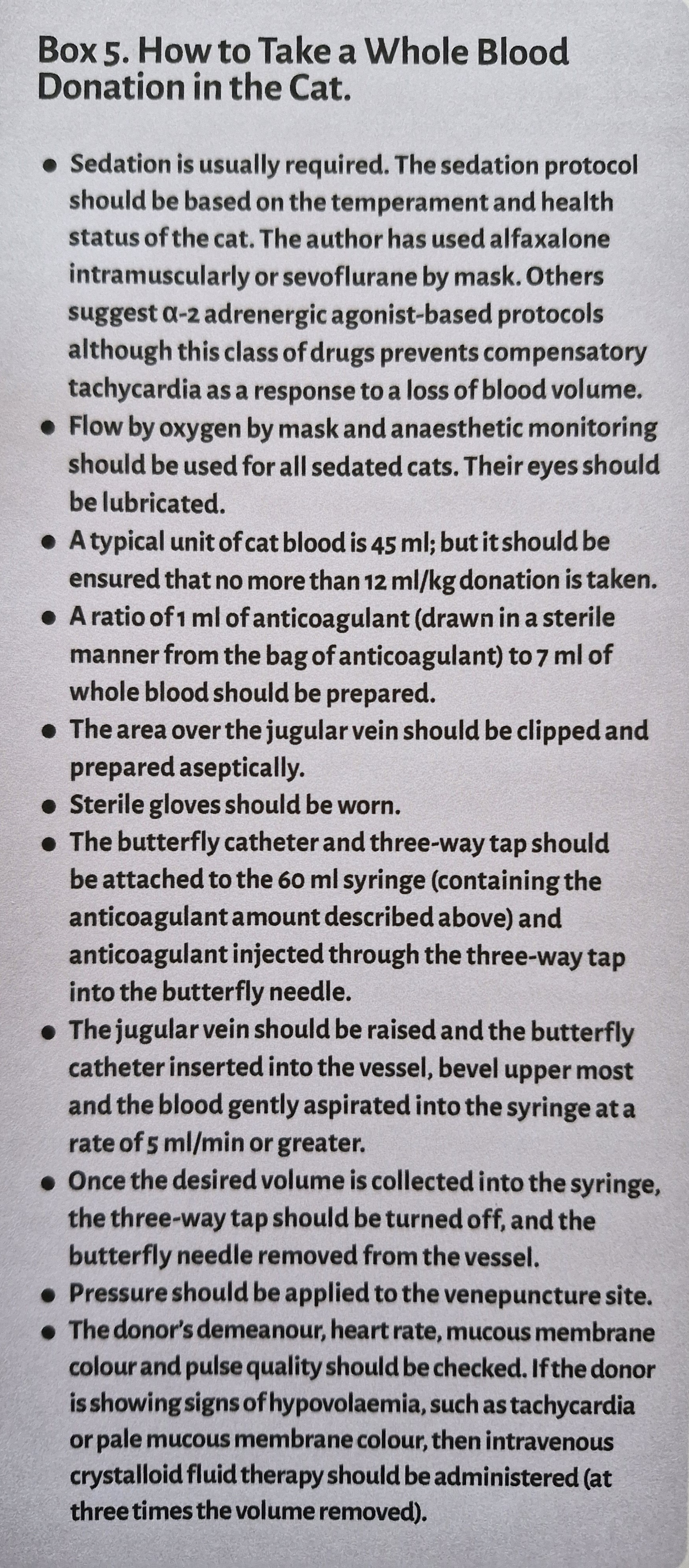
12ml/kg blood donation
1ml of anticoagulent to 7ml of whole blood
Alpha2 adrenergic agonist prevents compensatory tachycardia as a response to a loss of blood volume
What do you need to infuse with a blood transfusion?
A giving set with an in-line filter must be used with all blood products (to filter out any debris and microthrombi)
Smaller volume blood donations may be delivered with a syring driver with an in-line filter between the syring and IV catheter
Blood should not be administered theoigh lines with Hartmann's or other calcium-containing solutions in them
Citrate (part of the anticoagulent in the blood collection bag) binds to calcium in the blood and calcium is required for the coagulation cascade, therefor the citrate stops the blood clotting. Hartmann's contains calcium, so adding extra calcium to the mix allows blood clots to form where the 2 fluids mix
Monitoring the transfusion - what is important?
Recipient's baseline temperature, pulse and respiration (TPR) should be recorded before start; this makes it easier to note reactions whilst continuing observations during transfusion
Initial transfusion rate is 0,5ml/kg/hr for the first 15min to check for acute reactions. Patient continously monitored and TPR taken every 5min
If no signs of transfusion reaction after initial 15min; infusion rate should be increased to 5-20ml/kg/hr
TPR continuing every 15min first hr, half hourly for next hr, after that hourly
Ideally transfusion should be completed within 4 hrs
Dog; transfusion should be followed with 100ml of 0,9% saline to ensure blood product is not lost in drip tubing. Cat; sufficient saline flushed through administration line to flush all remaining whole blood into catheter
For a patient with acute hypovolaemic anaemia the benefit of a fast infusion rate may outweigh the risks of a transfusion reaction
A post transfusion blood sample should be taken to check for succes of transfusion; if the reason for transfusion was anaemia the PCV/TP should be re-checked; if the reason was hypoalbuminaemia, albumin should be re-checked. Should be repeated after a further 12hrs
What are immunological transfusion reactions?
Agitation/ restlessness/ change in attitude
Nausea, vomiting, salivation
Urticaria with our without pruritus
Anaphylaxis
Pyrexia
Tachypnoea/dyspnoea
Tachycardia
Hypotension
Seizures
Haemolysis, jaundice, haemoglobinuria
What are non-immunological transfusion reactions?
Hypocalcemia (this could be due to too much citrate binding blood calcium)
Circulatory overload
Hypothermia (blood not warmed prior to infusion)
Transmission of infectious disease
What to do if a transfusion reaction is suspected?
Stop and contact vet
Vet may decide to dampen down immune response by using corticosteroids and if appropriate administer antihistamines
Dependant on the cost/benefit ratio for a mild reaction the transfusion may continue but at a much slower rate
What is the transfusion volume calculation?
Intraoperative blood loss greater than 20% of blood volume should be treated with blood product, usually replacing the same volume that has been lost.
(90ml/kg dog, 56ml/kg cat)
Ml of donor blood required =
Recipient's blood volume X
Desired recipient PCV - current recipient PCV
: (divided by) donor PCV
When do we need to intervene when an animal is anorexic and why?
Feeding intervention should be instigated on day 3 of anorexia.
Beacuse compromised immunity is detectable in cats by day 4 of anorexia and metabolic changes in dogs by day 3.
Consequences of continued anorexia include infection, sepsis, organ failure, and poor wound healing.
Hyporexia (reduction in appetite) should also be considered as inadequate nutritional intake may result in similar complications
What are the 3 main macronutrients in critical care nutrition?
Protein, carbohydrates and fatty acids
What are carbohydrates used for?
Mostly converted to glucose and used for energy.
What is RER and how do we calculate it?
Resting Energy Requirement (calories)
Patients >2kg: 30 X bodyweight(kg) + 70
Patients <2kg: 70 X bodyweight(kg)0.75
For cats is slightly different, above formula tends to overestimate feline calorie requirements
RER = 40 (weight in kg)
What are proteins used for?
Required for metabolic function, tissue growth, function and repair.
Requirement for protein is significantly elevated in critical patients. Proteins should be easily digestible and so animal sources (egg/milk proteins) are often used for this reason.
Suggested proteins requirements are 2-3gr/kg body weight for a dog, and 3gr/kg body weight for a cat.
Some animals with renal or hepatic dysfunction cannot tolerate a high protein load as they have trouble eliminating the protein. However instead of restricting the protein, efforts should be made to help eliminate protein levels > fluid therapy to flush through kidneys
What are micronutrients?
Fatty acids, vitamins, minerals etc required to maintain healthy function and immunity.
Most veterinary foods are balanced and deficiency should not occur.
Electrolyte abnormalities are more common (with fluid losses)
What is, and why is enteral nutrition the best way to provide nutrition?
If an animal can an will eat > the intestinal epithelium gets its nutrition (especially glutamine) from the nutrients passing along the gut wall. If the gut does not get its nutrition, the chance of bacterial translocation (bacteria moving from the gut lumen into the blood stream) and sepsis is much greater.
This route is the cheapest and if animal is not eating by itself , coaxed feeding, appetite stimulants or some feeding tubes can be alternatives.
What is coaxed feeding?
Feeding a small, highly palatable, warm, smelly food in a stress free environment.
It is not force feeding of a semi liquid diet from a syringe, which often stresses the animal and provides negative reinforcement for the animal to stay anorexic
What can be used for appetite stimulation?
Mirtazepine and cyproheptadine have few side effects and are effective.
Diazepam (0,05 - 0,15 mg/kg IV or orally once a day) has been used with some succes in dogs/cats but should not be relied on for long term. As a benzodiazepine it can cause sedation or drowsiness and can cause liver damage in cats
What options ate there for tube feeding and when should it be implemented?
Assisted feeding should be implemented if the patient is not voluntarily meeting 75% of its resting energy requirements (RER).
From cranial to caudal:
Naso oesophageal (neus)
Oesophagostomy (slokdarm)
Gastrostomy (maag)
Jejunostomy (darm)
Label them! Central venous catheters are in the same insertion site wrapping
What is parental nutrition?
Nutrition is delivered via the IV route and bypasses the gut.
Only considered if enteral feeding is deemed hazardous or contra-indicated; patient is at increased risk of aspiration, such as depressed mentation.
Can be used to supplement enteral nutrition if patient is unable to meet 50% of its requirement via the digestive tract.
Solutions contain a protein source, a carbohydrate and a fat source. They must be prepared aseptically and deljvered via dedicated, central (usually jugular) venous catheter.
Risks associated with this include;
Thrombophlebitis of the catheterised vein due to hyperosmolarity (hence the use of central venous catheter), hyperglycaemia, hypertriglyceridaemia, and hyperammonaemia
Monitoring animals with feeding tubes, how?
Twice daily weighing
Body condition score
Hydration status assesment
TPR (temp, pulse, respiration)
Evaluation of demeanour
Check tube regularly to ensure they are patent
Gastrointestinal signs may occur after enteral feeding has started > start slow and dilute food.
Metabolic derangements can be seen but are more common in parentally fed patients rather than enteral route > can be identified with blood tests such as glucose, total solids, triglycerides, urea and electrolytes
Which electrolyte is considered the ‘osmotic skeleton’ of the extracellular fluid?
A - potassium
B - Calcium
C - Sodium
D - Chloride
C - Sodium