Cell Cycle
 Call Kai
 Learn
 Practice Test
 Spaced Repetition
 Match
 Flashcards
 Knowt Play
1/49

There's no tags or description
Looks like no tags are added yet.
50 Terms
Helicase
Enzyme that uses energy from ATP to unwind DNA replication
Primase
Enzyme that synthesizes RNA primers for DNA replication; makes an available 3' end in lagging strand
DNA Polymerase
Enzyme that synthesizes new DNA strands in the 5' to 3' direction
Ligase
final binding of nicks in DNA during synthesis and repair; seals backbone of new DNA stand
Topisomerase
Prevents supercoiling after DNA is replicated
Telomerase
An enzyme that catalyzes the lengthening of telomeres through its internal RNA template. Loses activity as cell ages.
Replisomes
All of the enzymes involved in DNA replication
Supercoiling
Bunching up of DNA that can cause DNA damage and mutation
G1 phase
Primary growth phase of the cell cycle; normal cell function occurs
Synthesis
DNA replication occurs
G2 phase
Organelles replicate; microtubules organize
Mitosis
Separated into 5 phases: prophase, prometaphase, metaphase, anaphase, telophase; when cell divides into two
Cytokenesis
The final stage of the cell cycle, in which the cell's cytoplasm divides, distributing the organelles into each of the two new cells.
Leading strand
The new continuous complementary DNA strand synthesized along the template strand in the mandatory 5' to 3' direction towards the replication fork
Lagging strand
A discontinuously synthesized DNA strand that elongates by means of Okazaki fragments, each synthesized in a 5' to 3' direction away from the replication fork.
Origin of replication
Site where the replication of a DNA molecule begins
Prokaryotic replication
occurs on a circular chromosome, one point of origin, replication runs in opposite directions
Binary fission
A form of asexual reproduction in single-celled organisms by which one cell divides into two cells of the same size
Eukaryotic replication
Starts at dozens of places on DNA molecule, proceeding in both directions
Replication fork
A Y-shaped region on a replicating DNA molecule where new strands are growing.
5' to 3'
the direction in which DNA is synthesized and read. DNA polymerase can only synthesize in this direction.
Okasaki fragments
Short segments of DNA synthesized on the lagging strand during DNA replication.
Chromosomes
threadlike structures made of DNA molecules and many histone proteins that contain the genes
Single stranded nick
Gap between adjacent DNA fragments after primer removal.
Telomeres
DNA at the tips of chromosomes that do not contain genetic information
Apoptosis
programmed cell suicide when cell runs out of telomeres; prevents loss of genetic information
alleles
Different versions of a gene
centromeres
the portion of DNA that kinetochore proteins attach to
homologous
term used to refer to chromosomes in which one set comes from the male parent and one set comes from the female parent
chromatids
one of two identical "sister" parts of a duplicated chromosome
autosomes
Chromosomes that are not directly involved in determining the sex of an individual.
diploid
containing two complete sets of chromosomes, one from each parent.
sex chromosome
Chromosomes that determine the sex of an individual
ploidy
Number of chromosome sets in a cell.
necrosis
accidental cell death where cell swells and bursts
mutagen
environmental exposure that increases the number of mutations in a cell. Radiation or chemicals
repair mechanisms
attempt to correct mistakes or damage in the DNA
specific repair mechanisms
target a single kind of mutation and repair only that damage
non-specific repair mechanisms
a repair mechanism that can repair several types of mutations.
photolyase
An enzyme that splits thymine dimers in the presence of visible light
excision repair
locates and repairs incorrect sequence by removing a segment of the DNA and then adding the correct nucleotides
spindle aparatus
structure made of spindle fibers, centrioles, and aster fibers that is involved in moving and organizing chromosomes before the cell divides
prophase
The first stage of mitosis; chromosomes become visable, nuclear envelop dissolves, spindle forms

prometaphase
The second stage of mitosis, in which the spindle microtubules attach to the kinetochores of the chromosomes.

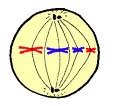
metaphase
The third stage of mitosis, moment of alignment of chromosomes along the plate single file
anaphase
The fourth stage of mitosis, beginning when sister chromatids separate from each other and ending when a complete set of daughter chromosomes arrives at each of the two poles of the cell.

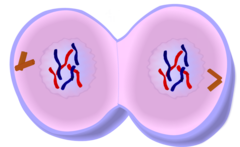
telophase
the final stage of mitosis, spindle apparatus disassembles, nuclear membrane reforms, chromosomes begin to uncoil, nucleolus reappears in each new cell
G1/S checkpoint
cell determines if DNA is in good condition for synthesis
G2/M checkpoint
Cell makes a commitment to mitosis; assesses success of DNA replication
Spindle checkpoint
ensures all chromosomes are attached to the spindle