JC Science - Earth and Space
 Call Kai
 Learn
 Practice Test
 Spaced Repetition
 Match
 Flashcards
 Knowt Play
1/53

There's no tags or description
Looks like no tags are added yet.
54 Terms
Astronomy
The study of the universe beyond the earths atmosphere
Geocentric Model
Model of the Solar System with the Earth in the center. First created by the Greeks.

Heliocentric Model
A representation of the relationship between the Sun and planets in which the planets revolve around the Sun. Copernicus proposed the model.

A celestial object
A a naturally made object outside the earths atmosphere
Star
A celestial bid that generates its own heat and light, consists of a gas held together by its own gravity

Planet
A planet is a celestial body that is in orbit around a star

Moon
A moon is a natural satellite of a planet

Asteroid
An asteroid is a small rocky body orbiting the sun

A comet
A comet is made from ice and dust and orbits the sun

A comet's tail always points
away from the sun due to solar winds

Solar system
The solar system is a group of planets, asteroids, comets and other celestial objects

Galaxy
A galaxy is a very large system of stars held together by gravity

What is the centre of our solar system
Sun

The size of our solar system is controlled by how far out it's ———- can control objects
Gravity
Our 8 planets
Mercury
Venus
Earth
Mars
Jupiter
Saturn
Uranus
Neptune
Order of planets from the sun
Mercury, Venus, Earth, Mars, Jupiter, Saturn, Uranus, Neptune (My Very Excited Mother Just Served Up Nachos)
Haley's comet is visible from earth approximately every —— years
75
Our solar system is part of what galaxy
The Milky Way galaxy

Outer space is what?
Empty volume that exists between galaxies
What is the most commonly accepted theory for the formation of the universe
The Big Bang theory
Describe the Big Bang theory
About 14 billion years ago all the mass and energy of the universe existed in a bubble the size of a pinhead which was hot as dense. It suddenly exploded and expanded to the size of earth now. Over time protons, neutrons and electrons were made and formed atoms. After 5 billion years these cloud of atoms created the first stars. After 5 billion years these stars died and exploded (supernova). This forced new heavier elements which gathered to create planetary systems and galaxies
What evidence is there for the Big Bang (1)
Edwin Hubble discovered that the universe is constantly expanding. We know this due to redshift in light as objects move away.

Redshift
shift of light to a longer wavelength as it moves away

What evidence is there for the Big Bang (2)
There is energy called Cosmic background radiation remaining everywhere in space left from the Big Bang

Gravity
-Known as the glue of the universe
-if two masses are placed near each other they will be attracted
-if the mass is small the force of attraction is small
-if the mass is large the of attraction is large

What happens as you move away from a celestial body
As you move away the force of gravity becomes less and less
What can planets be composed of?
Rock (earth) or gas (Jupiter)
rocky (terrestrial) planets
Mercury, Venus, Earth, Mars
Gaseous (Jovian) Planets
Jupiter, Saturn, Uranus, Neptune
Planets of greater density are likely to be made of ———-
Rock

Planets of less density are like to be made of ————
Gas

The earth orbits the sun every ——— days
365.25
The earth rotates on its own ———- every 24 hours this causes day and night
Axis
The moon orbits the Earth approx every —— days this causes moon phases
29
The ——- is the primary source of energy for the earth. It provides energy for photosynthesis and heats the earth
Sun
Earth's tilted axis
Tilted 23.5° relative to its orbit around the Sun
Causes Seasons- different areas receive different heat intensity throughout the year

In the summertime the northern hemisphere is titled ———— the sun
Towards
In the winter the northern hemisphere is titled ———- from the sun
Away
Does the moon create its own light?
No, it reflects light from the sun
Waxing
getting bigger
Waning
getting smaller
New Moon
A moon that is completely dark

Waxing Crescent
moon phase that comes after a new moon and before a first quarter moon; less than half of the moon is lit up on the right side

first quarter moon
The phase of the moon when it is one-quarter of the way through its orbit, and we see half of the moon lighted

Waxing Gibbous
A phase of the moon that comes after a 1st quarter moon and before a full moon where almost all of the moon is lit up from the right to the left, except a small bit on the left.

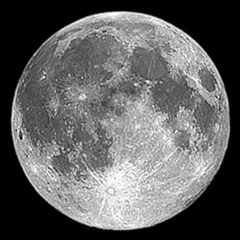
full moon
moon phase when the entire side facing Earth is illuminated.
Waning Gibbous
A phase of the moon that comes after a full moon and before a last quarter moon where all of the moon is lit up except for a small bit on the right side of the moon that we can see.

third quarter moon
The phase of the moon when it is three-quarters of the way through its orbit, and we see half of the moon lighted

Waning Crescent
moon phase that comes after a third quarter moon and before a new moon; less than half of the moon is lit up on the left side

When does an eclipse occur
When a celestial body gets in the way of sun illuminating another celestial body
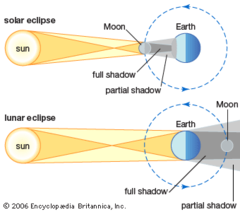
Lunar eclipse
Earth comes between sun and moon

Solar eclipse
Moon comes between sun and earth

Benefits of space exploration
- Satellites for communication
-Efficient solar panels
- Battery technology
Hazards of space exploration
-dangerous traveling to and from
- Radiation can cause cancers
- Bone density decreased