substance use disorder
 Call Kai
 Learn
 Practice Test
 Spaced Repetition
 Match
 Flashcards
 Knowt Play
1/36

There's no tags or description
Looks like no tags are added yet.
37 Terms
diagnostic and statistical manual of mental disorders
evolution of diagnostic labels over time
‘addiction’ - may imply character weakness or moral failure
replaced by ‘dependence’ - implied emphasis on biological adaptations
DSM-IV - distinction between substance abuse and substance dependence
DSM-5 - ‘abuse’ & ‘dependence’ combined into single diagnosis ‘substance use disorder’
diagnostic criteria for alcohol use disorder

SUD is:
meets any 2/11 diagnostic criteria
three severity categories: mild (2/3 criteria), moderate (4/5 criteria), severe (6+)
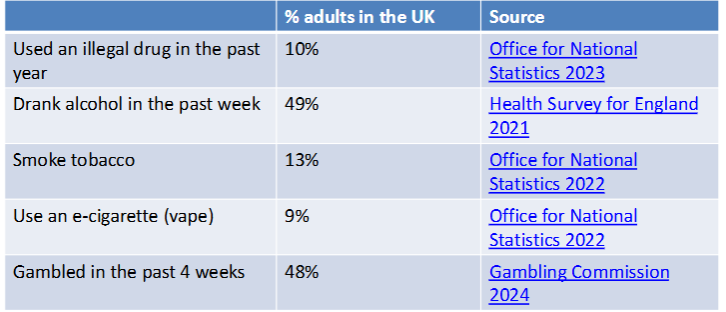
point prevalence estimates (UK)
treatment
>290,000 adults in contact with drug and alcohol treatment services in UK
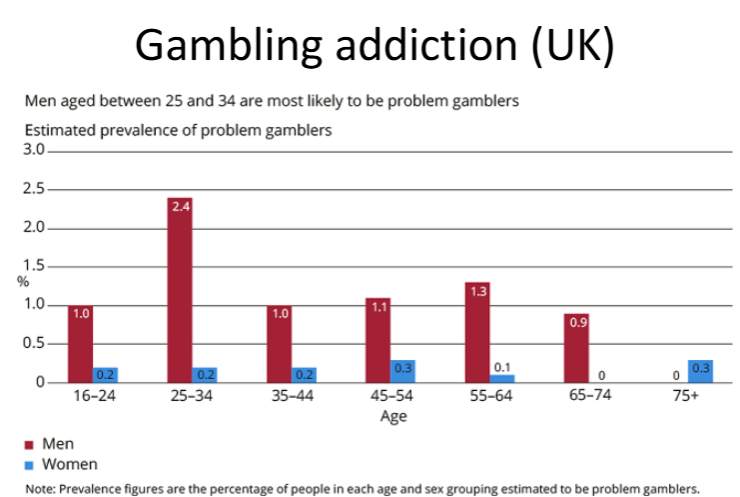
~9000 adults received treatment for gambling addiction in the UK in 2020
who gets treatment vs who needs it

is vaping replacing tobacco smoking in the UK?

gambling addiction
risk factors for addiction - heritability

genetic risk factors
heritable risk shared across SUDs (Agrawal and Lynskey 2008 - SUDs run in families) and with other ‘externalising psychopathology’ e.g. antisocial personality disorder
few candidate genes identified - probably, multiple genes are involved, each of which has a negligible effect in isolation
person who has close relative (parent/sibling) = increased risk of developing SUD - genetic or shared environment?
adoption/twin studies
adoptee who had alcohol-dependent bio parent is at greater increased risk of developing alcohol use disorder
twin studies demonstrated that heritability estimates for various types of SUDs range between 30-70%
risk factors: comorbidity
SUDs (all types) are more common in people who have also been diagnosed with:
bipolar, major depression, anxiety, social anxiety, ptsd, schizophrenia etc,,
causality is complicated
also, both SUDs and other mental disorders may both be influenced by the same underlying variables e.g. genetics/trauma

risk factors: traumatic life events
traumatic life events, particularly sexual abuse during childhood, associated with marked increase in risk for development of SUD (Anderson & Teicher, 2009; Brady et al., 2004)
people take drugs because of the outcomes that those drugs produce
to get high
to increase alertness and reduce fatigue
social facilitation
to alleviate distress
compulsive drug use
‘compulsion’ is evoked to explain addictive behaviour when the negative consequences of drug use appear to outweigh the positives
addicts are ‘compelled’ to use drugs despite their better judgement or desire not to
the dominant view is that addiction is a brain disease - disruptions to the dopamine reward system are crucial
token economy systems
token economies are fairly effective treatment for addiction
e.g. if cocaine addicts receive cash for proving they have not used cocaine, many of them are able to give up (Higgins et al., 1994)
if SUD can be ‘cured’ simply by increasing motivation to stop using drugs, does that mean it isn’t a disease?
is addiction a brain disease?
Volkow et al. (2016)

The ‘addicted brain’
‘addicted brains’ are hypoactive and have less grey matter in prefrontal regions including the anterior cingulate cortex/medial prefrontal cortex, striatum and other brain regions
drugs stimulate dopamine release in the brains ‘reward system’ - a pathway called the mesolimbic dopamine system - includes nucleus accumbens, ventral tegmental area, and some regions of prefrontal cortex

dopamine + classical conditioning
if rats exposed to pairing between a CS and an US - initially dopamine activity is unaffected by CS but big spike with US
after repeated CS-US pairings, spike in dopamine activity peaks whenever CS is presented
appears that dopamine release peaks when organisms expect to receive a reward not when they actually do
bio theory: incentive-sensitisation theory Robinson and Berridge (1993)
proposed that repeated drug use leads to a sensitised (progressively increasing) spike in activity in the mesolimbic dopamine system
dopamine response not seen when the person is experiencing effect of drug but when they are exposed to drug related cues
cues have powerful incentive motivational properties - increase instrumental responding to drug
call this process drug ‘wanting’, distinguished it from drug ‘liking’
theory proposes that dopamine dysfunction lies at root of addiction - nothing to do with pleasure produced by drug
bio theory: hedonic homeostatic dysregulation theory - Koob and Le Moal (1997)
proposes that malfunction of dopamine system lies at heart of SUD
repeated drug use leads to long term suppression of dopamine function
brain adapts to repeated increases in dopamine activity - followed by decreases in dopamine activity during drug withdrawal by lowering ‘set point’ of dopamine activity
proposes that dop is involved in regulation of mood so consequence of lowered set point is that addicts become increasingly miserable - only respite when taking drugs
cog theory: model of automaticity - Tiffany (1990)
drug use starts as voluntary (non-automatic)
with repeated performance, self-administration of drugs becomes automatic
people only suffer cravings when they have to engage non-automatic processes in order to obtain and then take drugs
however, for those addicted to illegal drugs, lots of planning is required so have to put in considerable mental effort
habits
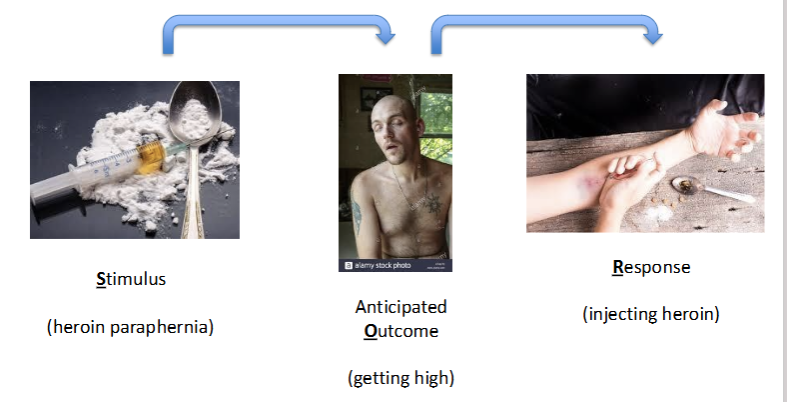
with repetition
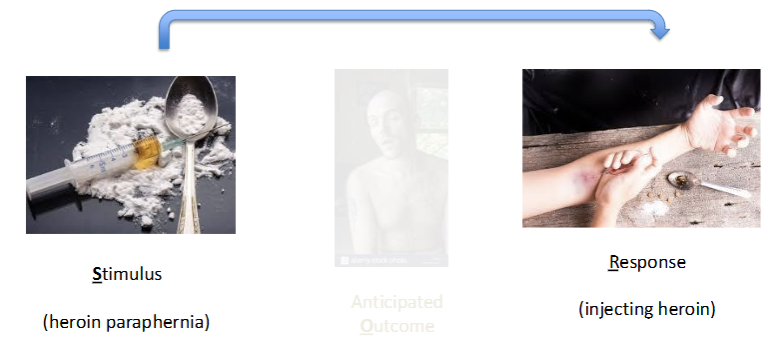
evidence for habits
habit = a shift from S-O-R to S-R responding
in lab animals, good evidence that drug seeking becomes habitual: it persists despite negative consequences
in humans, importance of ‘habit’ in addiction is disputed (Heather et al., 2017)
operant conditioning in addiction
performing behaviour = positive outcome - feeling ‘high’ = positive reinforcement
experience unpleasant withdrawal syndrome when stop taking drug - take drug and withdrawal symptom goes away = negative reinforcement
classical conditioning in addiction
drugs act as US
when people take them, they do so in the presence of drug-related cues e.g. sight/smell/taste of beer
paired with effects of alcohol (US)
so cues function as CS
CS and US consistently paired = CR
interaction classical and operant conditioning
Pavlovian to Instrumental Transfer (PIT)
CS paired with drug can initiate instrumental responding for same drug
this process might explain how classically conditioned cues can influence voluntary (operant) behaviour
e.g. someone with alcohol dependence walks past bar; bar acts as CS - elicits representation of outcome (being drunk); causes person to perform operant response that yields outcome
cog theory: dual process theories
Weirs, Field and Stacy (2016)
novice substance user
proposes that automatic processes reflect an incentive learning process and they are able to produce spontaneous behaviour before people have time to consider the consequences of their actions

addiction involves imbalance between controlled and automatic cognitive processes
addicted substance user

dual-process theories: evidence
addiction is characterised by automatic cognitive processing biases for substance-related cues e.g. attentional biases, automatic approach tendencies
‘re-training’ of these cognitive processing biases may be an effective treatment
recovery

treatment: talking therapies
motivational interviewing - encourage clients to recognise that they are ambivalent about their drug use and to gently encourage people to see the benefits of quitting/cutting down
CBT - aim to challenge dysfunctional beliefs that underly addiction and help people to identify and mitigate triggers for substance use
do talking therapies work?
both motivational interviewing and CBT are effective treatments for SUD - compared to control treatment they increase the percentage of patients who remain abstinent
they may work in different ways:
- CBT improves coping skills
- motivational interviewing changes motivational balance and increases ‘client change talk’
treatment: self help groups
free to taxpayer
new member paired with ‘sponsor’
help to achieve and maintain abstinence
effective as they increase self-efficacy and bring about changes in social networks
cue exposure therapy
aims to reduce or eliminate reactivity to drug cues
patient repeatedly exposed to drug-related cues but not able to take the drug
‘extinction’ training should mask associative relationship between the CS and the US - extinction of cue reactivity
ultimately reduce risk of relapse
however, no convincing evidence that it helps people abstain from drug use in the long term - maybe because it is context-dependent
treatment: pharmacotherapy
various drug treatments available - no ‘cure’ and nothing that addresses dysfunction in brain reward system
smoking - nicotine replacement therapy, varenicline, bipropion
heroin - methadone, buprenophine
alcohol - naltrexone, acamprosate, disulfiram