Proteins & Nucleic Acids: Structure, Function, and Key Concepts
 Call Kai
 Learn
Learn Practice Test
 Spaced Repetition
 Match
Match Flashcards
 Knowt Play
1/50

There's no tags or description
Looks like no tags are added yet.
51 Terms
What are proteins?
One of the most abundant organic molecules in living systems with the most diverse range of functions of all macromolecules.
What are the monomers of proteins?
Amino acids.

How many different amino acids are there?
20 different amino acids.
What is the structure of an amino acid?
Each amino acid has a central carbon atom, an amino group, a carboxyl group, a hydrogen, and a side chain (R group).
What is a peptide bond?
A covalent bond connecting two amino acids to form a polypeptide.

What is a polypeptide?
A polymer of amino acids.
How are peptide bonds formed?
Formed by dehydration synthesis
What determines a protein's shape, size, and function?
The sequence and number of amino acids.
What are the four levels of protein structure?
Primary, Secondary, Tertiary, Quaternary.
What is primary structure in proteins?
The unique order of amino acids in a polypeptide, determined by inherited genetic information.
What is secondary structure in proteins?
Folding of the protein due to chemical and physical interactions, commonly forming alpha helices and beta pleated sheets.

What is tertiary structure in proteins?
The unique 3D structure of a polypeptide formed by interactions between R groups that fold in on themselves.

What is quaternary structure in proteins?
Structure made up of two or more polypeptides, each called a subunit.
What are nucleic acids?
Molecules that carry the cell's genetic blueprint and instructions for its functioning.

What are the two main types of nucleic acids?
Deoxyribonucleic acid (DNA) and Ribonucleic acid (RNA).
What is the role of DNA?
Stores genetic information encoded in the sequence of nucleotide monomers.
What is the role of RNA?
Decodes DNA into instructions for protein synthesis.
What are the components of nucleic acids?
Nucleotides, which consist of a phosphate group, pentose sugar, and a nitrogenous base.

What are the four bases found in DNA?
Adenine (A), Guanine (G), Cytosine (C), and Thymine (T).

What are the four bases found in RNA?
Adenine (A), Guanine (G), Cytosine (C), and Uracil (U).
What is the structure of DNA?
Made of two polynucleotide strands connected by hydrogen bonds, forming a double helix.

What is the base-pair rule in DNA?
Adenine (A) pairs with Thymine (T) and Guanine (G) pairs with Cytosine (C).

What are the four major types of RNA?
Messenger RNA (mRNA), Ribosomal RNA (rRNA), Transfer RNA (tRNA), and MicroRNA (miRNA).

What is the name of the orange component of amino acids?
Amino functional group (NH2)
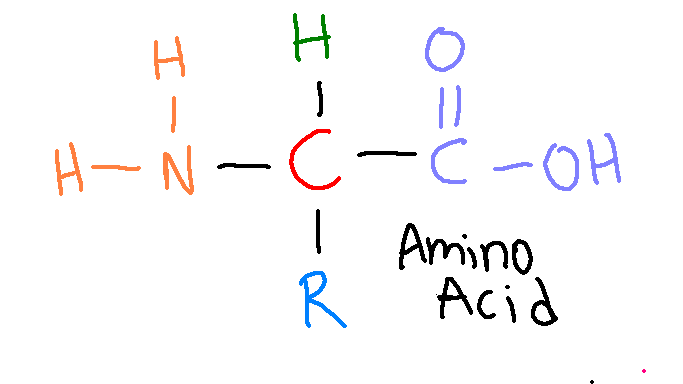
What is the name of the red component of amino acids?
Central carbon / Alpha Carbon

What is the name of the blue component of amino acids?
R group side chain. It varies depending on the type of amino acid

What is the name of the green component of amino acids?
The hydrogen
What is the name of the purple component of amino acids?
Carboxyl group
What does the alpha secondary structure look like?
A helix
What does the beta secondary structure look like?
A pleated sheet
What are secondary structures held together by?
Hydrogen bonds
In the tertiary structure, where do the nonpolar and hydrophobic R groups go?
On the inside
In the tertiary structure, where do the polar and hydrophilic R groups go?
On the outside
Which level is the final level for a single polypeptide chain?
The tertiary structure
What does dehydration synthesis produce?
Water molecules
How are peptide bonds broken down?
Hydrolysis
What does hydrolysis do?
Adds water to break apart peptide bonds
What are the monomers of Nucleic Acids?
nucleotides

What is the blue component of this nucleic acid?
Phosphate group (PO4)

What is the red component of this nucleic acid?
Pentose sugar

What happens when the pentose sugar has an OH?
It makes it a deoxyribose sugar
What does deoxyribose correspond to?
DNA
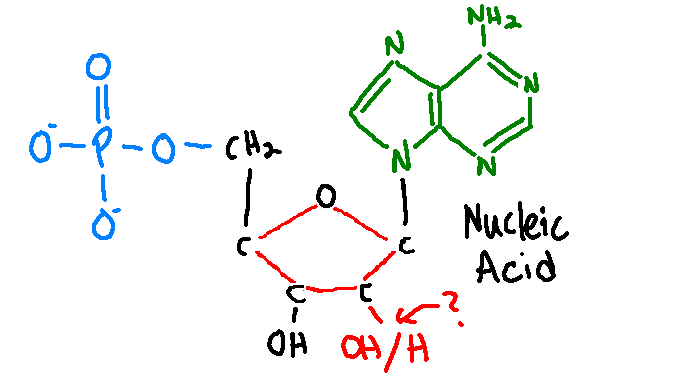
What happens when the pentose sugar has an H?
It makes it a ribose sugar
What does ribose correspond to?
RNA

What is the green component of the nucleic acid
Nitrogenous base
What is a nitrogenous base?
A single or double ring of carbon or nitrogen atoms
What is a purine?
2 carbon-nitrogen rings as the primary structure
Which nitrogenous bases are purines?
Adenine (A) and Guanine (G)
What is a pyrmidine?
1 carbon-nitrogen ring as the primary structure
Which bases are pyrmidines?
Thymine (T), Cytosine (C), Uracil (U - RNA)
What are the polymers of nucleic acids?
Polynucleotides