Genetics Chapter 12: DNA Replication and Recombination
 Call Kai
 Learn
 Practice Test
 Spaced Repetition
 Match
 Flashcards
 Knowt Play
1/88

There's no tags or description
Looks like no tags are added yet.
89 Terms
6.4 billion
how many DNA base pairs does a single-celled human zygote contain?
semiconservative
DNA replication is ___
one nucleotide strand in each piece of replicated DNA is original and stays intact (conserved), while the complementary strand is new
what is semiconservative replication?
conservative, dispersive, semiconservative
what were the original 3 models of DNA replication proposed?
conservative replication
what model of proposed DNA replication is shown?

dispersive replication
what model of proposed DNA replication is shown?
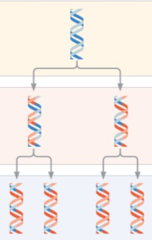
semiconservative replication
what model of proposed DNA replication is shown?

heavy DNA (with N15) settled in a low band, was put in media with light DNA (with N14) which settled higher in the tube, after one round of replication and intermediate band was produced
how did Meselson and Stahl show that DNA replication is semiconservative?
the light band reappeared higher up in the tube
in Meselson and Stahl's experiment, what happened after more than one round of replication?
a locus called the origin of replication
where is DNA replication of circular chromosomes initiated?
double-stranded DNA begins to unwind and generates a loop called the replication bubble
what happens at the origin of replication?
theta replication
what mode of replication often takes place in circular DNA?
bidirectionally
in theta replication, DNA is often replicated ___
in circular chromosomes, where the two strands separate from the double-stranded DNA helix
what is a replication fork?
by expansion of the replication fork
how does the replication bubble grow?
bi-directional replication
what type of DNA replication is shown?
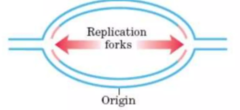
unidirectional replication
what type of DNA replication is shown?

some viruses and in the F factor of E. coli
what organisms does rolling-circle replication take place in?
a break in one of the nucleotide strands exposes a 3' -OH group
how is rolling-circle replication initiated?
new nucleotides are added to the exposed 3' end of the broken strand and the unbroken strand is used as a template
how does rolling-circle replication work?
it is displaced from the template, rolling out like thread being pulled off a spool
what happens to the 5' end in rolling-circle replication?
they are circularized and serve as a template to make the second DNA strand
what happens to the new single strands in rolling-circle replication?
there are multiple
what is significant about the origin of replication in eukaryotic linear chromosomes?
every 20,000 to 300,000 base pairs
how often do origins of replication occur in eukaryotic linear chromosomes?
replication bubbles initiate from multiple origins, replications proceeds bidirectionally until they meet and fuse
how does replication work in eukaryotic linear chromosomes?
two linear chromosomes are derived from one
what is the result of replication in eukaryotic linear chromosomes?
circular
what is the DNA template in Theta replication?
circular
what is the DNA template in rolling-circle replication?
linear
what is the DNA template in linear eukaryotic replication?
no
does Theta replication involve breakage of a nucleotide strand?
yes
does rolling-circle replication involve breakage of a nucleotide strand?
no
does linear eukaryotic replication involve breakage of a nucleotide strand?
unidirectional or bidirectional
is Theta replication unidirectional or bidirectional?
unidirectional
is rolling-circle replication unidirectional or bidirectional?
bidriectional
is linear eukaryotic replication unidirectional or bidirectional?
two circular molecules
what are the products of Theta replication?
one circular molecule and one linear molecule that may circularize
what are the products of rolling-circle replication?
1. a template consisting of single-stranded DNA
2. raw materials (substrates) to be assembled into a new nucleotide strand
3. enzymes and other proteins that "read" the template and assemble the substrates into a DNA molecule
what are the 3 major requirements for DNA replication?
the raw materials from which new DNA molecules are synthesized
what are deoxyribonucleoside triphosphates (dNTPs)?
a deoxyribose sugar and a nucleoside attached to 3 phosphate groups
what do deoxyribonucleoside triphosphates (dNTPs) consist of?
the 3' -OH of an existing strand by DNA polymerase
where are deoxyribonucleoside triphosphates (dNTPs) added and how?
base pairing constraints in the enzyme
what ensures the correct nucleotide is added in DNA replication?
a new 3' -OH as a substrate for the next addition
what does the addition of a deoxyribonucleoside triphosphate (dNTP) produce?
they are cleaved off to allow the addition of the dNTP
each nucleotide in DNA has 1 phosphate group, but deoxyribonucleoside triphosphates (dNTPs) have 3. what happens to the other 2?
high energy phosphates
what provides the energy for DNA replication?
5' to 3'
what direction do DNA polymerases always move?
5' to 3'
proofreading is only possible in the ___ direction
the 5' end is a monophosphate, a higher energy phosphate needed for polymerization
why is proofreading only possible in the 5' to 3' direction?
continuous
the leading strand undergoes ___ replication
discontinuous
the lagging strand undergoes ___ replication
the template strand exposed in the 3' to 5' direction, runs towards the replication fork
what is the leading strand?
the template strand exposed in the 5' to 3' direction, runs away from the replication fork
what is the lagging strand?
new priming to form fragments
what does the lagging strand require?
the short lengths of DNA produced by discontinuous replication of the lagging strand
what are okazaki fragments?
bacterial, eukaryotic
more details are known about ___ DNA synthesis that ___ DNA synthesis, but they are very similar
initiation, unwinding, elongation, termination
what are the four stages of bacterial replication?
binds to origin of replication and separates strands of DNA to initiate replication
what do initiator proteins do?
unwinds DNA at the replication fork
what does helicase do?
attach tightly to exposed single-stranded DNA after being unwound by helicase, protect the strand and prevent the formation of secondary structures
what do single-strand-binding proteins do?
torsional strain
what does opening the replication bubble cause?
a topoisomerase that relieves torsional strain
what is DNA gyrase?
cleaves one strand, allows rotation to relieve strain, and the re-ligates the strand, moves ahead of the replication fork
how does DNA gyrase work?
a 3'-OH group (to add a new nucleotide to)
what does DNA polymerase require?
an enzyme that synthesizes short RNA primers for DNA polmerase
what is primase?
short stretches of RNA nucleotides that provide a 3'-OH group to which DNA polymerases can attach DNA nucleotides
what are primers?
a ring-shaped polypeptide that encircles the DNA and allows the polymerase to slide easily along the DNA template strand during replication
what is the sliding clamp?
DNA Pol I
what DNA polymerase is the only one with 5' to 3' exonuclease activity?
removal of primers
what does 5' to 3' exonuclease activity of DNA Pol I allow?
DNA Pol IV
what is the only DNA polymerase with no 3' to 5' exonuclease activity?
processive
DNA Pol III is highly ___
it stays attached for a long time, making a long strand
what does it mean if something is highly processive?
removes and replaces primers
what is the function of DNA Pol I?
DNA repair; restarts replication after damaged DNA halts synthesis
what is the function of DNA Pol II?
elongates DNA from 3' -OH provided by primer
what is the function of DNA Pol III?
DNA repair
what is the function of DNA Pol IV?
gaps/breaks remaining in the DNA strand
what remains after DNA synthesis and removal of primers?
joins Okazaki fragments with phosphodiester bonds between nucleotides
what does DNA ligase do?
about 1 error per billion nucleotides added
what is the error rate in bacterial DNA synthesis?
old strand is methylated, new strand isn't
how does an enzyme know to repair the new strand of DNA instead of the template strand?
1 in 100,000
what is the error rate in DNA polymerases?
proofreading and DNA mismatch repair mechanisms
how are DNA polymerase errors corrected?
homologous
eukaryotic DNA replication is ___ with bacterial DNA replication
mark the origin of replication sites in eukaryotes
what do replication licensing factors do?
that replication initiates only once during a cell cycle to prevent chaos caused by multiple initiation events
what do replication licensing factors ensure?
involved in eukaryotic DNA replication, has primase activity and can initiate DNA synthesis
describe DNA polymerase-alpha
involved in eukaryotic DNA replication, completes lagging strand synthesis
describe DNA polymerase-delta
involved in eukaryotic DNA replication, replicates the leading strand
describe DNA polymerase-epsilon
contains 15-22 nucleotides that are complementary to the G-rich 3' overhang of telomers, serves as template strand for extending the telomere ends
what is significant about telomerase?
a structure formed when there is a single-strand DNA break and the two DNA molecules join
what are Holliday junctions?