NEUR30080 L1 SQ ion channels & permeability
 Call Kai
 Learn
 Practice Test
 Spaced Repetition
 Match
 Flashcards
 Knowt Play
1/68

There's no tags or description
Looks like no tags are added yet.
69 Terms
L1 learning objectives - answer these Qs

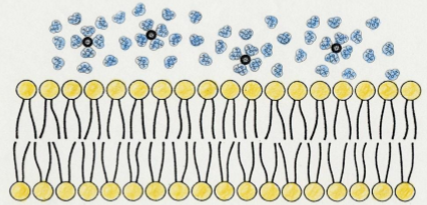
the lipid bilayer is a perfect insulator
ions have a shell of water, removing it has thermodynamic cost
bare diffusion is effectively zero (never) - an Na+ ion crosses about 1x in hours
therefore needs channels and transporters
ion movement
signals in the NS are ions crossing the memb
Na+, K+, Cl- and Ca2+ sit unequally at either side of memb
opening channels releases stored potential energy (stimulus changes permeability, opening channels, balance shifts, voltage moves)
depol = reduced voltage
4 types of channels & transporters

ion conc and locations at rest at rest

ions at rest diagram

aqueous pore
a water-filled path through the memb
selectivity filter
the narrowest point dictates permeability
gates
the moving part that opens/closes the channel
sensor
the domain that detects the stimulus: voltage, ligand, force or light
diagram of channel: pore, selectivity filter, gate, sensor

why K+ fits and Na+ does not
the filter is a ring of backbone carbonyls
O2 points inwards, precisely spaced
K+ sheds its water
carbonyl O2s perfectly surrogate their water molecules, energetically compensating for dehydration
Na+ too small
cannot simultaneously contact the pire O2s. the thermodynamic debt of dehydration is not repaid, therefore rejected
result
1000-fold selectivity
K+ vs Na+ selectivity diagram

hetero-oligomers
GABA-A receptors
nACH receptors (muscle)
voltage-gated K channel
NMDA receptors
AMPA receptors
homo-oligomers
nACH receptors (alpha-7, brain)
AMPARs (GluA1)
5-HT3A receptors
P2X receptors
hetero-oligomers diagrams

homo-oligomers diagrams

Na and Ca channels
one chain with four repeats - single polypeptides with 4 homologous domains
each domain contains 6 transmemb segments, folding for form a single central pore
two rounds of evolutionary duplication generated a single, continuous transcript
the four domains are asymmetrical, an evolutionary structural requirement for fast inactivation
Na and Ca channels diagram

Na and Ca channels - the sensor
S4 is the voltage sensor - an alpha-helix carrying reg spaced +charged Arg residues
depolarisation electrostatically repels S4 outward against massive electric field (107 V/m)
this physical movement of amino acids generates a gating charge - a tiny measurable capacitive current that precedes actual ion flow (conformational change)
sensing and gating are mechanically coupled - S4 translocation physically pulls the activation gate open
the sensor image

3 states
closed - poor blocked but the protein is primed to respond to a stimulus
open - conducting
inactivated - a secondary gate occludes the pore. The channels cannot reset until the memb repolarises (Na channels only
kinetic diversity - Na channels activate and inactivate rapidly, K channels activate with a delay
*inactivation structurally distinct from closure - dictates the refractory period
kinetic states image

conductance: Ohmic conduction
current scales linearly with voltage
the slope of the I-V curve equals conductance
only flows one direction instead of 2
conductance: rectification
asymmetrical conductance
ions flow more readily in one direction, yielding a non-linear I-V curve
rectification allows the cell to maintain a stable resting potential without leaking K+ during an AP
mainly K+, rectifying brings K+ out and wont let it back in
ohmic vs rectifying image

inward rectifier K+ channels (Kir)
conduct K+ inward current, restrict efflux
the polyamine plug
IC Mg2+ and polyamines occlude (block) the pore during depolarisation
leak channels
resting, constitutively active at rest - no stimulus needed, no gate
overwhelmingly K+ - more permeable to K+ than anything else at RMP
they set the RMP
gated channels
open only on a stimulus - voltage, ligand, light etc.
shut most of the time - why a resting neuron is stable and quiet
they CHANGE the potential - synaptic potentials, APs, everything transient
leak and gated channels link
leak channels explain why Vm = -65 mV
gated channels explain why it moves
studying a protein’s physics: use target mRNA
neuron has dozens of channel types, a mixture
microinject target mRNA into a Xenopus oocyte
translocation and trafficking: the oocytes machinery translates and inserts the protein into the memb
the macro-scale cell (1 mm) expressing a pure, isolated population of the target channel
isolate one variable, then measure it

single molecules: binary transitions
rectangular current steps reflect absolute open or closed states, there are no partial openings
single molecules: stochastic gating
identical voltage stimuli yield different opening latencies on every single trial
single molecules: Na+ kinetics
brief, early openings followed by inactivation
every channel will produce some current (consistent\)
single molecules: K+ kinetics and ensemble averaging
summing thousands of these stochastic, delayed openings yields the macroscopic, analogue current
NA+ channel image

K+ channel image
conformational change made visible

5 ways to open a channel

few hundred genes lead to many more channels
toxins in animals: voltage-gated Na+ channels

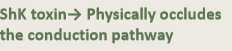
toxins in animals: voltage-gated K+ channels

toxins in animals: voltage-gated Ca2+ channels

poison dart frogs

blue ringed octopus & pufferfish

scorpion (Na)

tarantulas (Na)

green mambas

sea anemone
scorpions (K)

tarantulas (K)

black mambas

cone snails

scorpions (Ca)

funnel web spider

animal toxins table DONT MEMORISE

other function of channels
electrical signalling - APs
vesicular release - Ca-dependent exocytosis in neurons and glands
excitation-contraction coupling - Ca influx triggering muscle fibre contraction
intracellular coupling - direct and metabolic electrical continuity via connexons
epithelial transport - driving osmotic gradients for secretion and absorption
Q: the selectivity of the K+ channel for K+ over Na+ is explained by ____
precise substitution of K+’s hydration shell by carbonyl oxygens in the filter
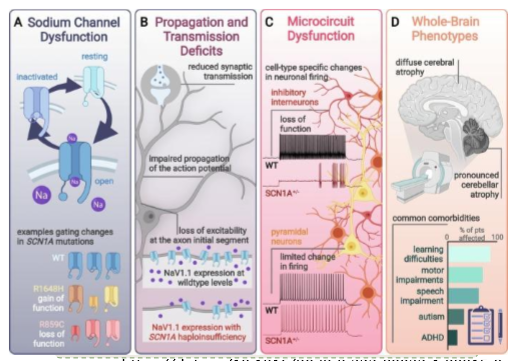
Dravet syndrome (epilepsy type)
SCN1A → Nav1.1, loss of function:
usually a de novo mutation, 80% Dravets cases
Nav1.1 sits in inhib interneurons:
fast-spiking PV cells depend on it to fire at high rates
lose it and inhibition fails first:
less Na+ current in the brake, not in the accelerator
seizures from a LOSS of excitability:
in the wrong cell, loss of function looks like gain of function
Dravet syndrome image
Nav1.7 - the volume knob for pain
SCN9A encodes Nav1.7
in nociceptors
loss of function: no pain at all
congenital insensitivity - otherwise normal sensation
gain of function: erythromelalgia
burning pain in the hands and feet, triggered by warmth
a major analgesic target right now, an on/off switch has already validated in humans
Nav1.7 image

the pump
primary active transport
the Na+/K+-ATPase exports 3 Na+ for every 2 K+ imported per ATP hydrolysed
electrogenic nature
it yields a net export of one positive charge per cycle, contrib to roughly -5 mV to the resting potential
gradient maintenance
primary physiological role is sustaining the massive concentration gradients required for signalling
up to 1/3 of a neuron’s ATP goes here, the resting potential is not free
the pump image

spending what the pump saved
the Na+/Ca2+ exchanger (NCX): imports 3 Na+ to export 1 Ca2+ against its massive gradient, without directly hydrolysing ATP
symporters (co-transporters): Glut reuptake rides the Na+ gradient to clear NTs from the syn cleft
primary transport: energy is derived directly from local ATP hydrolysis
secondary transport: energy is derived from the established Na+ electrochemical gradient - a delayed expernditure of the pump’s work
pumps image

channels signal, transporters maintain
classic proof of maintenance
Hodgkin and Keynes tracked radiolabelled Na+ efflux from the giant quid axon
metabolic dependence
efflux ceases when ATP is depleted or the pump is blocked, and resumes upon restoration
temporal disparity
channels conduct millions of ions per second, transporters cycle hundreds of times per second
functional dichotomy
channels transmit information, transporters restore the biophysical conditions required to transmit it
a neuron can fire a thousand times before the pump has restored what a single second of firing cost
channels signal, transporters maintain image

learning objectives