Nervous Tissue (pt.1)
 Call Kai
 Learn
 Practice Test
 Spaced Repetition
 Match
 Flashcards
 Knowt Play
1/52

There's no tags or description
Looks like no tags are added yet.
53 Terms
Neurons - Overview
form complex processing centers in the brain and spinal cord
connect all regions of the body to the brain and spinal cord
provide most functions of nervous system
most cannot undergo mitotic division
Neuroglia
outnumber neurons by ~25 times
support, nourish, protect neurons
maintain interstitial fluid
continue to undergo mitotic division
Neurons - Characteristics
electrical excitability
some neurons <1mm
some begin at brain and run all the way to the toes
Electrical Excitability
Neurons - Characteristics;
ability to respond to stimuli and convert it to an action potential/nerve impulse
Action potentials
Action potentials
Electrical excitability;
an electrical signal that propagates along the surface or the membrane of the neuron
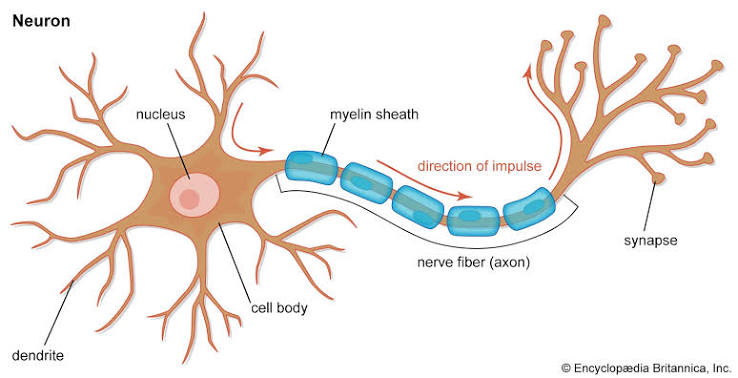
Neurons - Parts
Cell body
Dendrites
Axons

Cell body
Neuron - Parts;
also called “perikaryon” or “soma”
Nucleus
Cytoplasm
Typical cellular organelles
Nssl bodies
Neurofibrils
Microtubules
Somatic spines
Ganglion

Nissl bodies
Cell body;
free ribosomes and clusters of rough endoplasmic reticulum
sites of protein synthesis
Neurofibrils
Cell body;
provide shape and support
Microtubulues
Cell body;
move materials from cell bodies to axons
Somatic spines
Cell body;
small projections of plasma membrane which are receptor sites for chemical messengers from other neurons
Ganglion
Cell body;
collection of neuron cell bodies in the PNS
Dendrites
Neurons - Parts;
neuronal processes or extensions (nerve fibers)
typically multiple per neuron
receiving or input portion of neuron
usually short tapering and highly branches
Dendritic spines

Dendritic spines
Dendrites;
numerous receptor sites for chemical messengers from other neurons
Cytoplasm in neurons contain:
Nissl bodies
Mitochondria
other organelles
Axon
Neurons - Parts;
neurons have a single axon (or nerve fiber)
long, thin projection
Axon hillock, Initial segment, Trigger zone
Axoplasm, Axolemma, Axon collaterals, Axon terminals

Axon hillock
Axon;
cone-shaped junction of the cell body and axon

Initial segment
Axon;
most proximal part of the axon, distal to the axon hillock
Trigger zone
Axon;
junction of the axon hillock and initial segment where nerve impulses arise
Where do propagated nerve impulses go?
other neurons
Effector cells:
muscle fiber
gland cell
Axoplasm
Axon;
cytoplasm of axon
Contains:
mitochondria
microtubules
neurofibrils
no rough endoplasmic reticulum
no protein synthesis
Axolemma
Axon;
plasma membrane of axon
Axon collaterals
Axon;
branches off the axon typically at right angles
Axon terminals
Axon;
fine divisions of the axons and collaterals at the distal ends
Synpase
communication between two neurons or communication between a neuron and an effector cell
Synaptic end bulbs
Varicosities
Synaptic vesicles
Neurotransmitter
Synaptic end bulbs
Synapse;
swollen tips of some axon terminals
Varicosities
Synapse;
a string of swollen bumps of some axon terminals
Synaptic vesicles
Synapse;
membrane-enclosed sacs within synaptic end bulbs and varicosities that contain a neurotransmitter
Neurotransmatter
Synapse;
a molecule released from synaptic vesicles that excites or inhibits another neuron or effector cell
many neurons may have two or three types with different effects at NMJ
some bind receptors and act quickly opening/closing ion channels
some act slowly via second-messenger systems to influence chemical reactions at cell
exhibits excitation or inhibition of postsynaptic neurons or target cells
within brain = neurosecretory cells secrete hormones
Axon transport
materials synthesized or recycled in the cell body have to be transported into the axon
Slow axonal transport, Fast axonal transport
Slow axonal transport
Axon transport;
moves materials about 1-5mm per day
movement of axoplasm “down” the axon (in one direction)
Fast axonal transport
Axon transport;
moves material 200-400mm per day
uses proteins as motors to transport materials along the microtubules
transport in two directions away from the cell body and toward the cell body
Antegrade, Retrograde
Antegrade
Fast axonal transport;
organelles and synaptic vesicles
Retrograde
Fast axonal transport;
cellular material such as vesicles to be degraded or recycled, substances entering the axon, such as hormones, toxins, viruses
Structural Classification of Neurons
Multipolar
Bipolar
Pseudounipolar (Unipolar)
Multipolar neurons
Structural Classification of Neurons;
have several dendrites and one axon
most neurons of brain and spinal cord
all motor neurons

Bipolar neurons
Structural Classification of Neurons;
one main dendrite and one axon
Retina of the eye, inner ear, olfactory area of brain

Pseudounipolar neurons (Unipolar)
Structural Classification of Neurons;
dendrites and one axon refused together and emerge from the cell body
somatic sensory neurons
dendrites function as sensory receptors
trigger zone at the junction of dendrite and axon
cell bodies in ganglion

Functional Classification of Neurons
Sensory neurons (afferent)
Motor neurons (efferent)
Interneurons
Sensory neurons (afferent)
Functional Classification of Neurons;
contain sensory receptors at their distal end (dendrites) or are adjacent to separate cells that act as sensory receptors
stimuli activate sensory receptors
nerve impulse travels along the axon to the CNS
most are pseudounipolar (unipolar)
Motor neurons (efferent)
Functional Classification of Neurons;
carry nerve impulses away from CNS to effectors through cranial or spinal nerves
multipolar
Interneurons
Functional Classification of Neurons;
located within the CNS between sensory and motor neurons
process sensory information and elicit a motor response
most are multipolar
Gliomas
brain tumors derived from neuroglia
highly malignant and grow rapidly
Neuroglia - 6 types of cells
Found in CNS: astrocytes, oligodendrocytes, microglia, ependymal cells
Found in PNS: Schwann cells, satellite cells

Astrocytes - Characteristics
Neuroglia cell - found in CNS;
star-shaped
largest and most numerous
processes make contact with blood capillaries, neurons, and pia mater
Protoplasmic astrocytes, Fibrous astrocytes

Protoplasmic astrocytes
Astrocytes;
many short branching processes
found in grey mater
Fibrous astrocytes
Astrocytes;
many long unbranched processes
found in white mater
Astrocytes - Functions
contain microfilaments and support neurons
wrap around blood capillaries of CNS = “blood-brain barrier”
selectively permeable, protect CNS from toxic substances
in embryos = regulate growth, migration, and interconnection of brain neurons
maintain appropriate chemical environment for generation of nerve impulses
influence neural synapses playing a role in learning and memory
Oligodendrocytes
Neuroglia cell - found in CNS;
processes from myelin sheath around CNS axons
one oligodendrocyte may myelinate multiple axons

Microglial cells (microgliacytes)
Neuroglia cell - found in CNS;
function as phagocytes
remove cellular debris, microbes, damaged nervous tissue

Ependymal cells
Neuroglia cell - found in CNS;
cuboid to columnar cells possessing microvilli and cilia
arranged in single layer
line ventricles of brain and central canal of spinal cord
help produce cerebrospinal fluid
form the “blood-cerebrospinal fluid barrier”

Schwann cells
Neuroglia cell - found in PNS;
form myelin sheath around axons in the PNS
one cell myelinates a single axon
one cell may surround many nonmyelinated axons
participate in axon regeneration

Satellite cells
Neuroglia cell - found in PNS;
surround cell bodies of neurons of PNS ganglia
provide structural support
regulate exchange of material between neuron cell bodies and interstitial fluid
