BIOL 2420 Exam #2 Study Guide: Key Terms & Definitions
 Call Kai
 Learn
Learn Practice Test
 Spaced Repetition
 Match
Match Flashcards
 Knowt Play
1/216

There's no tags or description
Looks like no tags are added yet.
Name | Mastery | Learn | Test | Matching | Spaced | Call with Kai | Chat |
|---|
No analytics yet
Send a link to your students to track their progress
217 Terms
Of the microbes classified as aerotolerant anaerobes, facultative anaerobes, microaerophiles, obligate aerobes, and obligate anaerobes, which would be harmed by a high concentration of oxygen in their environment?
A. Obligate anaerobes only
B. Microaerophiles only
C. Facultative anaerobes and microaerophiles
D. Microaerophiles and obligate anaerobes
Microaerophiles and obligate anaerobes
Correct! Microaerophiles and obligate anaerobes cannot grow in a high concentration of oxygen.
Microaerophiles require a small amount of oxygen and cannot grow in the complete absence of oxygen; however, since they do not have enzymes that would render toxic forms of oxygen harmless, they cannot grow in a high concentration of oxygen. Obligate anaerobes require the absence of oxygen. If you had difficulty answering this question, refer to the section Nutrients: Chemical and Energy Requirements in Chapter 6 (Learning Outcomes 6.3 and 6.4).
Consider a mesophilic bacterium. What would happen if this bacterium were exposed to a temperature much higher or lower than its optimal temperature?
A. It would stop growing and possibly be killed.
B. Lower temperatures would speed up growth, higher temperatures would slow down growth.
C. There would be little or no effect on bacterial growth.
D. Higher temperatures would speed up growth, lower temperatures would slow down growth.
It would stop growing and possibly be killed.
Correct! Temperatures far outside a bacterium's optimal temperature range are detrimental to growth.
Organisms grow in a range of temperatures. At temperatures outside of this range the organisms' enzymes no longer function properly. Higher temperatures are usually more detrimental to an organism's ability to survive. In Chapter 6 you learned about physical and chemical requirements for microbial growth. In this chapter you will learn how this knowledge helps us manipulate environments to limit microbial growth. If you had difficulty answering this question, refer to the section Physical Requirements in Chapter 6 (Learning Outcome 6.6).
Some microbes are halophiles and can withstand a high concentration of salt in their environment. What happens to nonhalophiles under such a condition?
A. Salt enters the cell.
B. Salt leaves the cell.
C. Water leaves the cell.
D. Water enters the cell.
Water leaves the cell.
Correct! Through osmosis, water moves from a lower solute concentration to a higher solute concentration, in this case from inside the cell to outside.
Why do endospores form?
A. Endospores form to anchor bacteria to surfaces and prevent them from drying out.
B. Endospores develop during the log phase of microbial growth to help bacteria use nutrients in their medium.
C. Endospores form as a reproduction strategy for fungi, algae, and actinobacteria.
D. Endospores form as a defense strategy against inhospitable conditions.
Endospores form as a defense strategy against inhospitable conditions.
Correct! Endospores are the most resistant bacterial cells; in fact, endospores of Bacillus and Clostridium are the most resilient forms of life.
What term describes a procedure that destroys all microbes?
A. Sanitization
B. Pasteurization
C.Disinfection
D. Sterilization
Sterilization
Sterilization refers to the removal or destruction of all microbes, including viruses and bacterial endospores, in or on an object.
What microbial structures are the most resilient forms of life?
A. Fungal spores
B. Gram-positive bacteria
C. Bacterial endospores
D. Enveloped viruses
Bacterial endospores
Endospores are the most resilient forms of life. Due to their tough outer spore coat, they can survive environmental extremes of temperature, acidity, and dryness and can withstand many chemical disinfectants.
Press enter after select an option to check the answer
Enveloped viruses
What is the most likely biosafety level of your introductory microbiology lab classroom?
A. BSL - 4
B. BSL - 2
C. BSL - 1
D .BSL - 3
BSL - 1
Your classroom laboratory is quite likely a BSL-1 facility. These labs handle microbes not known to cause disease in healthy humans.
What is the decimal reduction time of this heat treatment against this organism? What is the thermal death time?
D=5 minutes
thermal death time=22.5 minutes.

Ultra-high-temperature pasteurization of milk requires a temperature of 134°C; what pressure must be applied to the milk to achieve this temperature?
29 psi.

What are the moist heat temperatures for milk?

What are the smallest pore size that blocks viruses?

Methods of Microbial Control

Which heat-related method of microbial control most effectively destroys bacterial endospores?
A. Boiling
B. Pasteurization
C. Autoclaving
D. Dry heat
Autoclaving
Autoclaving can practically sterilize, destroying even bacterial endospores.
Can't be used on high tech medical equipment with cameras, such as colonoscopy.
Which drying method of microbial control can also be used to preserve microbial cultures?
A. Lyophilization
B. Desiccation
C. Filtration
D. Dry heat
Lyophilization
After lyophilization, or freeze-drying, enough microbial cells may remain viable to enable cultures to be reconstituted many years after they were dried.
When might a researcher more likely use filtration as a sterilization method?
A.When she wishes to separate Gram-positive from Gram-negative bacteria.
B. When she is working with heat-sensitive materials.
C. When she is working in the food industry.
D. When she is working with protozoa.
When she is working with heat-sensitive materials.
When heat is not an option, filtration is an effective method of sterilization
Which form of radiation is most likely to control microbes in a barbershop or hair salon?
A. X-rays
B. Ultraviolet
C. Gamma rays
D. Electron Beams
Ultraviolet
Ultraviolet or UV radiation does not penetrate well, but effectively treats surfaces of objects such as barber's shears. This form of radiation is also effective in treating thin layers of transparent fluids such as water.
Which halogen is commonly used to degerm surgical sites?
A.Bromine
B. Iodine
C. Sodium hypochlorite
D. Chlorine dioxide
Iodine
Betadine (an iodophore) is commonly used as an antiseptic to degerm surgical sites in preparation for surgery.
Which oxidizing agent is sometimes used to treat drinking water?
A. Ozone
B. Peracetic acid
C. Surfactants
D. Hydrogen peroxide
Ozone
Some Canadian and European municipalities treat their drinking water with ozone rather than chlorine. It is an expensive control method.
How do aldehydes denature proteins to control microbes?
A. They irritate mucous membranes.
B. They reduce surface tension of solvents.
C. They cross-link organic functional groups.
D. They combine with sulfur atoms in molecules of cysteine.
They cross-link organic functional groups
Aldehydes cross-link organic functional groups like amino, hydroxyl, sulfhydryl, and carboxyl, which denatures proteins and inactivates nucleic acids.
Chemical Methods of Control
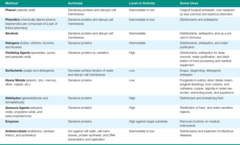
Which enzyme is used to reduce the number of bacteria in some cheeses and wine?
A. Protease
B. Prionzyme
C. Lysozyme
D. Cofactor
Lysozyme
Lysozyme is used by some food processors to reduce bacteria in wine and cheese. It is also naturally present in tears to protect the eyes.
Technically speaking, which antimicrobial drugs are produced naturally?
A. Antibiotics
B.Synthetics
C. Semisynthetics
D. Biofilms
Antibiotics
Technically, antibiotics are produced naturally. For example, a mold in the fungal genus Penicillium produces penicillin.
Which method would be most accurate for evaluating disinfectants or antiseptics by an American industrialist for any specific situation?
A. Kelsey-Sykes capacity test
B. Phenol coefficient
C. Use-dilution test
D. In-use test
In-use test
Compared to other evaluation methods, the in-use test provides a more accurate determination of the strength and proper application procedure of a given disinfection agent for each specific situation.
Many chemical disinfectants and antiseptics act by denaturing proteins. Why does denaturation kill cells?
Denaturing proteins changes the shape which kills cells because they are not able to carry out protein synthesis
In practical terms in everyday use, which of the following statements provides the definition of sterilization?
A. Sterilization eliminates all organisms and viruses.
B .Sterilization eliminates harmful microorganisms and viruses.
C. Sterilization eliminates prions.
D. Sterilization eliminates hyperthermophiles.
A. Sterilization eliminates all organisms and viruses.
Which of the following substances or processes kills microorganisms on laboratory surfaces?
A. antiseptics
B. disinfectants
C. degermers
D. pasteurization
B. disinfectants
Which of the following terms best describes the disinfecting of cafeteria plates?
A. pasteurization
B. antisepsis
C. sterilization
D. sanitization
D. sanitization

The microbial death rate is used to measure the effectiveness of _____.
A. a detergent
B. an antiseptic
C. sanitization techniques
D. all of the above
D. all of the above
Which of the following statements is true concerning the selection of an antimicrobial agent?
A. An ideal antimicrobial agent is stable during storage.
B. An ideal antimicrobial agent is fast acting.
C. Ideal microbial agents do not exist.
D. All of the above are correct.
D. All of the above are correct.
The endospores of which organism can be used as a biological indicator of sterilization? Why?
A. Bacillus stearothermophilus
B. Salmonella enterica
C. Mycobacterium tuberculosis
D. Staphylococcus aureus
A. Bacillus stearothermophilus
A company that manufactures an antimicrobial cleaner for kitchen counters claims that its product is effective when used in a 50% water solution. By what means might scientists best verify this statement?
A. disk-diffusion test
B. phenol coefficient
C. filter paper test
D. in-use test
D. in-use test
Which of the following items functions most like an autoclave?
A. boiling pan
B. incinerator
C. microwave oven
D. pressure cooker
D. pressure cooker
The preservation of beef jerky from microbial growth relies on which method of microbial control?
A. filtration
B. lyophilization
C. desiccation
D. radiation
C. desiccation
Which of the following types of radiation is more widely used as an antimicrobial technique?
A. electron beams
B. visible light waves
C. radio waves
D. microwaves
A. electron beams
Which of the following substances would most effectively inhibit anaerobes?
A. phenol
B. silver
C. ethanol
D. hydrogen peroxide
D. hydrogen peroxide
Which of the following adjectives best describes a surgical procedure that is free of microbial contaminants?
A. disinfected
B. sanitized
C. degermed
D. aseptic
D. aseptic
Biosafety Level 3 includes __________________.
A. double sets of entry doors
B. pressurized suits
C. showers in entryways
D. all of the above
A. double sets of entry doors
A sample of E. coli has been subjected to heat for a specified time, and 90% of the cells have been destroyed. Which of the following terms best describes this event?
A. thermal death point
B. thermal death time
C. decimal reduction time
D. none of the above
C. decimal reduction time
Which of the following substances is least toxic to humans?
A. carbolic acid
B. glutaraldehyde
C. hydrogen peroxide
D. formalin
C. hydrogen peroxide
Which of the following chemicals is active against bacterial endospores?
A. copper ions
B. ethylene oxide
C. ethanol
D. triclosan
B. ethylene oxide
Which of the following disinfectants acts against cell membranes?
A. phenol
B. peracetic acid
C. silver nitrate
D. glutaraldehyde
A. phenol
Which of the following disinfectants contains alcohol?
A. iodophor
B. quat
C. formalin
D. tincture of bromine
D. tincture of bromine
Which antimicrobial chemical has been used to sterilize spacecraft?
A. phenol
B. alcohol
C. heavy metal
D. ethylene oxide
D. ethylene oxide
Which class of surfactant is most soluble in water?
A. quaternary ammonium compounds
B. alcohols
C. soaps
D. peracetic acids
A. quaternary ammonium compounds
Deoxyribonucleic acid (DNA) is the genetic material in cells. Which of the following nucleotide bases are found in DNA: adenine (A), cytosine (C), guanine (G), thymine (T), or uracil (U)?
A. C, G, T, and U.
B. A, C, G, and T.
C. A, C, G, and U.
D. A, G, T, and U.
A, C, G, and T.
DNA is a polymer consisting of strands of nucleotides with the bases adenine, cytosine, guanine, and thymine. The basic structure of RNA is similar, but the monomers have a different sugar (ribose, instead of deoxyribose in DNA), and instead of thymine, RNA has uracil.
DNA is a double-stranded molecule, with the two strands running in opposite directions. Hydrogen bonds between nucleotides on opposite strands hold the two strands together. If there is a cytosine nucleotide on one strand of the DNA molecule, which nucleotide is found opposite the cytosine?
A. Adenine.
B. Cytosine.
C. Guanine.
D. Thymine.
Guanine
Cytosine pairs with guanine, and adenine with thymine. Three hydrogen bonds form between cytosine and guanine bases and two between adenine and thymine bases.
Which of the following bacterial structures transfers DNA horizontally by conjugation: cell wall, flagellum, glycocalyx, or pilus?
A. A flagellum
B. The cell wall
C. The glycocalyx
D. A pilus
A pilus
A bacterial pilus transfers DNA horizontally, from one bacterium to another. If you had difficulty answering this question, refer to the section Fimbriae and Pili in Chapter 3 (Learning Outcome 3.7)
In this chapter you will learn about the biochemical reactions that synthesize DNA, RNA, and proteins in cells. Are these reactions anabolic or catabolic, and do they require energy or do they produce energy?
A. They are catabolic reactions and produce energy.
B. They are anabolic reactions and require energy.
C. They are catabolic reactions and require energy input.
D. They are anabolic reactions and produce energy.
They are anabolic reactions and require energy.
DNA, RNA, and proteins are polymers that are synthesized by adding monomers together, which means they are anabolic reactions. Anabolic reactions require energy input.
Anabolic reactions are energy-requiring reactions in which larger molecules are made from smaller molecules and atoms. DNA, RNA, and proteins are large polymers synthesized by adding smaller monomers together, so they are anabolic reactions that require energy. If you had difficulty with this question, refer to the section Catabolism and Anabolism in Chapter 5 (Learning Outcome 5.1).
Do cells need to replicate their genomes and synthesize proteins continuously throughout their lives, or only just before cell division?
A. Protein synthesis occurs just before cell division, while the genome is replicated throughout the life of a cell.
B. The genome is replicated just before cell division, but proteins are synthesized continuously.
C. Both genome replication and protein synthesis occur only just before cell division.
Both genome replication and protein synthesis occur continuously throughout the life of a cell.
The genome is replicated just before cell division, but proteins are synthesized continuously.
Correct! Genome replication is necessary before cell division to ensure that both daughter cells receive a copy of the genome. Protein synthesis is required throughout the life of the cell.
Genome replication is necessary before cell division to ensure that both daughter cells receive a copy of the genome. Protein synthesis is required throughout the life of the cell since proteins are necessary for uptake of nutrients, excretion of waste products, metabolic reactions, synthesis of cellular structures, and motility. If you have difficulty answering this question, refer to the sections Binary Fission (Learning Outcome 6.14) and Phases of Microbial Population Growth (Learning Outcome 6.18) in Chapter 6.
What structures do DNA nucleotides and RNA nucleotides have in common?
DNA and RNA nucleotides are each composed of a pentose sugar, a phosphate, and a nitrogenous base.

Eukaryotic nuclear chromosomal packaging.

Characteristics of Microbial Genomes

Many bacteria have additional small molecules of DNA in addition to their main genome. What are these small molecules called?
A. Plasmids
B. Linear chromosomes
C. Multiple chromosomes
D. Circular chromosomes
Plasmids
Plasmids are small, usually circular, segments of DNA about 1-20% the size of a chromosome.
What type of cells "package" DNA with proteins called histones?
A. Prokaryotes: both bacteria and archaea
B. Eukaryotes and archaea
C. Eukaryotes only
D. Bacteria
Eukaryotes and archaea
What is the difference between dGTP and guanosine triphosphate ribonucleotide (rGTP)?
This molecule (dGTP) contains deoxyribose; rGTP contains ribose
Why is DNA replication termed "semiconservative"?
Semiconservative" refers to the fact that each of the daughter molecules retains one parental strand and has one new strand; in other words, each is half new and half old.
How does a cell ensure accurate DNA replication?
A. Complementary nucleotides "proofread" one another.
B. Because each nucleotide should only pair up with a complementary nucleotide on the opposite strand, incorrect nucleotides usually are not inserted in a growing strand—but if they are, DNA polymerase III removes the incorrect nucleotide with its proofreading function.
C. When a DNA molecule is "unzipped" by DNA helicase, complementary nucleotides ensure that the separated strands do not rejoin during replication.
D. Complementary nucleotides join Okazaki fragments together to form a continuous DNA strand.
Because each nucleotide should only pair up with a complementary nucleotide on the opposite strand, incorrect nucleotides usually are not inserted in a growing strand—but if they are, DNA polymerase III removes the incorrect nucleotide with its proofreading function.
Which enzyme is responsible for replacing RNA primers on newly synthesized DNA strands and is needed much more frequently on the lagging strand than on the leading strand?
DNA polymerase III
DNA polymerase I
Helicase
Primase
DNA polymerase I
Correct! DNA polymerase I replaces RNA nucleotides with DNA nucleotides, which is needed not only at the origins of replication on both strands but also at the beginning of each Okazaki fragment of the lagging strand.
During DNA synthesis, what enzyme works more or less alone to synthesize the leading strand?
A. Helicase
B. DNA polymerase I
C. DNA polymerase III
D. DNA ligase
DNA polymerase III
The main enzyme involved in producing the leading strand is DNA polymerase III
What is the difference between a promoter sequence and an origin?
A promoter is a DNA sequence that initiates transcription; an origin is a point where DNA replication begins.
Which step in the pathway from DNA to polypeptides produces mRNA?
A. Translation
B. Central dogma
C. Transcription
D. Mutation
Transcription
During transcription, DNA information is converted into messenger RNA (mRNA)
Where does transcription occur in prokaryotes?
A. Nucleus
B. Ribosome
C. Nucleolus
D. Cytoplasm
Cytoplasm
Transcription occurs in the cytoplasm in prokaryotes.
Comparison of Genetic Processes

What is the term for three RNA nucleotides that code for a specific amino acid during polypeptide synthesis?
A. UAG
B. Amino acids
C. Codon
D. Triplet
Codon
Messenger RNA is read in groups of three nucleotides, known as codons.
Which codon is considered the "start codon" and codes for methionine (in eukaryotes) and N-formylmethionine (in prokaryotes, mitochondria, and chloroplasts)?
A. UGA
B. AUG
C. UAG
D. UAA
AUG
AUG serves as a start codon and codes for methionine (or N-formylmethionine).
Which molecules carry new amino acids to the location where they are assembled into polypeptides?
A. Messenger RNAs
B. Ribosomes
C. Transfer RNAs
D. A sites
Transfer RNAs
Transfer RNA (tRNA) serves as a delivery vehicle, carrying amino acids to the ribosome.
Basic Roles of Operons in Regulating Transcription

What kind of gene sequence is typically active and producing proteins but can be shut down?
A. An operon
B. An inducible operon
C. A repressible operon
D. An operator
A repressible operon
Repressible operons are usually active, but may be deactivated with a molecule known as a repressor.
The Types of Point Mutations and Their Effects

What kind of mutation is characterized by having no effect on the final protein?
A. Missense mutation
B. Frameshift mutation
C. Silent mutation
D. Nonsense mutation
Silent mutation
Silent mutations involve a change in the original genetic code that does not change the final amino acid sequence.
What is the effect of ultraviolet light on DNA?
A. Frameshift insertion
B. Formation of pyrimidine dimers
C. Insertion of 5′-bromouracil
D. Frameshift deletion
Formation of pyrimidine dimers
When exposed to nonionizing radiation, adjacent pyrimidine bases (such as thymine) bond covalently to each other, distorting the sugar-phosphate backbone and interrupting DNA replication and transcription.
Is a cell more likely to pass on a harmful or a beneficial mutation to its descendants?
A. Beneficial
B. Both harmful and beneficial mutations are passed on at the same rate.
C. Harmful
D. Neither. Mutations aren't passed on to descendants.
Beneficial
Beneficial mutations allow the cell to survive and reproduce, which passes the mutation to its descendants.
What is the rate of mutation induced by the mutagen in (b)?
5−1
----- × 100%=400%
1
Rate of mutation can be calculated as follows:

A researcher testing for an antibiotic resistance mutation places a culture on a plate containing the antibiotic. What type of selection technique is she most likely using?
A. Point mutation
B. Positive selection
C. Negative selection
D. Ames test
Positive selection
In positive selection, only mutants that are resistant to the antibiotic can survive on media containing the antibiotic.
What is the normal function of ligase (during DNA replication)?
Ligase functions to anneal Okazaki fragments during replication of the lagging strand.
What is genetic recombination?
A. The formation of hydrogen bonds between complementary nucleotides.
B. The exchange of nucleotide sequences between two DNA molecules.
C. The introduction of DNA into a cell through horizontal transfer.
D. The transfer of DNA from one cell to another through a pilus.
The exchange of nucleotide sequences between two DNA molecules.
Genetic recombination involves the exchange of nucleotide sequences between two DNA molecules with stretches of identical or nearly identical sequences.
Natural Mechanisms of Horizontal Genetic Transfer in Bacteria

What kind of gene transfer between bacterial cells in the same generation utilizes the help of a virus?
A. Horizontal transfer
B. Transduction
C. Transformation
D. Conjugation
Transduction
Viruses known as bacteriophages can transfer segments of DNA between individual bacterial cells.
How does transposition differ from other recombination events?
A. It occurs more often than other recombination events.
B. It does not need a region of homology.
C. It occurs only in eukaryotic cells.
D. It occurs in RNA, not DNA
It does not need a region of homology.
Transposons, or jumping genes, are capable of inserting a segment of DNA at any point within a chromosome or plasmid.
Which of the following is most likely the number of base pairs in a bacterial chromosome?
4,000,000
4000
400
40
4,000,000
Which of the following is a true statement concerning prokaryotic chromosomes?
They typically have two or three origins of replication.
They contain single-stranded DNA.
They are located in the cytosol.
They are associated in linear pairs.
They are located in the cytosol.
A plasmid is ________.
a molecule of RNA found in bacterial cells
distinguished from a chromosome by being circular
a structure in bacterial cells formed from plasma membrane
extrachromosomal DNA
extrachromosomal DNA
Which of the following forms ionic bonds with eukaryotic DNA and stabilizes it?
chromatin
bacteriocin
histone
nucleoid
histone
Nucleotides used in the replication of DNA .
carry energy
are found in four forms, each with a deoxyribose sugar, a phosphate, and a base
are present in cells as triphosphate nucleotides
All of the above are correct.
All of the above are correct.
Which of the following molecules functions as a "proofreader" for a newly replicated strand of DNA?
DNA polymerase III
primase
helicase
ligase
DNA polymerase III
The addition of —CH3 to a cytosine nucleotide after DNA replication is called .
methylation
restriction
transcription
transversion
methylation
In translation, the site through which tRNA molecules leave a ribosome is called the .
A site
X site
P site
E site
E site
The Ames test .
uses auxotrophs and liver extract to reveal mutagens
is time intensive and costly
involves the isolation of a mutant by eliminating wild-type phenotypes with specific media
proves that suspected chemicals are carcinogenic
uses auxotrophs and liver extract to reveal mutagens
Which of the following methods of DNA repair involves enzymes that recognize and correct nucleotide errors in unmethylated strands of DNA?
light repair of T dimers
dark repair of P dimers
mismatch repair
SOS response
mismatch repair
Which of the following is not a mechanism of genetic transfer between cells?
transduction
transformation
transcription
conjugation
transcription
Cells that have the ability to take up DNA from their environment are said to be .
Hfr cells
transposing
genomic
competent
competent
Which of the following statements is true?
Conjugation requires a sex pilus extending from the surface of a cell.
Conjugation involves a C factor.
Conjugation is an artificial genetic engineering technique.
Conjugation involves DNA that has been released into the environment.
Conjugation requires a sex pilus extending from the surface of a cell.
Which of the following are called "jumping genes"?
Hfr cells
transducing phages
palindromic sequences
transposons
transposons
Although two cells are totally unrelated, one cell receives DNA from the other cell and incorporates this new DNA into its chromosome. This process is .
crossing over of DNA from the two cells
vertical gene transfer
horizontal gene transfer
transposition
horizontal gene transfer
Transcription produces .
DNA molecules
RNA molecules
polypeptides
palindromes
RNA molecules
A nucleotide is made of .
a five-carbon sugar
phosphate
a nitrogenous base
all of the above
all of the above
In DNA, adenine forms hydrogen bonds with .
three / uracil
two / uracil
two / thymine
three / thymine
two / thymine
A sequence of nucleotides formed during replication of the lagging DNA strand is a(n) .
palindrome
Okazaki fragment
coding strand
operon
Okazaki fragment
Which of the following is not part of an operon?
operator
promoter
origin
gene
origin