Biol 304 Discussion 10
 Call Kai
 Learn
 Practice Test
 Spaced Repetition
 Match
 Flashcards
 Knowt Play
1/43

There's no tags or description
Looks like no tags are added yet.
44 Terms
What is the difference between attached ribosomes and free ribosomes?
Free ribosomes make proteins that will stay inside the cell
Attached ribosomes make proteins that will leave the cell or be used in the cell membrane
What is the function of a ribosome?
To synthesize proteins
Do all organisms have ribosomal RNA (rRNA)?
Yes
What are the different "sites" on ribosome?
E, P, A
What is the difference between peptidyl-tRNA and amino-tRNA?
amino-tRNA has one amino acid on them
peptidyl-tRNA has multiple amino acids
What are the ends of the polypeptide called?
N-term and C-term
What are the different start codons that are recognized?
AUG UUG GUG
What amino acid do start codons encode?
Met
What are the different tRNAs that carry methionine?
tRNAf, tRNAi, tRNAm
Why would eIFs bind both the 5' cap and the PABP in eukaryotes?
It creates a loop for efficiency
What does RF stand for?
Release Factor: involved in termination of translation
Why are there different release factors such as RF1 and RF2?
What does RF3 do?**
What does RRF do?**
RF1: UAA UAG
RF2: UAA UGA
RF3: catalyzes the release of the peptide chain out
RRF: Ribosome Recycling Factor
If one is referring to a codon, what molecule is he or she referring to?
mRNA
If one is referring to an anticodon, what molecule is he or she referring to?
tRNA
Why do we say that the genetic code is nearly universal? What are examples of deviations? How do they arise?
Almost all organisms use the same aa or code
Examples are some lower organisms, like Ciliates using the UAG and UAA codons for glutamine instead of a STOP.
Mutations
Which factors bind the "A" site?
initiation: IF1
elongation: EF-Tu / aa-tRNA / GTP
termination: RF1/RF2, RF3, and RRF
In the given DNA template strand, the bold characters indicate the sequence that will be expressed. What would be the corresponding DNA message strand, mRNA, and protein in prokaryotes?
3'-CGGAT TACCGATGCATTGA TGAAAAA-5' template DNA
DNA message: 5' ATGGCTACGTAACT 3'
mRNA: 5' AUGGCUACGUAACU 3'
proteins: N-f-Met-Alanine-Threonine-C
When given the following DNA message sequence, what would be the corresponding DNA template strand, mRNA codon, tRNA anticodon, and amino acid?
5'-GTG-3' DNA message
DNA template: 3' CAC 5'
codon: 5' GUG 3'
anticodon: 3' CAC 5' (OR 3’-CAU-5’ DUE TO WOBBLE EFFECT)
amino acids: valine
When given the following tRNA anticodon, what would be the sequence of the corresponding DNA message and template strands, mRNA codon, and amino acid?
3'-AUU-5' Anticodon
DNA message: 5' TAA 3'
DNA template: 3' ATT 5'
codon: 5' UAA 3'
amino acid: STOP
A retrovirus infects a eukaryotic cell. It injects a (+) strand RNA. This virus has an IRES site and it does not require a cap for initiation. The bold region represents the (+) strand RNA of the virus. Find the (+) and (-) DNA strands, the mRNA that is transcribed, and the protein sequence.
5'-R-U5-GU GAUGACAUGCGGAAAACGUACAUAGCGU AU-U3-R-3'
Question 24
Question 25
How many codons are there? Why? How many of these encode amino acids?
64, because it's 4^3 (4 possible codons for 3 different positions). 61 code for amino acids (the other 3 are STOP codons)
Which amino acids have only one codon?
methionine and tryptophan
Which amino acids have six codons?
leucine, serine, arginine
What does third base degeneracy mean? What is the third base referring to? Which base might be irrelevant in the anticodon?
3rd base is sometimes irrelevant
the last position, 3’ on the mRNA codon
1st base (in the 5’ to 3’ direction)
What is the wobble effect? Can binding occur if the third base of the codon is G and the first of the anticodon is U? Can binding occur if the third base of the codon is U and the first of the anticodon is G? Can binding occur if the first base of the codon is G and the third base of the anticodon is U?
Wobble effect is when one tRNA can recognize many codons (even w/ incorrect paiting)
Yes.
Yes.
No.
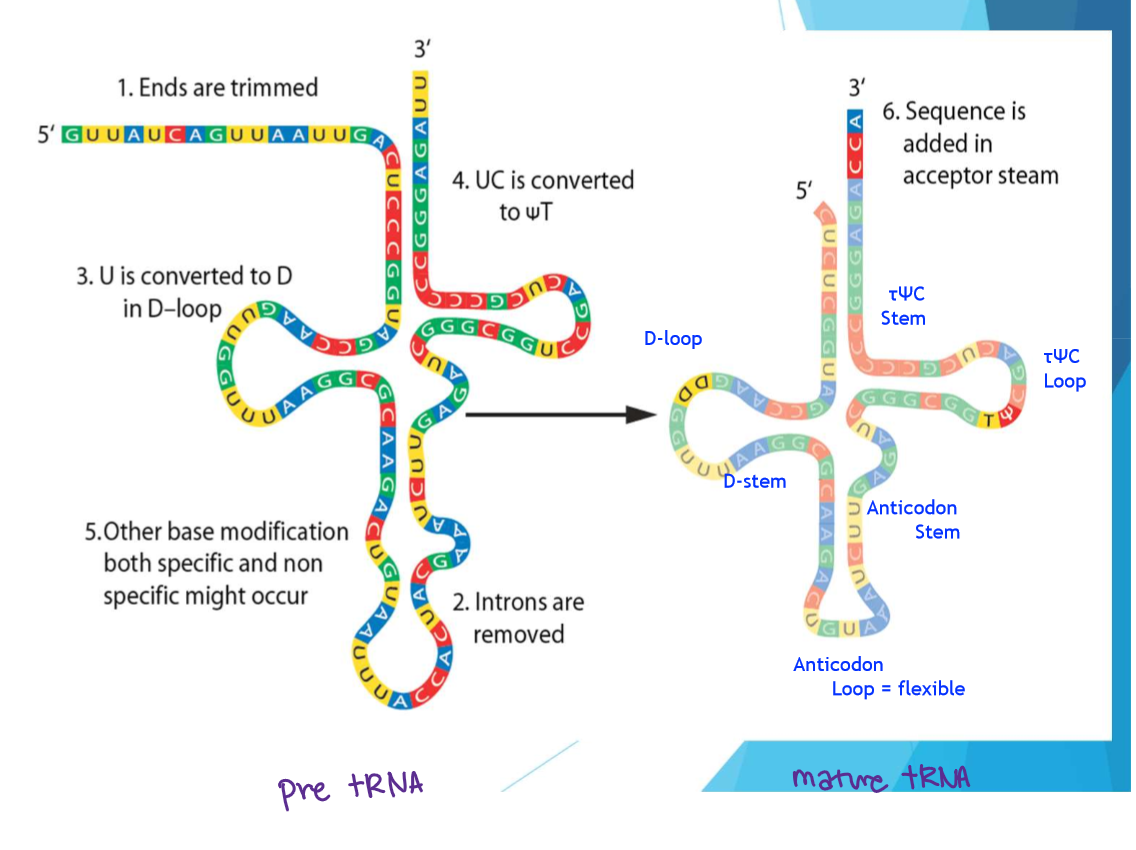
What post-transcriptional modifications happen to mRNA? What post-transcriptional modifications happen to tRNA?
mRNA: poly(A) tail, 5' G-cap, intron splicing
tRNA: ends are trimmed, introns removed, D-loop forms by turning U into D, adding CCA. base modifications: (ψ: pseudouridine D: dihydrouridine) SPECIAL NUCLEOTIDES!
Which RNA polymerase transcribes tRNA?
RNA pol III
What is the loop and stem of tRNA collectively called?
Arms
To which end of the tRNA is the amino acid attached?
3' CCA (sequence of acceptor site on tRNA)
Which functional group of an amino acid is attached to tRNA?
carboxyl group
What does ψ and D stand for?
ψ: pseudouridine
D: dihydrouridine
Why can "wobble" occur?
the loop in tRNA allows for flexibility
Translation
what is it?
stages?
protein synthesis RNA (nt) → protein (aa)
initiation (highly regulated), elongation, termination
Prokaryotic Stages of Translation: Initiation
pg 137
IF-3 binds to 30s to stabilize subunit
1F-2 and IF-1 are recruied
- IF-1 binds to A to prevent charged t-RNAs from entering the site
- IF-2 recruits 1st charged tRNA (f-met) into the P site
> process is GTP dependent and binding of f-met causes the releases of GDP
> NOTE: first aa binds to the p site and any other aa following will bind to the A siteIF-1 and IF-3 leave and 50s subunit joins 30 subunit (when connected creates the 70S initiation complex)

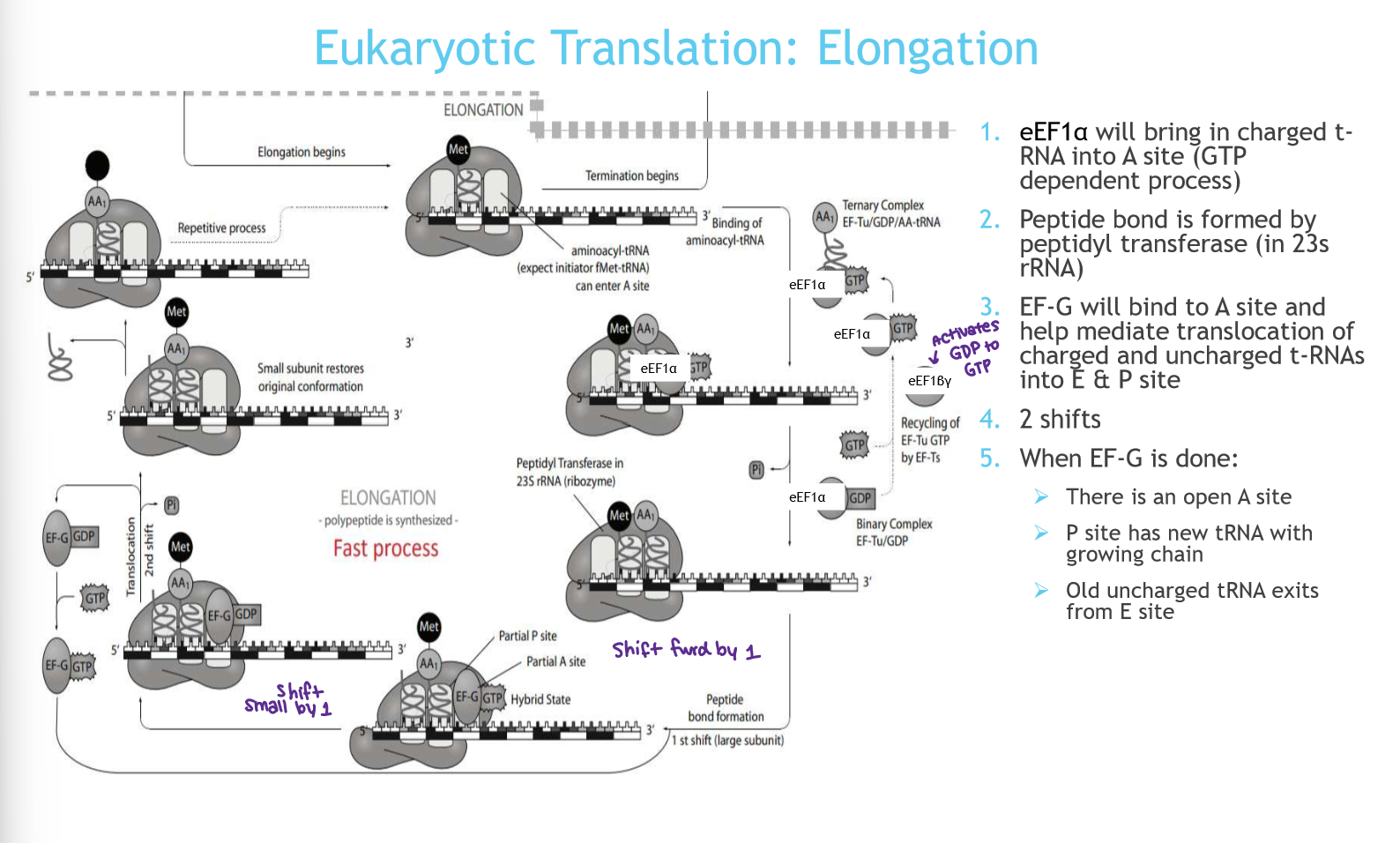
Prokaryotic / Eukaryotic Stages of Translation: Elongation
pg 137
EF-Tu / eEF1alpha will bring in charged t-RNA into A site (GTP dependent process)
Peptide bond is formed by Peptidyl transferase (in the 23S rRNA)
EF-G will bind to the A site and help mediate translocation of charged and uncharged t-RNAs into E & P site
2 shifts
When EF-G is done
- there is an open A site
- P site has a new tRNA with growing chainOld uncharged tRNA exists from E site

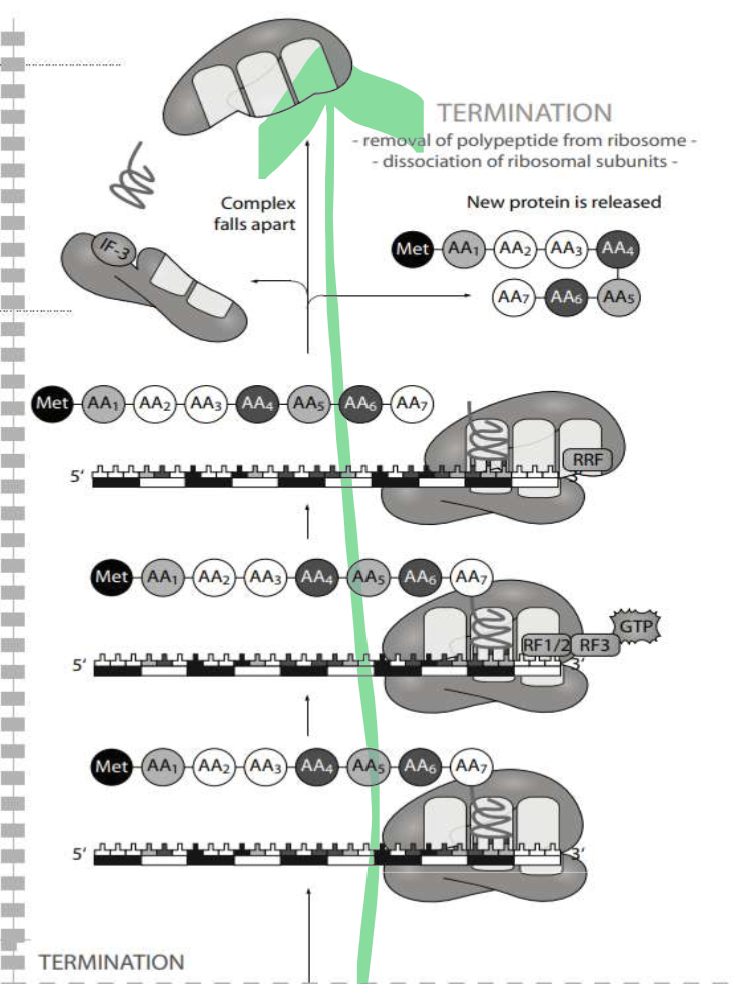
Prokaryotic/Eukaryotic Stages of Translation: Termination***!
pg 137
Ribosome will hit a stop codon (no tRNA for STOPs)
RF1 and RF2 will recognize stop codon
RF3 will bind and cause the release of the polypeptide chain
RRF will bind and cause a dissociation of large and small subunit
in eukaryotes the tRNA uses the exist site
Eukaryotic Initiation
What complex is involved? What are its components? What are they bound to?
43S pre-initiation complex
eIF1, eIF1a, eIF2, eIF3, Met-tRNAi
eIF2 bound to Met-tRNAi
Eukaryotic Initiation Steps
why circularize?
Cap binding complex
mRNA, eIF4A, B, E, and G
43S binds to 5’ end of mRNA
48S complex forms at initiation codon
eIF2, eIF3, eIF1, eIF1A, eIF4A, eIF4B, and eIF4
scans the 5’ for the first AUG in context
context: —NNPuNNAUGG
Why circularize?
to increase efficiency of reinitiation of ribosome

translation comparison prok vs euk
pg 136
tRNA Structure
carries aa into ribosomes
stem-loop regions of dsRNA (arms) that form 3D upside L-shaped tRNA

post translational modifications to pre-tRNA
introns removed
5’ end trimmed
3’ end added with 5’-CCA-3’
base modifications
wobble effect is what? show table of codon anticodon binding
binding between 3’ (3rd pos) of codon and 5’ (1st pos) of anticodon do not always follow standard base pairing rules
basically,
if 5’ anticodon is G or U, it can pair with 3’ codon U, or G and vice versa
