Bioinformatics Exam 2 review
 Call Kai
 Learn
 Practice Test
 Spaced Repetition
 Match
 Flashcards
 Knowt Play
1/68

There's no tags or description
Looks like no tags are added yet.
69 Terms
Read mapping can be
time-consuming
Mapping hundreds of millions of reads back to the reference genome is
CPU and RAM intensive and slow
Most mappers allow
~2 mismatches (for read mapping) within first 30bp (428 could still uniquely identify most 30bp sequences in a 3GB genome), slower when allowing indels.
BLAST
rapid heuristic approach for local alignment
can do this faster with some sacrifice
BLAST output: E-value
random hits with alignment
“chance”
Statistical significance: E-value (Expectation value)
indicates the number of alignments expected to occur by chance with equivalent or better scores
An E-value of 10
suggests you would expect to see 10 random hits of similar quality. These are generally not considered meaningful matches unless the query is very short.
An n E-value of 0.005
means you expect to find one such alignment in every 200 random searches. This is often used as a threshold for statistically significant matches.
Blasting a rat protein sequence
Use the “Reference proteins” database.
Choose “human (taxid: 9606)” as the organism.
Transcriptome
All of the expressed RNAs in a cell are its transcriptome
Transcriptome varies by
cell type, tissue and organ, environment and treatment, time of day and age
RNA-seq Experimental Design
ribo-minus
PolyA
strand-specific
ribo-minus
remove too abundant r/tRNA transcripts
80% RNA
PolyA
mRNA after splicing, enrich for exons, no r/tRNA, most popular
Strand-specific
directionality of RNA, useful for studying regulatory RNAs
RNA Sequencing: what does $200/sample mean?
• Single-end (SE) or pair-end (PE): PE getting more popular
• Depth: total number of reads
• Read length
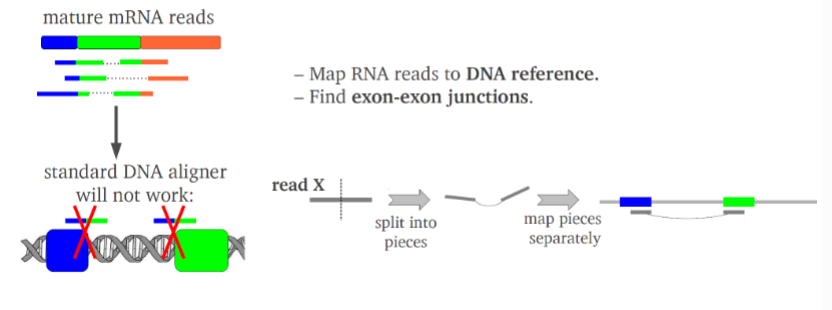
Sequence Alignment for RNA
map RNA reads to DNA reference
find exon-exon junctions
mature mRNA reads
standard DNA aligner will not work
RNA sequencing data are
quantitative
• Data are represented as “depth of coverage” plots.
• The higher a gene is expressed, the more reads we find for that gene, the higher the peak.
• Read distribution can be highly non-uniform → complicates statistical analysis.

Data is quantitative but
noisy
needed to do normalization
Strand-specific RNA sequencing
helps us resolve the reads
separate positive and negative
helps us separate overlapped genes

step 1 for RNA sequencing
reverse transcription from RNA to cDNA
step 2 for RNA sequencing
decide on design factors including polyA selection, single-strand vs double-strand, paired end vs single-end
step 3 for RNA sequencing
perform the actual sequencing
step 4 for RNA sequencing
aligment
step 5 for RNA sequencing
RNA quantification
step 6 for RNA sequencing
normalization
step 7 for RNA sequencing
differential expression analysis
step 8 for RNA sequencing
GO and KEGG enrichment analysis
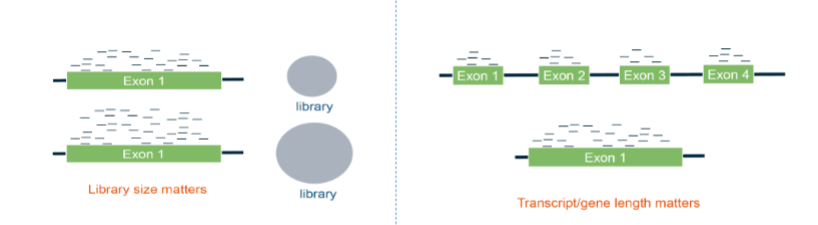
Normalization is important
larger library has more reads
larger transcript/genes have more reads
RPKM stands for
Reads Per Kilobase of transcript per Million mapped reads
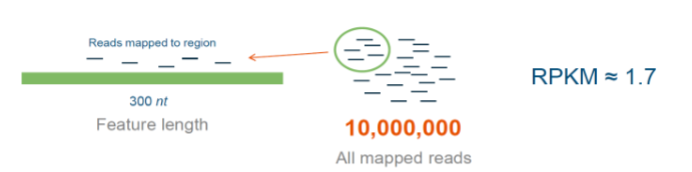
Question: Read count is 10 for a gene that is 2 Kb long from a sample that has 5 million reads. What’s the RPKM?
1
10 / (2 × 5)
RPKM formula
109 x (number of reads mapped to a region) / (total reads x region length)
total reads
adjust library size difference
region length
adjust transcript/gene length difference
The only difference between RPKM and FPKM is that FPKM takes into account
that two reads can map to one fragment (and so it doesn’t count this fragment twice)
RPKM is for
single-end sequencing
PKM is for
paired-end sequencing
Alternative splicing
very common
90% of gene undergoes
Allele specific expression
some more expressed than other
pair of chromosomes
both can be expressed into RNA, etc.

Detection of allele-specific expression by RNA-seq
genome is not a reference genome
50/50 split
significant allele expression for one over the other if not 50/50 split

The Genotype-Tissue Expression (GTEx) project aims to
characterize variation in gene expression levels across individuals and diverse tissues of the human body, many of which are not easily accessible
GTEx v8:
RNA-seq data from 15,201 samples across 49 tissues from 838 donors
Expression profiles
patients= column
rows= genes
2 different directions
For most of these methods, we can think of the output as a 2D matrix
ach row/column represents an expression profile
Differential expression – which genes have different expression levels across two groups?

Differential expression (DE) input
RNA-seq RPKM between two conditions (e.g., healthy v.s. disease). Each gene will be tested separately for DE.
Differential expression (DE) output
DE testing result for each gene.
visualizing differential expression: volcano plo
• Each dot is a gene tested for differential expression
• X-axis: log fold change (logFC)
• Y-axis: -log(p-value)
• Color: sig. up regulation, sig. down regulation, not sig.
X-axis: log fold change (logFC)
direction of change
reverse order if negative
Wilcoxon rank sum test
Test that is non parametric
• Also know as the Mann-Whitney U test
• Nonparametric version of two-sample t-test
• No distribution assumption of the data (e.g., normally distributed)
Wilcoxon rank sum test example
native american group sum is 75
takes sum, sorts from smallest ot largest, only take sum of NA groups
MSCE
mean sister chromatid exchange measurments
Gene ontology (GO)
• A hierarchy of roles of genes and gene products.
• Composed of three independent ontologies: molecular function, biological process, cellular component.
• GO itself does not contain any information on genes or gene products.
T or F: Gene Ontology exhibits hierarchy structure?
True
Curators annotate their findings of
genes (known as annotations)
Molecular Function (MF)
Describes activities, such as catalytic or binding activities, that can be performed by individual gene products or assembled complexes of gene products at the molecular level.
Biological Process (BP)
Defined as a biological objective to which the genes or gene products contribute
Cellular Component (CC
Refers to the place in the cell where the gene products are active.
Motivation
• 100 balls, 40 white, draw 10 of them, is there an enrichment if out of the 10 draws 8 of them are white?
• 20,000 genes, 617 genes within the apoptosis GO, ran an RNA-seq experiment between two conditions and got 200 significantly differentially expressed genes, 80 of them are from the apoptosis GO. Is there an enrichment?
Kyoto Encyclopedia of Genes and Genomes (KEGG)
Can think of this as a graph, with nodes representing compounds and edges representing reactions.
Can perform KEGG pathway enrichment analysis, similar to GO enrichment analysis
different way to summarize different genes into pathways
GO and KEGG enrichments
can test for each term one at a time to test if they are significantly enriched
GO on top
KEGG on bottom

Supervised learning
outcome measurement Y (Also called dependent variable, response, target)
vector of p predictor measurements X (also called inputs, regressors, covariates, features, independent variables)
regression and classification
type 2 diabetes is what type of supervised learning
classification
classification
categorical Y
finite, unordered set
Regression problem
Y is quantitative
continuous
Unsupervised learning
no outcome variable
objective is more fuzzy- groups of samples that behave similar
Supervised has
X, y
• Given an observation x, what is the best label y? (e.g., classification, regression)
unsupervised has
X
• Given a set of x’s, output their hidden structure (e.g., clustering)
outlier
a data point whose response y does not follow the general trend of the rest of the data
A data point has high leverage if
it has a "pull" on the regression line and can significantly influence the slope and intercept of the model
Logistic regression with categorial outcome
y = 3 possibilities
1 = stroke
2 = drug overdose
3 = epileptic seizure
linear regression is not appropriate here