Biochem Section 2 - Enzyme Mechanisms and Into to Metabolism
 Call Kai
 Learn
 Practice Test
 Spaced Repetition
 Match
 Flashcards
 Knowt Play
1/46

There's no tags or description
Looks like no tags are added yet.
47 Terms
chymotrypsin
digestive protease of the small intestine
serine proteases have an active site where serine covalently attaches to the substrate
these proteases cut pepetide bonds after large nonpolar residues (Phe, Trp, Tyr)
what is the inactive precursor to chymotrypsin
chymotrypsinogen
how is chymotrypsinogen activated
trypsin comes in and cleaves chymotrypsinogen
chymotrypsinogen cleaves itself into three pieces that are still connected via disulfide bonds
active unit is called alpha-chymotrypsin
what two things are within the active site
catalytic triad - Ser, His, Asp
A hydrophobic pocket that accommodates large nonpolar molecules - an S1 pocket
what are the three S1 pockets and what fits into each
a negatively charged pocket that fits trypsin
a broad nonpolar pocket that fits chymotrypsin
A narrow nonpolar pocket that fits elastase
Catalytic triad - Ser195
acts as the nucleophile in covalent catalysis
Catalytic triad - His57
acts as a general base, then a general acid - acid base catalysis
Asp102
orients His57 and favors its proton abstraction
oxyanion hole
stabilizes the negative charge on the tetrahedral intermediate - electrostatic catalysis
chymotrypsin substrate binding
step 1
the nonpolar side chain of substrate fits into the hydrophobic S1 pocket
this positions the peptide bond for attack
chymotrypsin nucleophilic attack
step 2
uses three strategies
acid base- His57 takes a proton from Ser195
covalent - Ser195 attacks the carbonyl carbon
electrostatic - oxyanion hole stabilizes the negative oxygen
chymotrypsin bond cleavage
step 3
uses 2 strategies
acid base - a protonated His57 donates a proton to the leaveing amino group
covalent - an acyl-enzyme intermediate forms
chymotrpysin water enters active site
step 4
uses acid-base catalysis - product 1 (LG) has left and water comes into its place, the separated His57 acts as a base on the water and makes it inot a peroxide
makes another acyl-enzyme intermediates with oxyanion stabilizing the negative charge
Chymotrypsin water attacks
step 5
uses two strats
colvalent - OH attacks the acyl-enzyme carbonyl
electrostatic - the oxyanion hole stabilizes the negative tetrahedral intermediate
chymotrypsin break the covalent bond to substrate
step 6
uses acid base catalysis - the intermediate collapses and a carboxylate forms
His57 donates a proton to Ser195 which then leaves the substrate
chymotrypsin product release
step 7
product 2 dissociates and the free enzyme is ready for another substrate
what are burst kinetics and does Chymotrypsin follow it
two phase process with fast first phase and second slow phase
yes - steps 1-3 are fast and 4-7 are slow
CRISPR-Cas9
bacterial adaptive immune system that defends against a phage
there are 2 type and 6 classes - Cas9=Class 2 Type 2 (nuclease)
invading DNA can enter bacterial plasmids and the trcrRNA and cRNA recognize repeats that tell them where to cut out the foeign DNA
important domains of Cas9
HNH and RuvC act as nucleases
PAM interacting domain links to DNA
what kinds of amino acids are most expected ot bind to DNA/RNA
positively charges amino acids like lysine, arginine and histidine because if the negatively charged backbone
where does Cas 9 bind to nucleic acids
at its two positively charged clefts
PAM sequence
binds to the genome
NGG motif - any aa with two guanines
Cas9 DNA targeting
Two arginines H bond with the two guanines of the PAM
Ser and Glu backbone amide hold phosphate lock loop and begin to unwind the DNA
guide RNA pairs wiht the target DNA
phosphate lock loop
ensures DNA gets pulled apart and doesnt go right back
How does Cas 9 cleave DNA
it makes a double stranded break - overall hydrolysis of aphosphodiester bond
HNH and RuvC both come in to cut 3-4 bp from target DNA
HNH cuts the strand paired with the guideRNA - gets stabilized by Mg2+
RuvC cuts the other strand
water acts as a nucleophile on phosphate - His deprotonates
what catalytic strategies does cas9 use
Metal ion - Mg2+ positions phosphate and water
acid-base - active site His deprotonates water into hydroxide for attack
electrostatic - positive charge clefts in Cas9 stabilize the negatively charged backbone
does the mechanism of Cas9 involve an intermediate?
no, water attacks phosphate directly
PRMT1
acts as a major protein arginine methyltransferase in mammals
substrate: histone H4 and many non-histone proteins
plays roles in splicing, transcription, signaling
what is the structure of PRMT1
adoMet-binding domain (Rossman fold) - binds SAM
beta-barrel domain - binds the arginine substrate
dimerization arm - allows PRMT1 to work as a dimer
the surface of PRMT1 has acidic grooves that conatin Arg-rich substrate - good cause histone tails and RGG motifs are positively charged
What is contained in the active site of PRMT1
SAM/AdoMet - the methyl donor (electrophile)
Substrate Arg - a guanidinium acts as nuc
E144 and E153 - electron pair that holds arginine
R54 and D76 - Hol SAM and E144 in place
positioning of PRMT1
step 1 of mech
uses electrostatic catalysis - E pair hydorogens bonds to guanidinium and orient a N toward the SAM methyl group
R54 and D76 hold SAM in place during this
methyl transfer of PRMT1
step 2 of mech
uses nucleophilic attack (Sn2) - arginine N attacks the SAM methyl carbon and the C-S bond breaks
SAM becomes SAH
No intermediate
proton removal of PRMT1
step 3 of mech
uses acid bas catal - E144 acts as general base, taking a proton from methylated N
E144 becomes COOH and Arginine carries one methyl group
how is the PRMT1 enzyme regenerated
E144 transfers its proton to water and enzyme releases the methylated Arg and SAH cofactor
metabolism
all chemical reactions of a cell
catabolism
breaks molecules down and releases energy
many fuels broken down to a few shared molecules
anabolism
builds molecules and needs energy
few precursors build many products
true or false - the more reduced a carbon is the more energy its oxidation releases
true
fatty acids are highly reduced carbs are moderatley
How does ATP act as the energy currency
it stores and releases energy
how does coupling reactions make unfavorable reactions possible
coupling a reaction to ATP hydrolysis makes the overall delta G favorable making a release of energy possible
low product concentration also pulls a reaction forward

homeostasis
keeps the concentration of most metabolites at steady state
pathways are at steady state unless perturbed
after perturbation a new steady state will be established
what happens in the steady state of a metabolite
the rate od synthesis of a metabolite equals the rate of breakdown of the metabolite
metabolic flux
rate that molecules move the pathway per unit time
in equilibrium when forward and reervse rates are equal
how does metabolic flux have to do with the alcohol flush reaction
when breaking down alcohol, ethanol gets oxidized to acetaldehyde
acetaldehyde is very toxic when it build up and is normally converted into nontoxic acetate by ALDH
If ALDH does not work properly, a build up of acetaldehyde occurs and leads to symptoms like redness, nausea, etc
process shows a mismatch in the metabolic flux of the intermediate and product
feedback inhibition
The end product inhibits the first enzyme of the same pathway
as the product builds, the flux slows, and the product is used until flux recovers
true or false phosphorylation turns enzyme activity up
true
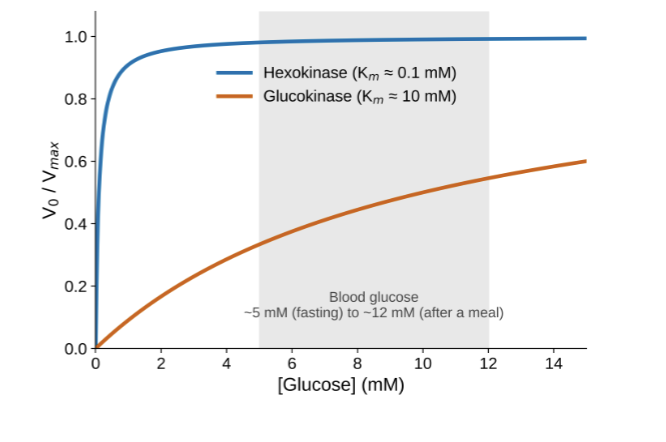
How do Hexokinase and glucokinase catalyze the same reaction with diff Kms
hexokinase (Km 0.1)is in most tissues and cannot let G-6-P out of the cell unlike glucokinase (Km=10) which is in the liver namely
hexokinase gets inhibited by G6P and glucokinase does not since the glucose can leave
this is because there needs to still be some kind of free glucose in the blood