Aging and Adulthood Midterm 1
 Call Kai
 Learn
Learn Practice Test
 Spaced Repetition
 Match
Match Flashcards
 Knowt Play
1/55

There's no tags or description
Looks like no tags are added yet.
Name | Mastery | Learn | Test | Matching | Spaced | Call with Kai | Chat |
|---|
No analytics yet
Send a link to your students to track their progress
56 Terms
How do biological systems change as we age? What are the 10 bodily systems affected?
CDEIIMRRUN As we age, biological changes influence the pscyhological experience of aging through a decline in all bodily systems: CDEIIMRRUN
Cardiovascular, digestive, endocrine, immune, integumentary, musculo-skeletal, reproductive, respiration, urinary, nervous
What are common experiences in 10 bodily systems as we age?
CARDIOVASCULAR left ventricle wall thickens → higher BP + reduced elasticity of arteries (harder to control blood flow)
DIGESTIVE weakened esophageal contractions and sphincter → false sense of fullness + increased vulnerability to lactose intolerance
ENDOCRINE cessation of estrogen from the ovaries, slower reduction for andropause, thyroid function decrease, lower insulin (30% older adults have diabetes, 50% are pre-diabetic)
IMMUNE reduced macrophages, white blood cells, and T cells → increased vulnerability to infection + reduced responsiveness to vaccines
INTEGUMENTARY thinning epidermis, dermis, and subcutis, less collagen → less elasticity and less UV radiation filtration
MUSCULOSKELETAL reduced bone density → osteopenia (more in women than men), muscle becomes fat + joints surrounding cartilage thin
REPRODUCTIVE hormonal changes from menopause and andropause lead to sexual functioning changes → urethra shortening, vaginal atrophy + decreased capacity for erection, longer refractory period )
RESPIRATORY reduced peak air flow + gas exchange → increased breathlessness
URINARY reduced kidney cells → reduced overall size of kidney, increased rigidity of bladder, ,bladder leakage, and feelings of fullness
NERVOUS reduced auditory/visual/tactile acuity and reduced olfcatory and gustatory sensitivity → FUNCTIONAL AND STRUCTURAL CHANGES IN THE BRAIN
What are 6 STRUCTURAL changes to the brain as we age? How much volume decreases per year after age 35 and age 60?
We have a DECREASE in volume of 0.2% per year after age 35 and 0.5% per year after age 60!!!!!
SHRINKAGE OF GYRI (elevated ridges) + WIDENING OF SULCI (creases/folds)
SHRINKAGE OF PREFRONTAL CORTEX, CEREBELELUM, AND HIPPOCAMPUS
PFC: responsible for executive functions of attention, problem-solving, decision making, social inhibition)
CEREBELLUM: responsible for regulation of balance, motor coordination, and control
HIPPOCAMPUS: responsible for memory, pattern recognition, and spatial location
DETERIORATION OF GREY AND WHITE MATTER
GREY: number of neurons (no longer reproducing after cell death), number and size of dendrites, less synapses between neurons (beginning in young adulthood)
WHITE: slower communication between neurons, due to less myelin to produce the myelin sheath
ENLARGEMENT OF CEREBRAL VENTRICLES
CSF (reduces feeling of weight of brain, removes waste, etc.) fills in extra space from enlarged ventricles → more volume, but not increased effects
CHANGES IN CEREBROVASCULATURE
oxygen and glucose, as the primary energy of the brain, travel less effectively due to changes in blood flow
LOSS OF MICROGLIAL CELLS
phagocytosis and inflammatory response engulfing abnormal proteins is decreased
diminishing our abilities to respond to diseases + toxicity
What is an important caveat about STRUCTURAL CHANGES in the brain in the literature?
An important caveat about the numerous structural changes in the brain is that:
RESEARCHERS who excluded those with cardiovascular risk factors or covert brain diseases have failed to demonstrate some of these changes
What are 2 FUNCTIONAL CHANGES in the aging brain?
The functions of DOPAMINE AND SEROTONIN (two neurotransmitter systems) alter neuronal communication as we age
How does DOPAMINE function as a FUNCTIONAL CHANGE of the aging brain? How much dopamine functionality fo we lose per decade from yound adulthood to older adulthood?
DOPAMINE produced in substantia nigra (movement) and vental tegmental area (reward and reinforcement) of midbrain
precursor is PHENYLALANINE
Deficits as we age affect:
ATTENTION (dopamine deficits → ADHD)
MOVEMENT (dopamine deficits in substantia nigra→ related to Parkinson’s)
MEMORY (dopamine deficits in PFC → bad for Short term memory)
REINFORCEMENT + REWARD (dopamine deficits in VTA → anhedonia, dopamine surplus in VTA → manic state )
As we age, we have reduced dopamine functionality with a decrease in SYNTHESIS, RECEPTORS, and TRANSPORTERS by 3.7-14% per decade between young adulthood and older adulthood
transporter decrease is thought to be a compensatory mechanism in the body to counteract decreased synthesis and allow more available dopamine in the synaptic cleft
How does SEROTONIN function as a FUNCTIONAL CHANGE in the aging brain?
SEROTONIN produced in the raphe nuclei of the brainstem
related to MOOD, FEEDING (feelings of satiety), SEXUAL FUNCTIONING, SLEEP (melatonin precursor)
As we age, we have decreased functionality in the SYNTHESIS, RECEPTORS, and TRANSPORTERS by 1.2-7% per decade between young adulthood and older adulthood
transporter decrease is thought to be a compensatory mechanism in the body to counteract decreased synthesis and allow more available serotonin in the synaptic cleft
What is neuroplasticity’s role in the aging brain? Which 2 structures’ synapses continue to form in older adulthood?
NEUROPLASTICITY was thought to be limited to the young, but despite the numerous age-related STRUCTURAL AND FUNCTIONAL CHANGES in the aging brain, new neuronal connections still develop in older adults
Synapses between the HIPPOCAMPUS through retrieval, and spatial location, and sensory processing in the OLFACTORY BULB, strengthen into older adulthood through new memories related to smell
How are researchers studying older adulthood neuroplasticity?
NEUROPLASTICITY creates great opportunity for environmental development as we age, RESEARCHERS are examining the effects of environmental interventions on the aging brain
environmental environments, exercise, and training programs
What are 3 PIECES OF EVIDENCE SUPPORTING GENETIC THEORIES OF AGING?
GENETIC THEORIES OF AGING hold that biological aging is determined by genes that contribute to age-related diseases and influence life span
Some species show no evidence of biological aging and no increases in rates of death over time
Among species that exhibit biological aging, differences in maximum life span vary considerably - body size, brain size, metabolic rate
the max life span of a human is 122 years, whereas for chimpanzees it’s 37 years → sharing 98% of DNA, RESEARCHERS suggest that a SMALL number of genes influence life span
What is the HERITABILITY of lifespan? Nature or Nurture?
HERITABILITY of life span in humans is 25-30% attributable to genetic factors alone
ENVIRONMENT accounts for 70-75% of life span, in light of EPIGENETICS (capacity for environmental factors to turn on and off genes through methylation Co3)
As we age, GENES are more important than ENVIRONMENT to determine how long we will live!!!!!!!!!!!!!!!!!!!!!!!!!!!!!!!!!!!!!!!!!!
What are 2 genes that influence life span? How have researchers identified these as related to life span?
APOLIPROTEIN E (APOEe2)
Located on chromosome 19, APOEe2 is associated with longer life span
FORKHEAD BOX O (FOXO3)
Located on chromosome 6, FOXO3 is associated with longer life span
BOTH APOEe2 and FOXO3 ARE MORE PROMINENT IN CENTENARIANS THAN NON-CENTENARIANS - potentially associated with lengthening the life span
What are 3 genes that influence age-related disease?
KIDNEY AND BRAIN EXPRESSED PROTEIN (KIBRA)
located on chromosome 5, associated with decreased HIPPOCAMPAL activation → memory impairments and late onset Alzheimer’s disease
LIPOPROTEIN A (LPA)
located on chromosome 6, associated with CARDIOVASCULAR EVENTS → coronary artery disease, stroke leading to brain effects
SH2B ADAPTER PROTEIN 3 (SH2B3)
located on chromosome 12, associated with cancer of the lung and prostate, coronary heart disease, and rheumatoid arthritis
What are 2 WAYS THAT RESEARCHERS are exploring ways to reduce genes that limit life span or contribute to age-related disease?
GENE EDITING/KNOCK OUT GENES
injecting a RNA that acts as a GPS to locate problematic chromosome regions, pinning the locus, which is then cut out of the chromosome and altered
VIRAL VECTORS
using viruses that are taken up by host cells through the blood stream, migrating to the nucleus to highjack cellular machinery + transferring desirable genetic material that can increase life span and scathe off age-related diseases
What is the TELOMERE THEORY OF AGING?
THE TELOMERE THEORY OF AGING holds that biological aging is determined by telomeres and their impact on cellular division
HAYFLICK LIMIT holds that cells undergo a finite number of divisions, which declines with age
TELOMERES determine the number of times a cell can divide, located at the ends of chromosomes as shoelaces, that protect DNA from degradation
What are the 7 steps of cells following the reaching of a CRITICAL LENGTH?
OVER TIME AS WE AGE:
Cells continue to divide until they reach a CRITICAL LENGTH
CELLULAR SENESCENCE OCCURS, where a cell can no longer divide
These cells become SENESCENCE-ASSOCIATED SECRETORY PHENOTYPES (SASPs)
They become “bad neighbours” that damage surrounding cells and stimulate growth of malignant cells
SASPs continue to develop with age
Functional impairments in tissues and organs occur
Age-related frailty, disease, disability, and death occur
How are researchers investigating interventions to combat TELOMERE SHORTENING?
TELOMEREASE GENE TRANSFER is the process where TELOMERASE (enzyme that lengthens telomeres and avoids cells reaching SASP status) is produced using VIRAL VECTORS
uncontrolled telomerase would lead to infinite cancer, resarchers are trying to balance an increased lifespan without creating immortal cells
What is the FREE RADICAL THEORY OF AGING?
The FREE RADICAL THEORY OF AGING holds that biological aging is determined by reactive oxygen species which cause cumulative damage to cells
REACTIVE OXYGEN SPECIES (ROS) are chemically reactive oxygen-containing molecules (O2-, H2O2) wanting to bind to other molecules, causing functional impairments and dysregulation
ROS are generated by mitochondria, as byproducts of adenosine triphosphosphate (ATP) production
ROS attacks macromolecules
What are the 6 STEPS involved in the FREE RADICAL THEORY OF AGING?
PRODUCTION OF ATP IN MITCOCHONDRIA
GENERATION OF REACTIVE OXYGEN SPECIES (ex. O2-, H2O2)
ATTACK + DAMAGE CELLULAR MACROMOLECULES (proteins, lipids, DNA)
DAMAGED CELLULAR MACROMOLECULES ACCUMULATE WITH AGE
FUNCTIONAL IMPAIRMENTS IN TISSUES AND ORGANS
AGE-RELATED FRAILTY, DISEASE, DISABILITY, AND DEATH
What are 2 ways researchers are investigating interventions to combat Reactive Oxygen Species?
Researchers are looking at ANTIOXIDANTS (vitamin c and e, superoxide dismutase) from fruits and vegetables that neutralize superoxide O2- into water
CALORIC RESTRICTION
in diverse species, a 20-40% decrease in caloric intake extends lifespan by 20-50% and reduces the onset of age-related disease
this slows metabolism and may, in turn, reduce proliferation of ROS production
for average human, caloric restriction can extend lifespan by 30 years
DEFINE older adulthood: young-old, old-old, and oldest-old, centenarians, and super-centenarians
YOUNG-OLD is 65 to 74
OLD-OLD is 75 to 84
OLDEST-OLD is 85+
CENTENARIAN is 100+
SUPER CENTENARIANS are 110+
What is TERMINAL DROP?
TERMINAL DROP last 1 to 5 years of life
Individuals demonstrate decline in cognitive abilities that do not generally decline as a consequence of PRIMARY AGING
Thought of as behavioural or biological consequences not related from time since birth—but time to death.
verbal abilities remain intact with primary aging, but a loss of vocabulary would indicate terminal drop
What is PRIMARY, SECONDARY, and TERTIARY AGING?
PRIMARY AGING are intrinsic, progressive, and universal alteration in bodily systems
normative and irreversible
puberty, menopause, skin wrinkling
SECONDARY AGING is abnormal and diseas in bodily systems
preventible or reversible processes
skin cancer, Alzheimer’s
TERTIARY AGING is due to rapid loss from multiple bodily systems at the end of life
mortality-related processes
Termina Drop
What is HETEROGENEITY IN AGING among older adults?
The older people are, the more diverse they are, with greater variability!
Standard deviations much greater for older adults than the young
What 3 FACTORS contribute to HETEROGENEITY in older adults?
BIOLOGICAL SEX
MARITAL STATUS
ETHNICITY
How does BIOLOGICAL SEX contribute to older adult heterogeneity? What are the 2 terms related to this contribution (6 mediators PSHROS)?
BIOLOGICAL SEX mortality rates are lower among females than males, but morbidity rates are higher in females than males → THE MORALITY-MORBIDITY PARADOX
more female centenarians than male centenarians
gap is closing as population + male smoking rates have decreased
HOWEVER, there is more diabetes, heart disease, and cancer in males than females .. but everything else is more common in females
MEDIATORS:
physiological factors (estrogen and secondary X chromosome is protective against secondary aging)
social network integration (married men report more that their spouse is primary social support, opposed to women’s reports)
health-related factors (routine visits to physicians)
risk-taking behaviours (drinking heavily)
occupation (more hazardous conditions)
socioeconomic status (FEMINIZATION OF POVERTY → women are more likely to be poor than men, among retirees women have a pension 55% that of men, many abandon pensions as they take maternity leave, less health care access)
How does MARITAL STATUS contribute to the HETEROGENEITY of aging adults? What is the term related to this contribution (4 mediators HRSS)?
MARITAL STATUS mortality and morbidity is lower among individuals who are married, than those never married, divorced, or widowed
benefits are greater for men than women, as seen through tendencies in social support perception
MEDIATORS:
health-related habits (routine visits to physicians)
risk-taking behaviours (drinking heavily)
integration into social networks (married men report more that their spouse is primary social support, opposed to women’s reports)
socioeconomic status (feminization of poverty)
WIDOWHOOD EFFECT → increased probability of death in the 6 to 12 months following the death of a spouse especially in YOUNGER WIDOWS with lower capacity to accommodate loss
How does ETHNICITY contribute to the HETEROGENEITY of older adults? What is the 1 term related to this contribution (5 mediators MESEH)?
ETHNICITY in contrast to sex and martial status, association between ethnicity and mortality/morbidity rates is complex and changing over time
MEDIATORS
migration history (culturally insensitive healthcare, economic or political persecution experiences, PTSD, etc.)
experiences with discrimination
socioeconomic status
experiences of language fluency
health-related habits (HEALTHY IMMIGRANT EFFECT → coming to Canada requires health and less economic needs, leading to better health outcomes in IMMIGRANTS > NON-IMMIGRANTS, but immigrants’ descendants become less healthy over time)
What is the main takeaway about all the factors that influence the HETEROGENEITY of older adults? 2 TERMS RELATED TO THIS
All factors (biological sex, marital status, and ethnicity) interact to produce unique trajectories of individual difference
MULTIPLE JEOPARDY is the disadvantage of multiple factors which works with…
CUMULATIVE DISADVANTAGE, where hardships compound over time to cause gaps between individuals to widen over time → HETEROGENEITY IN OLDER ADULTS
Define AGE STEREOTYPES
AGE STEREOTYPES are cognitive schemas or organized knowledge structures that reflect beliefs about the shared characteristics of individuals of distinct age groups
they can be either explicit or implicit
What is the MULTIPLE STEREOTYPE MODEL? What are the 4 negative subtypes and the 3 positive subtypes?
The MULTIPLE STEREOTYPE MODEL holds that there are 7 stereotype subtypes of older adults
People shared their stereotypes of older adults + researchers sorted them into different stereotype subtypes
NEGATIVE
- SEVERELY IMPAIRED slow thinking, incompetent
- DESPONDENT depressed, sad
- SHREW/CURMUDGEON complaining, ill-tempered, nosy
-RECLUSE quiet, timid, naive
POSITIVE
-GOLDEN AGE alert, active, sociable, productive, sexual
-PERFECT GRANDPARENT interesting, kind, loving, generous
-JOHN WAYNE CONSERVATIVE patriotic, religious, retired, nostalgic, proud
What is the STEREOTYPE CONTENT MODEL
The STEREOTYPE CONTENT MODEL asserts that stereotypes of older adults are ambivalent
On pillars of WARMTH AND COMPETENCE, individual groups can differ from the scales of low to high on either pole
OLDER ADULTS ARE PERCEIVED AS HIGH WARMTH, LOW COMPETENCE → primarily driving PITY
What is AGEISM? What are the correlates and prevalence of AGEISM?
AGEISM is the negative attitudes towards older adults, old age, and the aging process, discriminatory behaviour against older adults, and institutional practices and policies that PERPETRATE STEREOTYPES OF OLDER ADULTS
51% of respondents believe that ageism is the most tolerated form of social bias
63% of older adults report unfair of differential treatment because of their age
70% of older adults report experiencing everyday ageism
What are THE 5 different forms of ELDER ABUSE (NFPPS)?
ELDER ABUSE is a single or repeated act or lack of appropriate action, occurring within any relationship where there is an expectation of trust which causes harm or distress to an older person
NEGLECT not fulfilling fundamental obligations
FINANCIAL forging signatures to obtain property without authorization
PHYSICAL pain, injuries, associated with slapping, hitting, etc.
PSYCHOLOGICAL intimidation, harassement, humiliation
SEXUAL ABUSE coerced nudeness, rape
What are the CORRELATES AND PREVALENCES OF ELDER ABUSE?
ELDER ABUSE is associated with increased morbidity among victims: anxiety, dementia, depression, PTSD, perception of overall health
AND increased mortality among victims: cardiovascular related mortality, shorter telomere length → chronic stress from abuse leading to low grade inflammation + rapid cell turnover
ELDER ABUSE LEADS TO ELEVATED CORTISOL, which SUPPRESSES TELOMERASE
In Canada: 10% of older adults report elder abuse, but this is an underestimation of around only 1 in 24 cases being reported due to fear, lack of legal protections, or mental and physical incapacity
How can ELDER ABUSE be explained by the STEREOTYPE CONTENT MODEL?
Through the STEREOTYPE CONTENT MODEL we see older adults as high in warmth and low in competence, the model holds that stereotypes give rise to emotion, with emotions giving rise to behaviours
may lead to… APPA
ACTIVE FACILITATION in those we deem high warmth → through (pity OR admiration) as an effortful support and extension of the self to support an older adult OR
PASSIVE FACILITATION in those we deem high competence → through (admiration OR envy) effortful helping behaviours - offering senior discounts, letting an older person work slower, etc.
PASSIVE HARM in those we deem low competence - through (pity OR contempt) low intention harm, possible abuse of an elder: neglect
ACTIVE HARM in those we deem low warmth → through (contempt OR envy) possible abuse of an elder: financial, physical, psychological, sexual

What is STEREOTYPE THREAT? How does it influence older adults?
STEREOTYPE THREAT is the tendency for members of a stereotyped group to “underperform” following activation of a negative stereotype of their group
involve explicit stereotype (consciously recognized stereotypes) activation
results from anxiety that they will confirm negative stereotypes → the anxiety hinders behaviour and, in turn, confirms the stereotype
How does STEREOTYPE THREAT influence older adults?
STEREOTYPE THREAT affects older adults across multiple domains → memory performance, self-reported health, self-reported loneliness, help-seeking behaviour
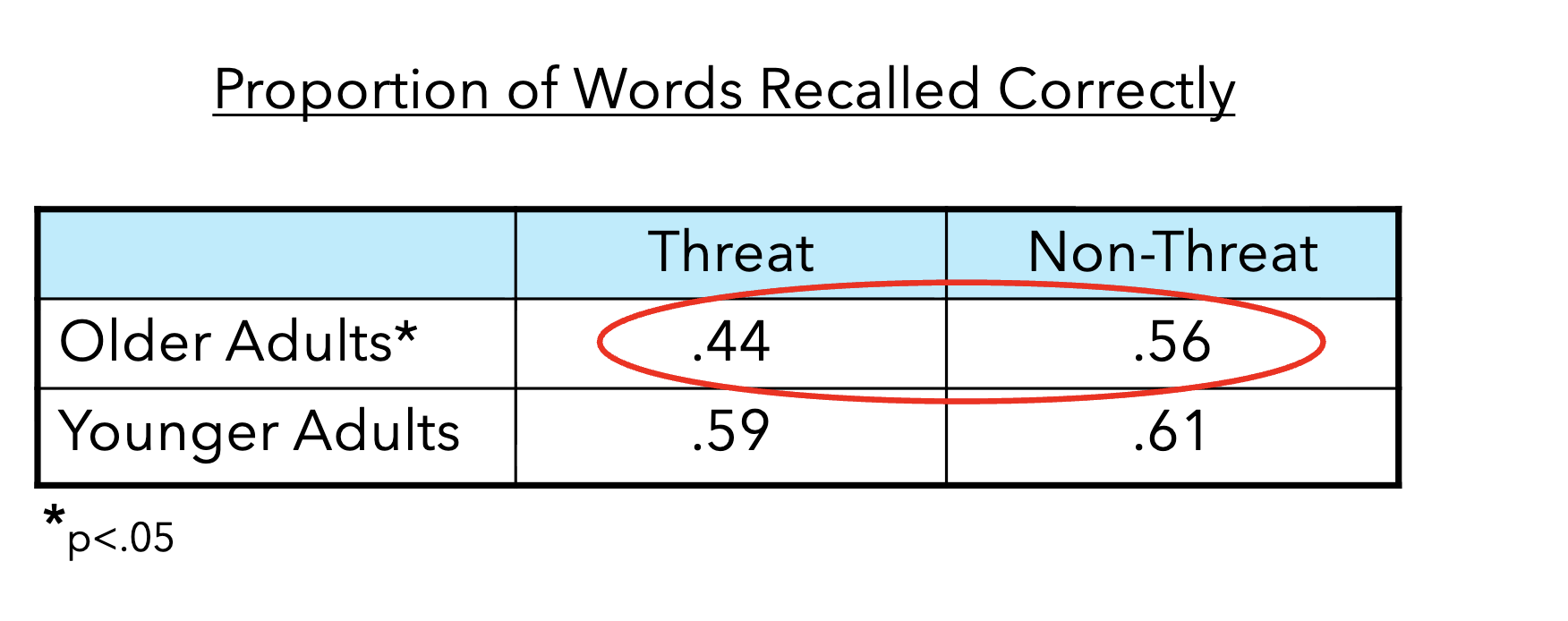
ex. Among younger and older adults randomly assigned to conditions
A) THREAT CONDITION: participants read a functional research article reporting that older adults have poorer memory skills than younger adults, then asked to perform a memory recall test
B) NON-THREAT CONDITION: participants were told they would complete a series of tasks
FINDING was that stereotype activation resulted in reduced performance on a memory recall test among older adults but not younger adults → THIS MAY LEAD OLDER ADULTS TO AVOID ACTIVITIES THAT REAFFIRM NEGATIVE STEREOTYPES
What is SELF-STEREOTYPING? How does this relate to LEVY’s theory of stereotype embodiment?
SELF-STEREOTYPING is the tendency for members of a stereotyped group to adopt and assimilate to the stereotype of their group
involving IMPLICIT STEREOTYPE ACTIVATION/ salience from self-relevance from LEVY’S THEORY OF STEREOTYPE EMBODIMENT
IN OLDER ADULTS this affects gait, memory performance, functional health, and survival
What was the OHIO LONGITUDINAL STUDY OF AGING + RETIREMENT? What were measures and 2 findings + their mediators?
The OHIO LONGITUDINAL STUDY OF AGING + RETIREMENT was a longitudinal study beginning in 1975, looking at those aged 50 or older at baseline + followed them for 2 decades
MEASURES: self-perceptions of aging (SPA), perceived health, functional health, will-to-live, survival
There were 2 MAIN FINDINGS + their mediators
Participants with more negative self-perceptions of aging at baseline had more functional health problems over time than participants with positive self-perceptions of aging (WIDENING GAP BETWEEN THE GROUPS OVERTIME)
PERCEIVED CONTROL (the belief that one has a choice among responses that are differentially effective in achieving a desired outcome) partially mediated relationship between self-perceptions of aging (SPA) + functional health over time
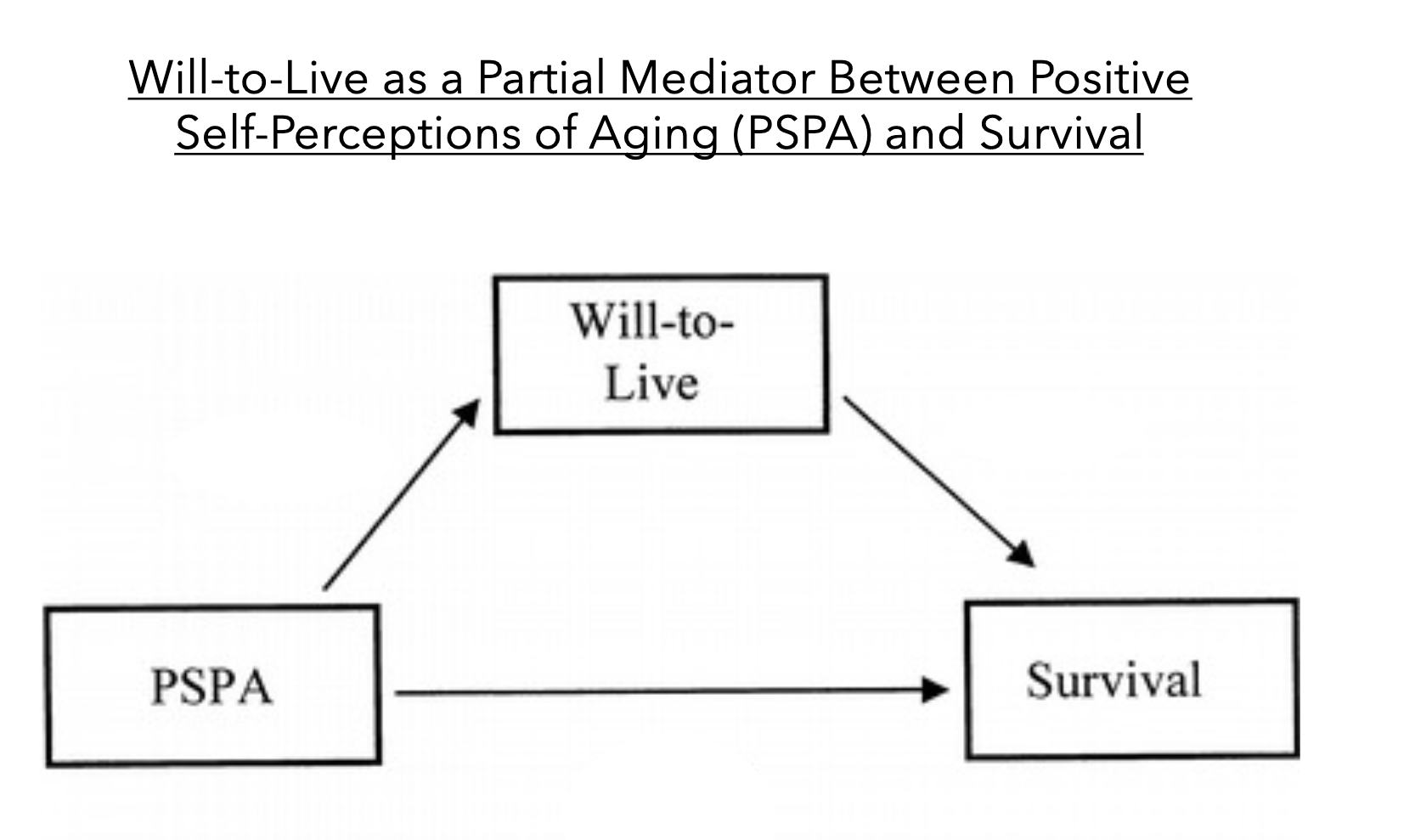
Median survival among participants with more negative self-perceptions of aging was 7.6 years earlier than median survival rates of those with positive self-perceptions of aging (by 15 years after the study, 0.5 of POOR SPA group had passed vs. 22.6 years for group with POSITIVE SPA)
WILL-TO-LIVE (perceived benefits of one’s life outweigh perceived hardships) partially mediated this relationship between self-perceptions of aging (SPA) + survival
What mediates the relationship between self-perceptions of aging and functional health outcomes in the OHIO LONGITUDINAL STUDY?
PERCEIVED CONTROL partially mediates the relationship between SPAs and functional health outcomes
one’s belief that a one has a choice among responses that are differentially effective in achieving a desired outcome → related to LEVY reading about stereotype embodiment… behaviour (those with the negative idea that health deficits are inevitable with age are less likely to engage in health practices as they are futile?)
What mediates the relationship between self-perceptions of aging and survival in the OHIO LONGITUDINAL STUDY?
WILL-TO-LIVE partially mediates the relationship between SPAs and survival outcomes
one’s perception that benefits of one’s life outweighs the perceived hardships
What is the PEACE model of combatting ageism? What are its 2 CRITICAL COMPONENTS (2 and 5 - GAPEI)
The PEACE MODEL is the POSITIVE EDUCATION ABOUT AGING AND CONTACT EXPERIENCES (PEACE) model proposed by Levy focusing on 2 CRITICAL COMPONENTS:
a) EDUCATION ABOUT AGING such as…
acts on aging
positive older adult role models that dispel negative and inaccurate images of older adulthood
b) POSITIVE CONTACT EXPERIENCES that are…
individualized (one to one)
provide or promote equal status during interactions
cooperative or involve working toward a common goal
involve sharing personal information
sanctioned within the setting such as by authority figures
Recreate the first figure of Levy’s paper Toward Reducing Ageism

In Towards Reducing Ageism, how do FOSTER GRANDPARENTS act as an example of the PEACE model?
FOSTER GRANDPARENTS incorporate both the education and contact components of Levy’s PEACE model
Through an older adult role model, EDUCATION ABOUT AGING is achieved
Through the experiences being individualized, personal, equal, cooperative, and with authority figures, POSITIVE CONTACT is achieved
How do AGE STEREOTYPES connect to broader systems, structures, and mental models?
AGEISM is a complex issue with many working parts → SYSTEMS THINKING, where change cannot be fully predicted
What is a STRENGTHS-BASED vs DEFICIT-BASED APPROACH?
A STRENGTHS-BASED APPROACH sees older adults as community experts with lived experiences
focus on existing assets, capacities, and resilience
creates solutions WITH the community, not for the community
A DEFICITS-BASED APPROACH sees older adults as individuals with little control over their lives as recipients of care
What is ROOT CAUSE ANALYSIS BRIEFLY?
LEAVES represent daily/observable impacts of AGEISM
TRUNK represents systematic/structural elements that enable AGEISM
ROOTS represent key mental models that are behind structures and impacts

In GERONTOLOGICAL IMAGINATION, what 3 PROBLEMS does Ferraro identify within gerontology?
NO SINGULAR PARADIGM/FUNDAMENTAL IMAGE OF THE FIELD
many unifying concepts and methods, but no clear paradigm of what a gerontologist is
problems in the articulation of what aging is
NO CONSENSUS ON EDUCATIONAL STANDARDS
paradigm should precede educational solidifying → no singular role or set of schooling to properly labeled a “gerontologist”
we should focus on developing the primary disciplines: psychology, nursing, sociology, and social work
NO AXIOMS TO CHALLENGE, STRENGTHEN, OR REINFORCE
Building on this, moving from how one “becomes” a gerontologist → What fundamental image must be developed in order for anyone studying aging, regardless of his or her background?
What is a GERONTOLOGICAL IMAGINATION and why is it needed?
The GERONTOLOGICAL IMAGINATION is an awareness of the process of human aging that enables us to understand the scientific contributions of a variety of researchers studying aging → allowing people, not just scientists, to comprehend the biological, behavioural, and social links that influence human aging
What are Ferraro’s 7 elements of proposing a GERONTOLOGICAL IMAGINATION?
AGING + CAUSALITY aging is not a cause of all age-related phenomena (correlated but not causal, are time and aging) —> Hayflick’s Limit, the number of passages a cell underwent was causing change, not aging or how long it had been
using COHORT/GENERATIONAL EFFECTS is better at looking for actual causes among age/generation matched individuals, but is still not fully causal
AGING AS A MULTIFACETED CHANGE we see an aging organism, but there are many systems aging simultaneously at different rates
aging is an “embedded dyanism” as there are many clocks that time us
GENETIC INFLUENCES ON AGING using twin studies and genealogical/family lineage studies!!!!!! Genes make up 25% of what determines longevity, seen in comparable longevity of identical monozygotic twins > dizygotic fraternal twins
some genes are associated with lengthening life, potentially warding off diseases through oxidative stress resistance or modifications of metabolism
AGING AND HETEROGENEITY people become less alike as they age
using age as a categorizing variable is problematic, whereas childhood and youth are age-graded times, made up of normative experiences, this is not the case for older adults
heterogeneity is prime evidence of the modifiability of the aging process, some older adults have no pathological presence in the brain at all
AGING AND LIFE COURSE ANALYSES studying the life span, as if we hope to understand older age, we must understand the earlier life transitions + their psychological relevance
CUMULATIVE DISADVANTAGE accumulated childhood misfortune reduces the likelihood of avoiding disease → there is then efforts needed to alleviate adverse experiences for children to have the long-term benefits for successful aging
AGING AND CUMULATIVE DISADVANTAGE disadvantage accumulates over the life course, thereby differentiating a cohort over time
disadvantages may scar a person’s life chances, but there’s still much neuroplasticity and individual diversity → researchers should also study cases where disadvantage does NOT accumulate
AGING AND AGEISM scholars, those working to combat ageism, etc.
Researcher, Pat Moore, disguised herself as a poor old woman, middle-class woman and a wealthy woman
those working with older individuals may be most prone to ageism in their orientations → clinicians may become unable to see older adults outside of disease, disability, or death they often see at clinics invisible elders
What are the 4 components of Levy’s STEREOTYPE EMBODIMENT?
STEREOTYPE EMBODIMENT entails that stereotypes are embodied when their assimilation from the surrounding culture leads to self-definitions that, in turn, influence functioning and health
WHEN STEREOTYPES…
become internalized across the life span
are able to operate unconsciously
gain salience from self relevance
utilize multiple pathways
What are 2 DIMENSIONS that STEREOTYPE EMBODIMENT can occur?
TOP DOWN from society to the individual
OVER TIME from childhood to adulthood
What occurs in the study of stereotype priming on handwriting? What is another similar priming study on will to live?
Those who were primed with unconscious operations (quick enough to go to the unconscious, but slow enough to encode) of
NEGATIVE PRIMES had hand writing that was perceived to be older than writing samples from before their exposure
POSITIVE PRIMES had hand writing that was perceived to be younger than writing samples from before exposure
similar for primes of “if they would choose a life-prolonging medical intervention at the cost of losing services and care of extended family” those positively primed, accepted
those negatively primed, rejected
What happens in a study looking at cardiovascular events and the internalization of stereotypes of older adults?
Those with more negative age stereotypes were more likely to have had experienced a cardiovascular event over the next 38 years
adjusted for covariates
explained partially by how much exposure someone had to American culture, particularly television
What are psychological, behavioural and physiological pathways of age stereotypes from the STEREOTYPE EMBODIMENT PAPER BY LEVY?
PSYCHOLOGICAL
age stereotypes generate expectations that act as self-fulfilling prophecies
in a study where older adults were expose to positive age-sterotypes, they outperformed negative age-sterotype groups in both physical and cognitive tasks
BEHAVIOURAL
one’s self-perceptions of aging influences their behaviour
those with negative self-perceptions, who may see physical decline as inevitable in the aging process, will engage less with health behaviours like taking vitamins and excercising
a sense of helplessness and a loss of PERCEIVED CONTROL on what one can do to influence their health, and vice versa
PHYSIOLOGICAL
The automatic nervous system responds to stress
those experiencing more negative stereotypes may demonstrate higher cardiovascular responses to stress → can lead to heart problems
cortisol leading to telomerase suppression
oxidative stress from metaboism and ATP production