Joint play and special tests - Hip
 Call Kai
 Learn
 Practice Test
 Spaced Repetition
 Match
 Flashcards
 Knowt Play
1/43

There's no tags or description
Looks like no tags are added yet.
44 Terms
Long and short-axis distraction is best for what motions
general
(Hip) Posterior glides are associated with what motions
flexion and internal rotation
(Hip) Anterior glides are associated with what motions
extension and external rotation
(Hip) inferior glides are associated with what motion
abduction
Flexion adduction test

The flexion adduction test assesses for the presence of
FAI, hip dysplasia, and piriformis syndrome
A positive flexion adduction test is
inability to adduct the flexed hip past midline toward the opposite hip
Flexion, Adduction, Axial Compression Test

The flexion adduction axial compression test assesses
labral degeneration, fraying, or tearing
a posative flexion adduction axial compression test is
reproduction of pain/discomfort in the groin
Internal Rotation-Flexion-Axial Compression Test
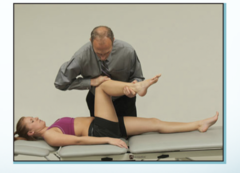
Internal Rotation-Flexion-Axial Compression Test tests for
labral degeneration, fraying, or tearing
a positive Internal Rotation-Flexion-Axial Compression Test is
reproduction of pain/discomfort in the groin
Internal Rotation load/grind test

Internal Rotation load/grind test assess
labral pathology
Fitzgerald test

Fitzgerald test screens for
posterior or anterior labrum pathology, FAI
a positive Fitzgerald is
reproduction of the patient's pain with/ without a click.
Scour test

scour test screens for
OA, labrum tear, FAI, Joint capsule pathology, iliopsoas strain, femoral neck patholgy
a positive scour test is
pain or apprehension at a given point during the examination.
FABER (patrick) test

FABER/Patrick test asses for
Hip pathology, Labrum OA, Iliopsoas, Capsule, Sacroiliac joint dysfunction
A positive FABER test is
concordant pain near the anterior or lateral capsule of the hip
Craig test

Craig test screens for
femoral anteversion or femoral retroversion
a posative craig test would be
8-15º
- Anteversion is any angle greater than 15
- retroversion is any angle less than 8
Log roll test

log roll test screens for
labral tears and iliofemoral ligament laxity
a positive log roll test is
a click (labrum) or excessive external rotation (ligament)
Trendelenburg sign

Trendelenburg sign tests for
abnormal pelvic drop
resisted straight leg raise test

resisted straight leg raise test asses for
inflammation, appendicitis or inflammation of the iliopsoas
A positive resisted straight leg raise test would be
reproduction of pain in the lower quadrant,
Thomas test

Thomas test assesses for
tightness of the hip flexors of the extended leg
a posative thomas test would be
Failure for the leg to drop to table
Ober test

ober test screens for
tightness of structures including ITB and TFL
a posative ober test would be
failure of the knee to drop to the plinth
Fulcrum test
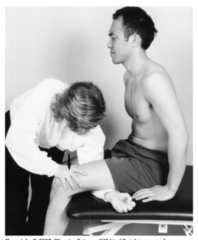
The fulcrum test screens for
femoral shaft stress fracture
a positive fulcrum test would be
if the patient reports increased discomfort/sharp pain, usually accompanied by apprehension