A&P Chapter 12: Neuron Excitability
 Call Kai
 Learn
Learn Practice Test
 Spaced Repetition
 Match
Match Flashcards
 Knowt Play
1/66

There's no tags or description
Looks like no tags are added yet.
Name | Mastery | Learn | Test | Matching | Spaced | Call with Kai | Chat |
|---|
No analytics yet
Send a link to your students to track their progress
67 Terms
Sensory Function/ Sensory Neurons?
Receptors detect stimuli and send sensory signals to Spinal Cord and Brain
Brain and Spinal Cord determine the response
Motor Function/ Motor Neurons?
Brain and spinal send motor output via nerves to effectors (a.k.a Muscles or Glands)
The Neuron is the structural unit of the nervous system, the next few slides go over its characteristics
Excitability is the ability to?
Respond to a stimulus
The stimulus from excitability causes?
Change in cell’s membrane potential
Conductivity is the neuron’s ability to?
Propagate electrical signals, where Voltage-gated channels along membrane open sequentially
Secretion, is the Neuron’s ability to?
Release a neurotransmitter in response to conductive activity
The messenger is released from the?
Vesicle to influence target cell
Neurons also have extreme longevity, where call can live throughout person’s lifetime
Parts of a Neuron
The Cell Body (soma, perikaryon) is a spherical structure, with cone shaped axon hillock. What would it contain?
Contain nucleus
Contains chromatophilic substance made of ribosomes
Dendrites are short. unmyelinated processes that?
-Branch of cell body-
Receive input and transfer it to cell body
The axon is a long process emanating from?
Axon Hillock
What are the Cytoplasm, and membrane of axon called?
Cyto= axoplasm
Membr= axolemma
The axon will split into branches called?
Axon collaterals
Most axons and collaterals branch extensively at distal end
Tips of these extensions are?
Synaptic knobs (synaptic bulbs, end bulbs, terminal boutons)
The synaptic knobs house?
Synaptic vesicles containing NT
The axon may be insulated with a?, in which their are gaps between the regions called?
Myelin sheath, formed by glial cells
Neurofibril nodes are the gaps

Structures in a Typical Neuron
Synapse are a location where? and what are the two types?
A neuron connects to another, or an effector
-Chemical (more common)
-Electrical
The electrical Synapse is formed by what?
Presynaptic and Postsynaptic neurons bound together by gap junctions
Are Electrical Synapse slow or fast?
Fast, with no synaptic delay in passing electrical signal
A Chemical Synapse will also contain a Presynaptic and Postsynaptic, which do what?
Presynaptic Neuron’s axon terminal produces signal
Postsynaptic Neuron’s dendrites receives signal
The Chemical Synapse contains a Synaptic Cleft which is?
Small fluid filled gap between neurons
Events of Synaptic Communication for Chemical
Neurotransmitter molecules released from vesicles of synaptic knobinto cleft
Neurotransmitter diffuses across cleft and binds to postsynapticreceptors
Binding of neurotransmitter to receptor excites postsynaptic cell
Synaptic delay: time it takes for all of these events
What are pumps?
Membrane proteins that maintain a concentration gradient by moving substances up (against) their concentration gradient
Pumps require? (Has a note in their as well)
Cellular Energy
(Neurons have sodium-potassium pumps and calcium pumps in their membranes)
What are channels?
Protein pores in the membrane that allow ions to move down their concentration gradient (into or out of the cell) by facilitated diffusion
When open, they allow a specific type of ion to diffuse
What is a leak (passive) channel?
A channel always open for continuous diffusion
Chemically gated channels are normally closed, but open when?
Neurotransmitter binds
Chemically gated cation channel allow passage of two cations
Voltage gated channels are normally closed, but open when?
Membrane charge changes
Voltage-gated Na+ channels have activation and inactivation ggates
Modality-gated channels, are channels that open in response to?, functioning in the?
Open in response to specific type of sensory stimulus, functioning in the sensory receptors
(Examples like change in, temperature, pressure, light)
Where can we find a Modality-gated channels?
Found in membranes of sensory neurons
Come back to slide 13-19
Electrical energy is the? (Has an important note)
Movement of charged particles
Neuron activity depends on electrical current
Voltage (V) is the amount of difference in?
Electrical charges between two places, representing potential energy
(Measured in volts/millivolts)
Current (I) is the movement of?
Charged particles across barrier separating them
Resistance (R) is an?
Opposition to movement of charged particles (that is the barrier)
Increase in resistance lowers the current
Ohm’s law, states the Current= Voltage/resistance (I=V/R), meaning that?
Current increases with larger voltage and smaller resistance
Come back to the rest of slide 21-23
What the difference in channels between the Receptive Segment and Initial Segment, and Conductive Segment?
The initial segment is the area with Chemically-Gated cation channels, in which they switch at the initial segment, where the voltage-gated channel appear in conductive segment
What exists across plasma membranes?
An Ions concentration gradient’s
What kind of Ion Concentration Gradients occur?
Higher concentration of K+ in cytosol verses interstitial fluid (IF)
Higher concentrations of Na+ , Cl- , Ca
What gradient exists at the Synaptic Knob?
Calcium Concentration Gradient
Their is an electrical charge difference across the membrane, called membrane potential where?
Cytosol is relatively negative compared to IF
The electrical gradient is the?
Difference between the ion charge versus the Intracellular Charge/Cytosolic Charge
What is the Resting Membrane Potential
-70 mV
What is our Chemical Gradient?
The difference in Ion Concentration inside versus outside the cell
The Equilibrium potential occurs when we have?
Some sort of balance between our Electrochemical gradient in, and out of the cell
This equilibrium potential would cause?
No net current
Understand the Idea between Potassium and Sodium with Chemical and Electrical Gradients, which we can see on slide 26-28
What are Graded Potentials?
Small short lived changes in the RMP (Resting-Membrane Potential)
What are a few characteristics about Graded Potentials?
Established in the receptive segment by the opening of chemically gated ion channels
Local current changes are short-lived
Vary in degree of changes and direction of change of the RMP
What are the two things that a Graded Potential can cause?
A depolarization where membrane potential becomes more positive, or a Hyperpolarization where the membrane potential becomes more negative
Graded Potentials in a postsynaptic neuron are called?
Postsynaptic potentials
What is the postsynaptic potential resulted in depolarization and hyperpolarization called?
In depolarization is called an Excitatory Postsynaptic Potential (EPSP)
In hyper-polarization is called an Inhibitory postsynaptic potential (IPSP)
Why can numerous postsynaptic potential be generated?
Because postsynaptic neuron can bind many NT molecules simultaneously
What are EPSP caused by?
An entry of Na+ entry

What are IPSPs caused by?
K+ exit or Cl- entry
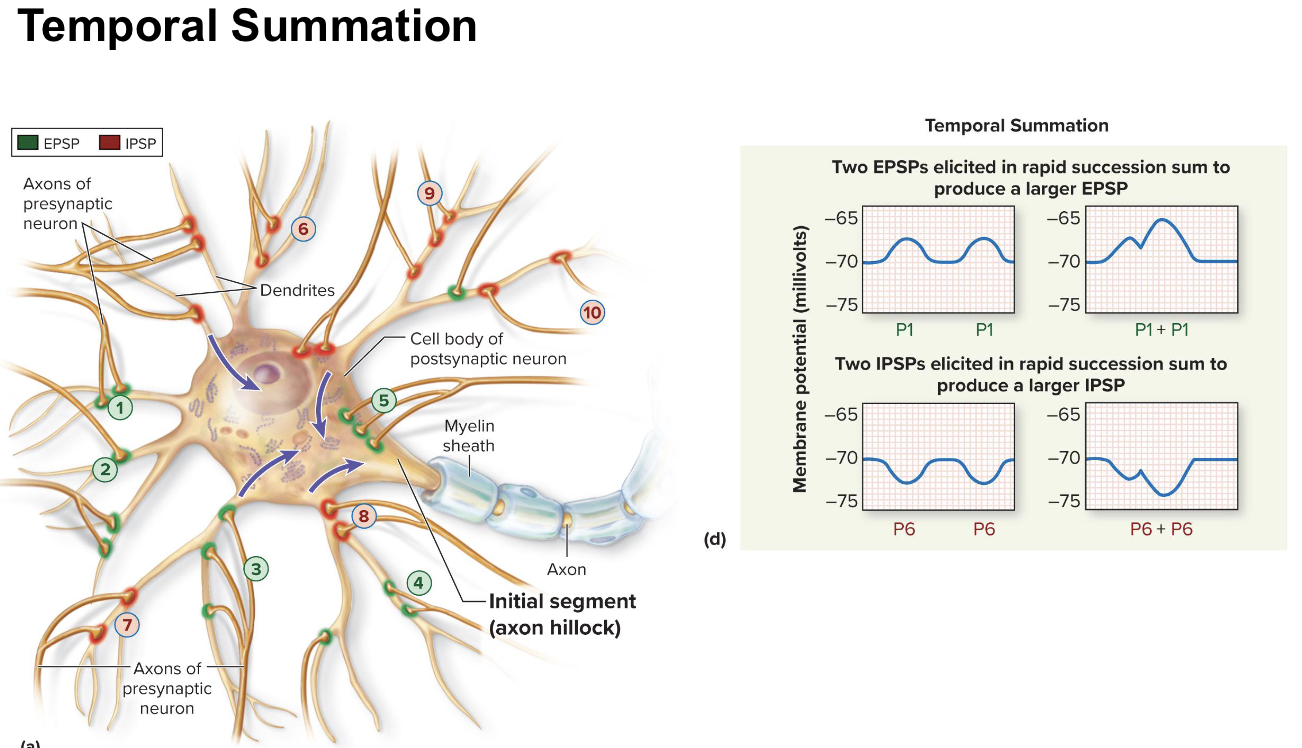
The Summation of EPSPs and IPSPs is the voltage changes from what structures, being added together?
Dendrites and Soma are added
The sum produced may or may not reach the?
Threshold membrane potential for initiating an Action Potential
(The minimum voltage change required)
What is the charge of the Threshold?
-55 mV
If the threshold is reached at the axon hillock (initial segment) what will occur?
Voltage-gated channels open, and AP is generated
Spatial Summation occurs when?
Multiple locations on cell’s receptive region receive NT simultaneously and generate postsynaptic potentials

Temporal Summation occurs when?
A single presynaptic neuron repeatedly releases NT and produces multiple EPSPs within a very short period of time