temperature relations with plants
 Call Kai
 Learn
 Practice Test
 Spaced Repetition
 Match
 Flashcards
 Knowt Play
1/14

There's no tags or description
Looks like no tags are added yet.
15 Terms
The Old Man Or Senile Head
Cactus
Some Adaptations Of ____ ____ ____, Cephalocereus senilis, To Hot Deserts
Its Blanket Of Spines -
•Reduces -
o Body T0 During The Day
o Transpiration
o Wind Contact
•Reflects Sunlight
•Retains Heat At Night
o Prevents Frost Injury At Night
Cacti
The Spines Of ____ Are Adaptations To High T0, Intense Sunlight, And Low Moisture Habitats
Cacti Spines -
•Protect Internal Carbohydrates And Water From Herbivores
•Reduce Wind Contact And Consequently Transpiration
•Reflect Sunlight
Stems
The Photosynthetic ____ Of Cacti Reduce Water Loss
They Are Covered By A Thick Waxy Cuticle
•They Replaced Leaves As The
Photosynthetic Organ
Stomata
The Location Of ____ In Cacti Stems
Reduces Water Loss
The “Sunken Stomatal Crypts” Are Located In Grooves Or
Indentations
This Reduces Wind Contact And Consequently
Transpiration
Hydrenchyma Tissue
Succulent Species Store Water In Specialized Cells In
____ ____
Large Saguaro Cacti Store >1000 Kg Of Water In These “Internal
Water Tanks”
Crassulacean Acid Metabolism (CAM)
____ ____ ____ Is An Adaptation To High T0, Intense Sunlight, And Low
Moisture Habitats
•Stomata Open At Night And Close During The
Day
• At Night, CO2 Is Converted To Malic Acid
Molecules And Stored In The Vacuole
• During The Day, CO2 Is Released From Malic
Acid Molecules And Converted To
Carbohydrate By The Calvin Cycle Reactions
Specialized Root Systems
Adaptations To High T0, Intense Sunlight, Low Moisture Habitats Include ____ ____ ____
Deep Root Systems Access H2O In Deeper Soil
Shallow Root Systems Absorb H2O After Infrequent Flooding, Rain, Or Dew Formation
The Small Roots Shed After H2O Absorption To Retain More H2O
Window Plants
The Subterranean Body Of ____ ____ (Fenestraria rhopalophylla)
Is An Adaptation To High T0, Intense Sunlight, Low Moisture Habitats
Its Underground Body Lowers Body T0 And Reduces Water Loss
•Its Upper Surface Intercepts PAR To Enable Photosynthesis
o Flowers Develop Above Soil Surface
Quiver Tree
The ____ ____ Has Many Adaptations To Hot
Desert Habitats
Blue Green Leaves
•High Above The Soil Surface
•Reflect Sunlight
•Thick Waxy Cuticle
Deep Roots
Dehydrated Organs Self-Amputate
Low Stomata Density
Secretions On Organs Reflect Sunlight
Succulence
True Rose Of Jericho
The Adaptations Of The ____ ____ ____, Anastatica hierochuntica, To Hot Desert Habitats
Prolonged Dormancy
• “Resurrection” After Flooding Or Rain
• Organs Quickly Rehydrate
Fruits Release Seeds After Flooding Or
Rain
Accelerated
Some Hot Desert-Adapted Species Evolved ____ Life Cycles
The Dormant Seeds Of These Ephemeral Species Germinate Upon Hydration
• Seedlings Quickly Develop And Reproduce (~3 Weeks) When H2O Is Available
o Abscisic Acid (ABA) Prevents Premature Seed Germination During Drought

Fog
Some Plant Species Drink ____ In Low Moisture Habitats
Cacti Spines Collect H2O Droplets
•The Stem Direct Droplets To Roots
Grasses Collect Droplets At Tips
•Grooves In Leaves Direct Droplets To Roots
Open Stomata Can Absorb Droplets
Giant Redwood Trees
____ ____ ____ Drink Fog During Dry Summers
They Obtain ~40% Of Their H2O From Fog
Axial Leaves Absorb H2O Directly By
“Combing Fog” From The Air
H2O Condenses On Axial And Peripheral
Leaf Surfaces To Form Larger Droplets That
Fall To The Ground Surface
Plants
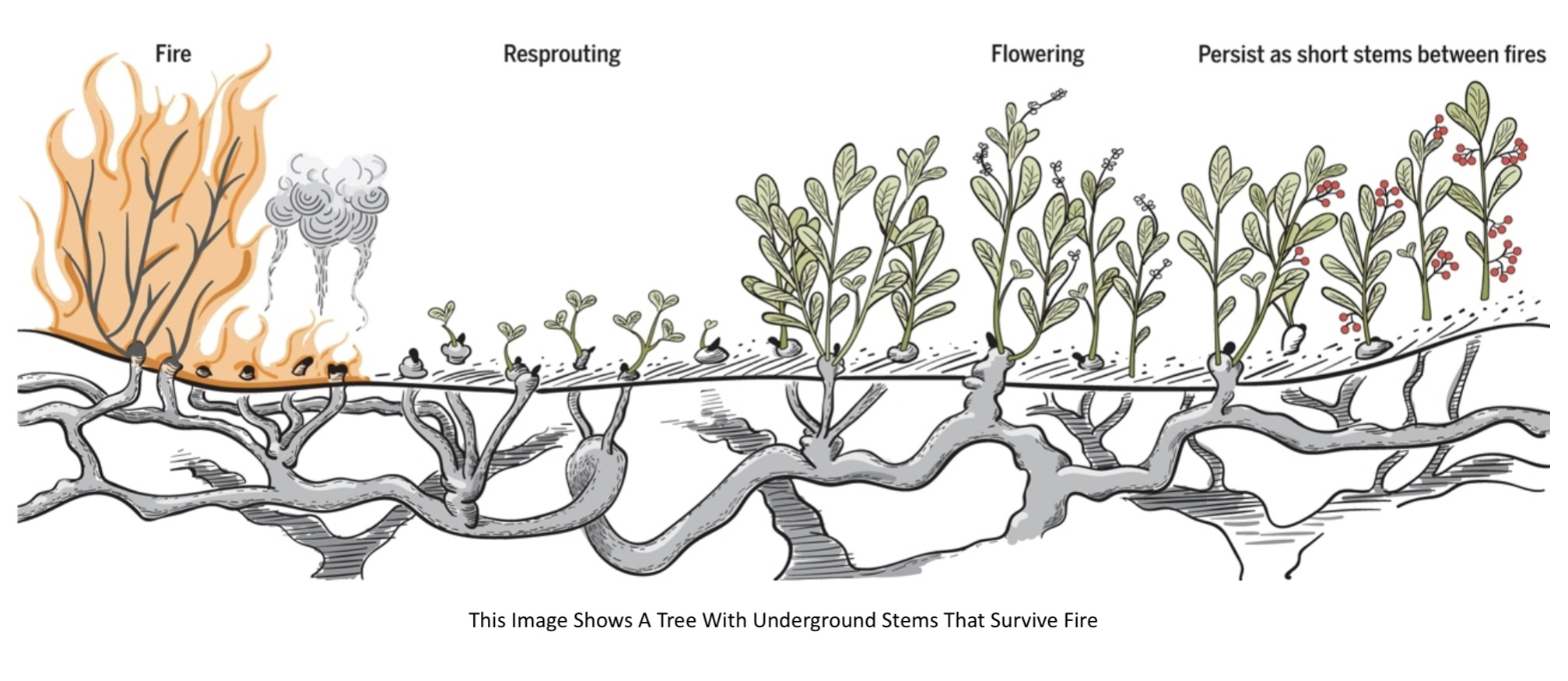
____ Evolved Intriguing Adaptations To Fire Prone Environments
Subterranean Vegetative Organs Survive Fire Injury
•The Underground Stems Generate Sprouts After Fire
Nitrogen-Poor Soils
Some Flowering Plant Species Are Adapted To ____ ____ ____
They Evolved Carnivorous Organs That -
•Attract Prey
•Capture Prey
•Consume Prey
•Digest Prey