MAE 381 EXAM 3 (strengthening mechanisms)
 Call Kai
 Learn
 Practice Test
 Spaced Repetition
 Match
 Flashcards
 Knowt Play
1/20

There's no tags or description
Looks like no tags are added yet.
21 Terms
If we want to make a material harder and stronger → _________ dislocation motion.
restrict
1) Grain Size Reduction
decreasing size of crystalline grains - Grain boundaries act as a barrier to dislocation motion
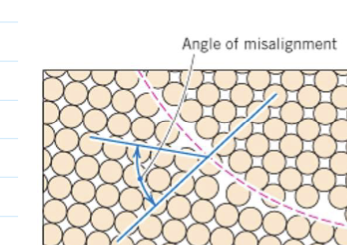
Two Reasons that Grain Boundaries act as a Barrier:
1) Dislocation must change slip direction as it crosses boundary (More difficult for grain dislocations to cross high angle grain boundaries → pile up instead of crossing)
2) Atomic disorder results in a discontinuity of slip planes
Rate of Solidification
slower cooling → larger grains
Heat treatments
grains grow at elevated temps
2) Solid Solution Strengthening
Adding impurities atoms to metals.
impurity atoms increase lattice strain, different sizes distort the crystal lattice, making dislocation movement more difficult
Why do impurity atoms cause lattice strain?
Impurity atoms are different sizes from the host atoms, so they distort the surrounding crystal lattice, then they store lattice energy.
Where do smaller impurity atoms prefer to locate near an edge dislocation?
In the compressive region where atoms are squeezed together → reduces overall lattice strain
Where do larger impurity atoms prefer to locate near an edge dislocation?
In the tensile region where atoms are further apart →reduces overall lattice strain
3) Strain hardening
Plastic deformation increases hardness and strength by increasing dislocation density -. dislocations are harder to move when they are closer together
Why does plastic deformation increase dislocation density?
Dislocations multiply during plastic deformation.
How do two positive edge dislocations on the same slip plane interact?
They repel each other because their stress fields interact. This repulsion can obstruct their movement. (more likely)
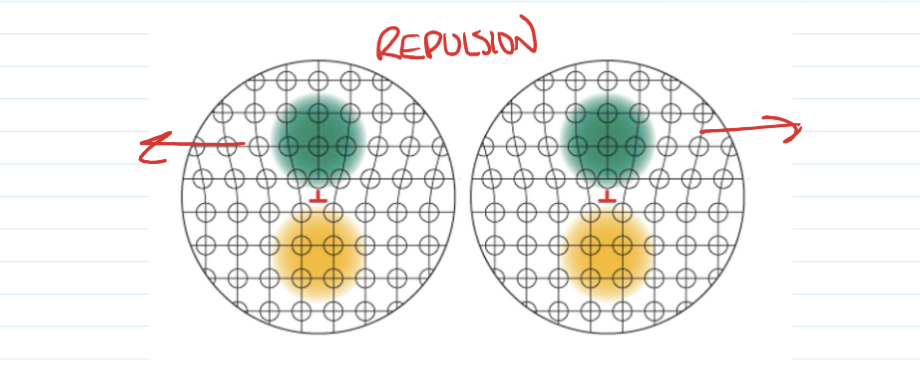
What happens when two edge dislocations of opposite signs meet on the same slip plane?
They attract each other. If they meet, their extra half-planes can join and the dislocations can annihilate. (not as common)

Why does strain hardening depend on dislocation density?
Dislocations are harder to move when they are closer together
As yield strength and tensile strength increase with additional cold work we sacrifice_____.
ductility
Recovery-________
relief of some internal strain energy, usually by heat treatment.
why heat? → enhance atomic diffusion
Why does a cold-worked metal have high internal strain energy?
Plastic deformation increases dislocation density. These dislocations distort the crystal lattice and store strain energy
Recrystallization
The formation of a new set of strain free grains within a previously cold-worked material → usually requires annealing heat treatment
Grain boundaries have ______ energy.
High
Increasing grain size _________ overall energy.
decreases
Where does grain growth occur?
by the migration of grain boundaries