Heat & Mass Midterm
 Call Kai
 Learn
 Practice Test
 Spaced Repetition
 Match
 Flashcards
 Knowt Play
1/18

Earn XP
Description and Tags
Chapters 1,2
19 Terms
Define Heat: symbol, units and definition
Heat (Q): The amount of thermal energy transferred over a time interval
Unit: J
Define Heat Rate: symbol, units and definition
Heat Rate (q): Heat transfer per unit time
Unit: W (J/s)
Define Heat Flux: symbol, units and definition
Heat Flux (q′′): Heat transfer per unit area (W/m2)
What are the 3 modes of heat transfer?
Conduction
Convection
Radiation
Define Conduction
Molecular energy transfer in solids or stationary fluids
Define Convection
Heat transfer between a surface and a moving fluid (often air)
Define Radiation
Electromagnetic heat transfer
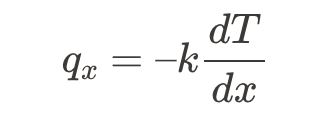
What is the formula for Fourier’s Law?
Define each variable and its units
q′′ → Heat flux (W/m2)
k → Thermal conductivity (W/(m⋅K))
dT/dx → Temperature gradient (K/m)

Define Thermal Conductivity: symbol, units and definition
Thermal Conductivity (k): the ability of a material to transfer heat through conduction. It is an intrinsic property of a given material.
For a give amount of heat flux, the larger 𝑘 is, the ___________ the temperature gradient is.
smaller
can be seen from Fourier’s Law
if qx (or q′′) is held constant, than a larger k means a smaller dT/dx
A higher thermal conductivity _________ heat transfer.
increases
High k (copper, aluminum) → heat moves easily → more heat transfer
Low k (foam, insulation, air) → heat moves poorly → less heat transfer
can also be seen from Fourier’s Law
A higher temperature gradient _________ heat transfer.
increases
Small temperature difference over a distance → weak driving force → less heat transfer
Large temperature difference over a distance → strong driving force → more heat transfer
can also be seen from Fourier’s Law
Explain why there is a negative sign in Fourier’s Law
The negative sign in Fourier's Law ensures that the heat flux is directed from regions of higher temperature to regions of lower temperature.
Since the temperature gradient dT/dx points toward increasing temperature, heat must flow in the opposite direction.
Therefore a negative sign is required to make the heat-flux vector point from hot to cold.
What is heat transfer?
Thermal energy in transit due to a temperature difference
What is thermal energy?
What is the symbol and units?
Thermal energy (Ut): The energy associated with the microscopic behavior of matter.
Units: J or J/kg
Define Temperature: symbol, units and definition
Temperature (T): A means of indirectly assessing the amount of thermal energy stored in matter
Unit: K (or °C, °F)
What is the difference between heat and thermal energy?
Thermal energy is the total internal kinetic and vibrational energy of all the atoms and particles inside an object or substance.
An object possesses thermal energy.
Heat is thermal energy in transit. It is the energy that moves from one object to another because of a difference in temperature.
An object does not "have" heat; heat only exists when it is moving from a warmer place to a cooler one.
What is the energy balance equation for steady-state with no generation?
E˙in=E˙out
Steady-state → Ėst = 0
No generation → Ėg = 0
So E˙in−E˙out+E˙gen=E˙st reduces to E˙in=E˙out
If a question asks for the heat loss through a wall, do you compute q or q’’?
q
heat loss here means heat rate