bonding

0.0(0)
Studied by 0 people
call kaiCall Kai
learnLearn
examPractice Test
spaced repetitionSpaced Repetition
heart puzzleMatch
flashcardsFlashcards
GameKnowt Play
Card Sorting

1/53

encourage image

There's no tags or description

Looks like no tags are added yet.

54 Terms

1
New cards
term image
knowt flashcard image
2
New cards
term image
knowt flashcard image
3
New cards
term image
knowt flashcard image
4
New cards
term image
knowt flashcard image
5
New cards
term image
knowt flashcard image
6
New cards
term image
knowt flashcard image
7
New cards
term image
knowt flashcard image
8
New cards
term image
knowt flashcard image
9
New cards
term image

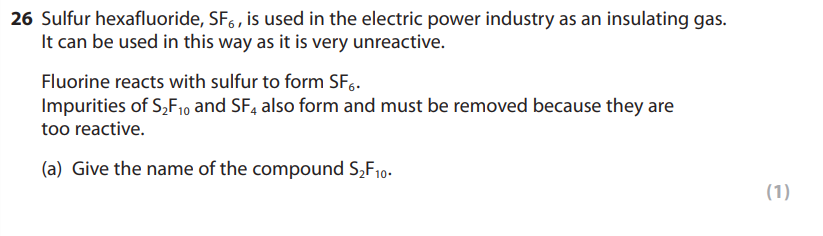
It is disulfur rather than "disulfide" because the -ide ending is only ever added to the second element in a two-element compound.

<p><span><mark>It is </mark></span><strong><mark>disulfur</mark></strong><mark> rather than "disulfide" because the </mark><strong><mark>-ide</mark></strong><mark> ending is only ever added to the </mark><strong><mark>second</mark></strong><mark> element in a two-element compound</mark>.</p>
10
New cards

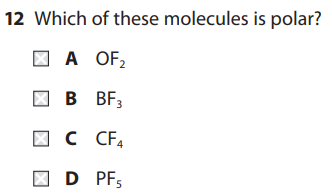
polar molecules

Molecules with Two Atoms
– Identical atoms (H₂, O₂) → non-polar
– Different atoms (HCl) → polar due to electronegativity difference

🔹 Molecules with More Than Two Atoms
– Why symmetry matters
– Why CH₃Cl is polar

🔹 Role of Lone Pairs
– Why H₂O and NH₃ are polar
– How shape affects dipole moments
Symmetrical shapes with identical outer atoms and no lone pair on the central atom cancel out.

Dipoles do not cancel when:

. the central atom has lone pairs (bent H2O, pyramidal

NH3, bent SO2)

. the outer atoms are different (CHCI3, CH2Cl2, HCI)

Polar molecules have a permanent dipole -> permanent

dipole-dipole forces (Topic 7 link)

<p>Molecules with Two Atoms <br>– Identical atoms (H₂, O₂) → non-polar <br>– Different atoms (HCl) → polar due to electronegativity difference <br><br><span data-name="small_blue_diamond" data-type="emoji">🔹</span> Molecules with More Than Two Atoms <br>– Why symmetry matters <br>– Why CH₃Cl is polar <br><br><span data-name="small_blue_diamond" data-type="emoji">🔹</span> Role of Lone Pairs <br>– Why H₂O and NH₃ are polar <br>– How shape affects dipole moments <br><strong>Symmetrical</strong> shapes with identical outer atoms and no lone pair on the central atom cancel out.</p><p>Dipoles do not cancel when:</p><p>. the central atom has lone pairs (bent H2O, pyramidal</p><p>NH3, bent SO2)</p><p>. the outer atoms are different (CHCI3, CH2Cl2, HCI)</p><p>Polar molecules have a permanent dipole -&gt; permanent</p><p>dipole-dipole forces (Topic 7 link) </p>
11
New cards
term image
knowt flashcard image
12
New cards
term image
knowt flashcard image
13
New cards
term image
knowt flashcard image
14
New cards
term image
knowt flashcard image
15
New cards
<p>(d) Arsenic also forms a pentachloride with the formula AsCl5.</p><p>Give one possible reason why nitrogen is the only Group 5 element that</p><p>does not form a pentachloride.</p><p></p>

(d) Arsenic also forms a pentachloride with the formula AsCl5.

Give one possible reason why nitrogen is the only Group 5 element that

does not form a pentachloride.


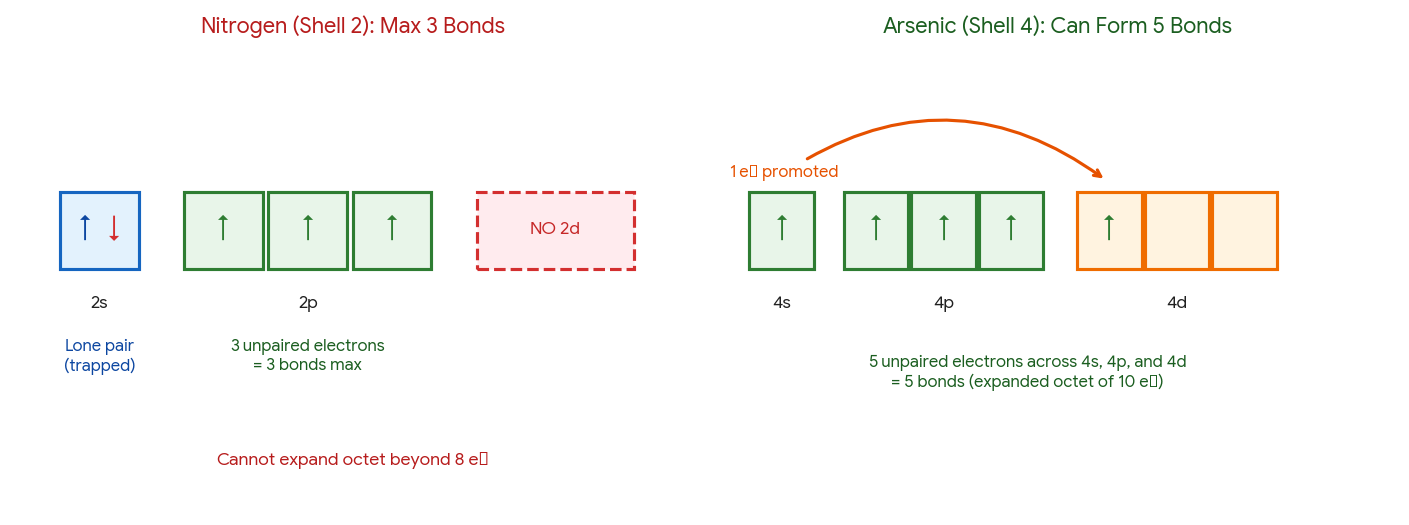
1. Why 5 Outer Electrons ≠ 5 Bonds for Nitrogen

A covalent bond requires two atoms to share a pair of electrons (1 from nitrogen + 1 from chlorine). To form 5 bonds, nitrogen needs 5 separate boxes (orbitals), each holding 1 unpaired electron.

Look at nitrogen's outer shell (n = 2): it only has 4 orbitals total (one 2s and three 2p orbitals). By the Pauli Exclusion Principle, each orbital can hold a maximum of 2 electrons:

  • 2s orbital: 2 paired electrons ([↑↓]) → forms a lone pair (cannot bond normally).

  • Three 2p orbitals: 3 unpaired electrons ([↑] [↑] [↑]) → forms 3 covalent bonds (e.g., NCl₃).

Because there are only 4 orbitals in the second shell, there is literally nowhere to move one of the 2s electrons to unpair it—2d orbitals do not exist! The maximum number of electrons the second shell can ever hold is 8 (4 orbitals × 2 electrons).

2. How Arsenic (As) Uses d-Orbitals to Make 5 Bonds

Arsenic also has 5 outer electrons (4s² 4p³), but its outer shell (n = 4) also includes empty 4d orbitals:

  • Arsenic spends a small amount of energy to promote one of its paired 4s electrons into an empty 4d orbital.

  • Now arsenic has 5 unpaired electrons across five separate orbitals (4s¹ 4p³ 4d¹), allowing it to form 5 covalent bonds with 5 chlorine atoms (10 shared electrons total around As).


<p><strong>1. Why 5 Outer Electrons ≠ 5 Bonds for Nitrogen</strong></p><p>A covalent bond requires two atoms to share a pair of electrons (1 from nitrogen + 1 from chlorine). To form 5 bonds, nitrogen needs 5 separate boxes (orbitals), each holding 1 unpaired electron.</p><p>Look at nitrogen's outer shell (n = 2): it only has 4 orbitals total (one 2s and three 2p orbitals). By the Pauli Exclusion Principle, each orbital can hold a maximum of 2 electrons:</p><ul><li><p><span><strong>2s orbital:</strong> 2 paired electrons ([↑↓]) → forms a lone pair (cannot bond normally).</span></p></li><li><p><span><strong>Three 2p orbitals:</strong> 3 unpaired electrons ([↑] [↑] [↑]) → forms 3 covalent bonds (e.g., NCl₃).</span></p></li></ul><p>Because there are only 4 orbitals in the second shell, there is literally nowhere to move one of the 2s electrons to unpair it—2d orbitals do not exist! The maximum number of electrons the second shell can ever hold is 8 (4 orbitals × 2 electrons).</p><p><strong>2. How Arsenic (As) Uses d-Orbitals to Make 5 Bonds</strong></p><p>Arsenic also has 5 outer electrons (4s² 4p³), but its outer shell (n = 4) also includes empty 4d orbitals:</p><ul><li><p><span>Arsenic spends a small amount of energy to promote one of its paired 4s electrons into an empty 4d orbital.</span></p></li><li><p><span>Now arsenic has 5 unpaired electrons across five separate orbitals (4s¹ 4p³ 4d¹), allowing it to form 5 covalent bonds with 5 chlorine atoms (10 shared electrons total around As).</span></p></li></ul><p></p>
16
New cards
term image
knowt flashcard image
17
New cards
term image
knowt flashcard image
18
New cards
term image
knowt flashcard image
19
New cards
term image
knowt flashcard image
20
New cards
term image
knowt flashcard image
21
New cards
term image
knowt flashcard image
22
New cards
term image
knowt flashcard image
23
New cards
term image
knowt flashcard image
24
New cards
term image
knowt flashcard image
25
New cards
term image
knowt flashcard image
26
New cards
term image
knowt flashcard image
27
New cards
term image
knowt flashcard image
28
New cards
term image
knowt flashcard image
29
New cards
term image

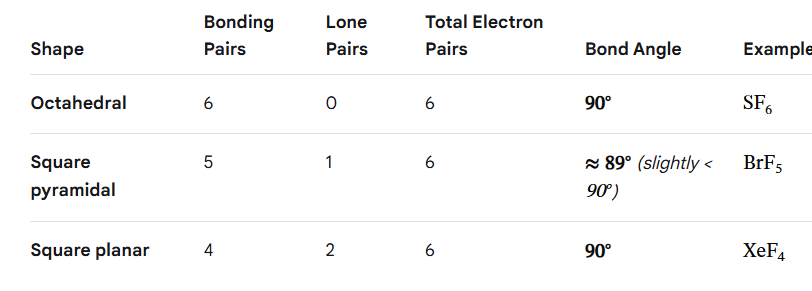
Shape

Bonding Pairs

Lone Pairs

Total Electron Pairs

Bond Angle

Example

Octahedral

6

0

6

\(90^{\circ }\)

SF6

Square pyramidal

5

1

6

\(\approx 89^{\circ }\) (slightly < \(90^{\circ }\))

BrF5

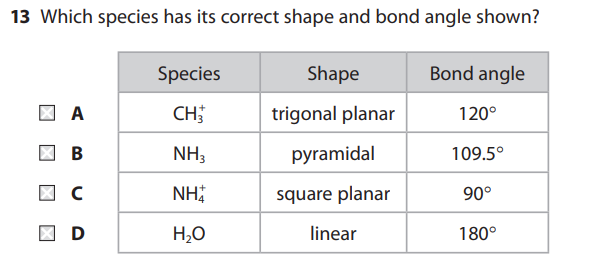
Square planar

4

2

6

\(90^{\circ }\)

XeF4

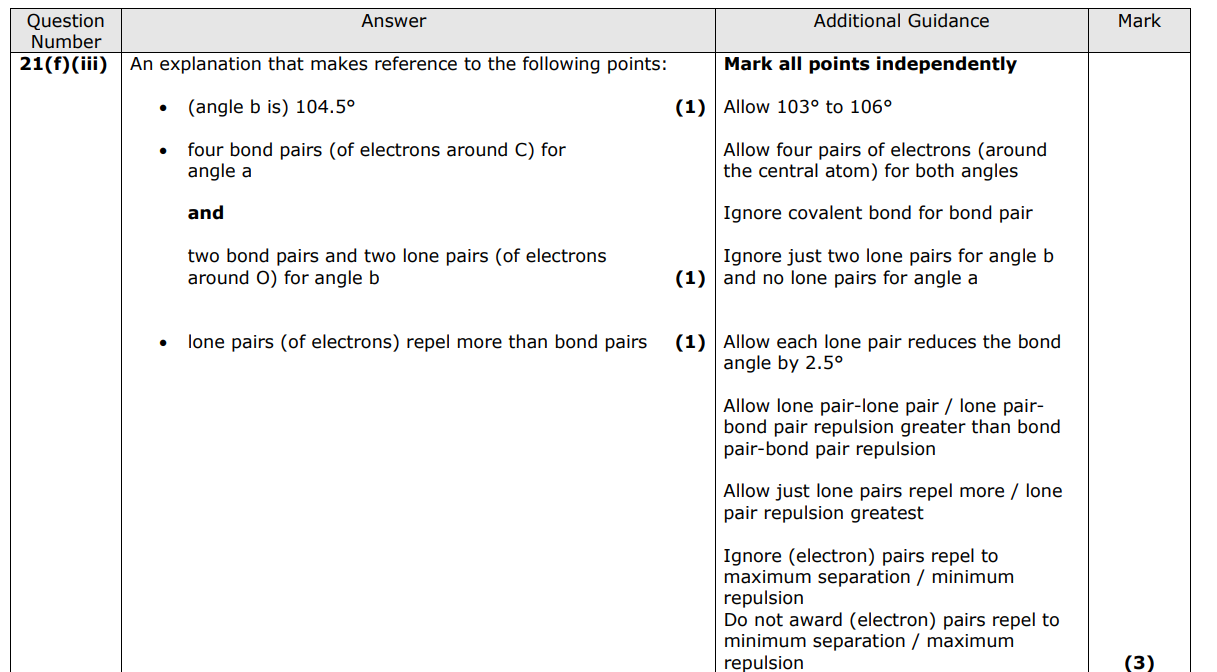
A square planar shape happens when a central atom has 4 bonding pairs and 2 lone pairs

(6 electron pairs total), arranged like a flat "+" sign with \(90^{\circ }\) bond angles.

  1. Start with 6 electron pairs (Octahedral): Six electron pairs arrange themselves in 3D as an octahedron (4 in a flat square middle, 1 straight up, 1 straight down).

  2. Place the 2 lone pairs opposite each other: Because lone pairs repel more strongly than bonding pairs, they sit as far apart as possible—one directly on top and one directly on the bottom (\(180^{\circ }\) apart).

  3. Resulting shape: When you look only at the atoms, the 4 bonded atoms sit flat in a single plane at the corners of a square, each separated by \(90^{\circ }\).

<table style="width: 0px;"><colgroup></colgroup><tbody><tr><th colspan="undefined" rowspan="1" style=""><p>Shape</p></th><th colspan="undefined" rowspan="1" style=""><p>Bonding Pairs</p></th><th colspan="undefined" rowspan="1" style=""><p>Lone Pairs</p></th><th colspan="undefined" rowspan="1" style=""><p>Total Electron Pairs</p></th><th colspan="undefined" rowspan="1" style=""><p>Bond Angle</p></th><th colspan="undefined" rowspan="1" style=""><p>Example</p></th></tr><tr><td colspan="NaN" rowspan="1" style=""><p><strong>Octahedral</strong></p></td><td colspan="NaN" rowspan="1" style=""><p>6</p></td><td colspan="NaN" rowspan="1" style=""><p>0</p></td><td colspan="NaN" rowspan="1" style=""><p>6</p></td><td colspan="NaN" rowspan="1" style=""><p><strong>\(90^{\circ }\)</strong></p></td><td colspan="NaN" rowspan="1" style=""><p>SF6</p></td></tr><tr><td colspan="NaN" rowspan="1" style=""><p><strong>Square pyramidal</strong></p></td><td colspan="NaN" rowspan="1" style=""><p>5</p></td><td colspan="NaN" rowspan="1" style=""><p>1</p></td><td colspan="NaN" rowspan="1" style=""><p>6</p></td><td colspan="NaN" rowspan="1" style=""><p><strong>\(\approx 89^{\circ }\)</strong> <em>(slightly &lt; \(90^{\circ }\))</em></p></td><td colspan="NaN" rowspan="1" style=""><p>BrF5</p></td></tr><tr><td colspan="NaN" rowspan="1" style=""><p><strong>Square planar</strong></p></td><td colspan="NaN" rowspan="1" style=""><p>4</p></td><td colspan="NaN" rowspan="1" style=""><p>2</p></td><td colspan="NaN" rowspan="1" style=""><p>6</p></td><td colspan="NaN" rowspan="1" style=""><p><strong>\(90^{\circ }\)</strong></p></td><td colspan="NaN" rowspan="1" style=""><p>XeF4</p></td></tr></tbody></table><p>A <strong>square planar</strong> shape happens when a central atom has <strong>4 bonding pairs and 2 lone pairs</strong></p><p>(6 electron pairs total), arranged like a flat "+" sign with <strong>\(90^{\circ }\)</strong> bond angles.</p><ol><li><p><span><strong>Start with 6 electron pairs (Octahedral):</strong> Six electron pairs arrange themselves in 3D as an octahedron (4 in a flat square middle, 1 straight up, 1 straight down).</span></p></li><li><p><span><strong>Place the 2 lone pairs opposite each other:</strong> Because lone pairs repel more strongly than bonding pairs, they sit as far apart as possible—one directly on <strong>top</strong> and one directly on the <strong>bottom</strong> (\(180^{\circ }\) apart).</span></p></li><li><p><span><strong>Resulting shape:</strong> When you look only at the atoms, the 4 bonded atoms sit flat in a single plane at the corners of a square, each separated by <strong>\(90^{\circ }\)</strong>.</span></p></li></ol><p></p>
30
New cards
term image
knowt flashcard image
31
New cards
term image
knowt flashcard image
32
New cards
term image
knowt flashcard image
33
New cards
term image
knowt flashcard image
34
New cards
term image
knowt flashcard image
35
New cards
term image
knowt flashcard image
36
New cards
term image
knowt flashcard image
37
New cards
term image

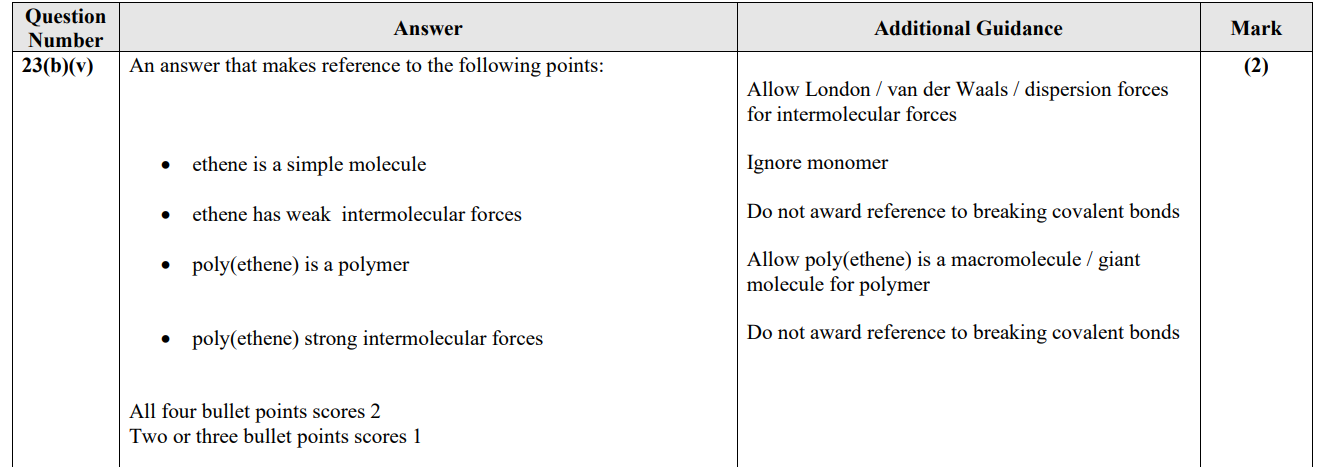
Yes, polymers are made of giant molecules—just really, really long ones!

Think of a polymer like a pile of cooked spaghetti:

  • One strand of spaghetti = One polymer molecule (made of thousands of monomers covalently bonded together in a long chain).

  • The whole bowl of spaghetti = The solid plastic (millions of these long chain molecules tangled up next to each other).

<p><span><strong><mark>Yes, polymers are made of giant molecules—just really, really long ones!</mark></strong></span></p><p>Think of a polymer like a <strong>pile of cooked spaghetti</strong>:</p><ul><li><p><span><strong>One strand of spaghetti</strong> = <strong>One polymer molecule</strong> (made of thousands of monomers covalently bonded together in a long chain).</span></p></li><li><p><span><strong>The whole bowl of spaghetti</strong> = <strong>The solid plastic</strong> (millions of these long chain molecules tangled up next to each other).</span></p></li></ul><p></p>
38
New cards
term image
knowt flashcard image
39
New cards

Electronegativity

"The ability of an atom to attract the bonding pair of electrons (in a covalent bond)."

40
New cards
term image
knowt flashcard image
41
New cards
term image
knowt flashcard image
42
New cards
term image
knowt flashcard image
43
New cards
term image
knowt flashcard image
44
New cards
term image
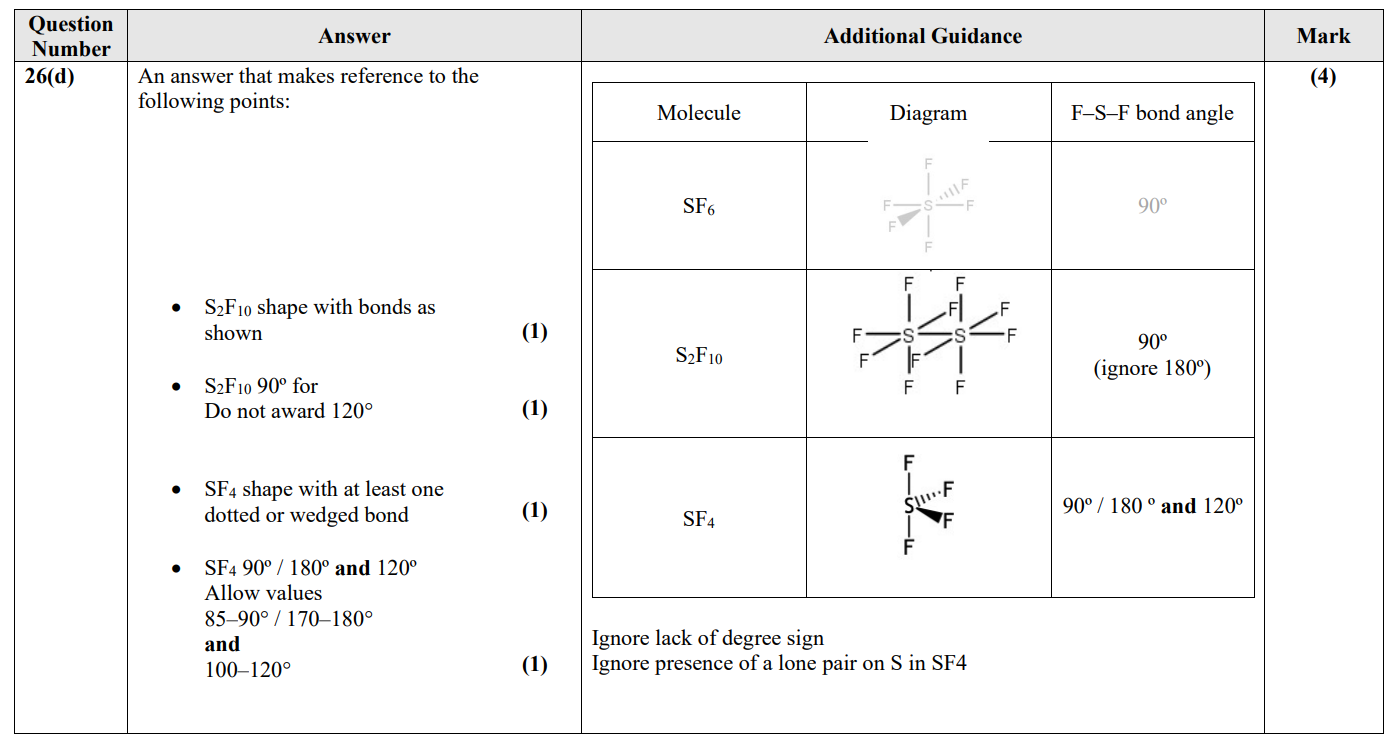
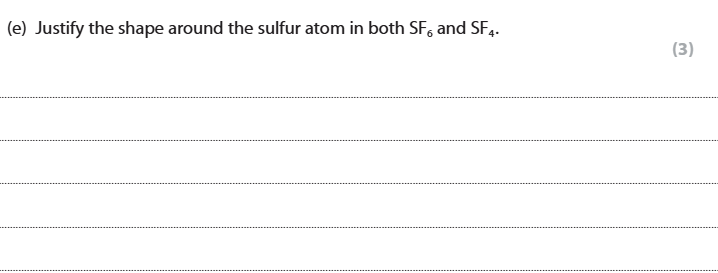
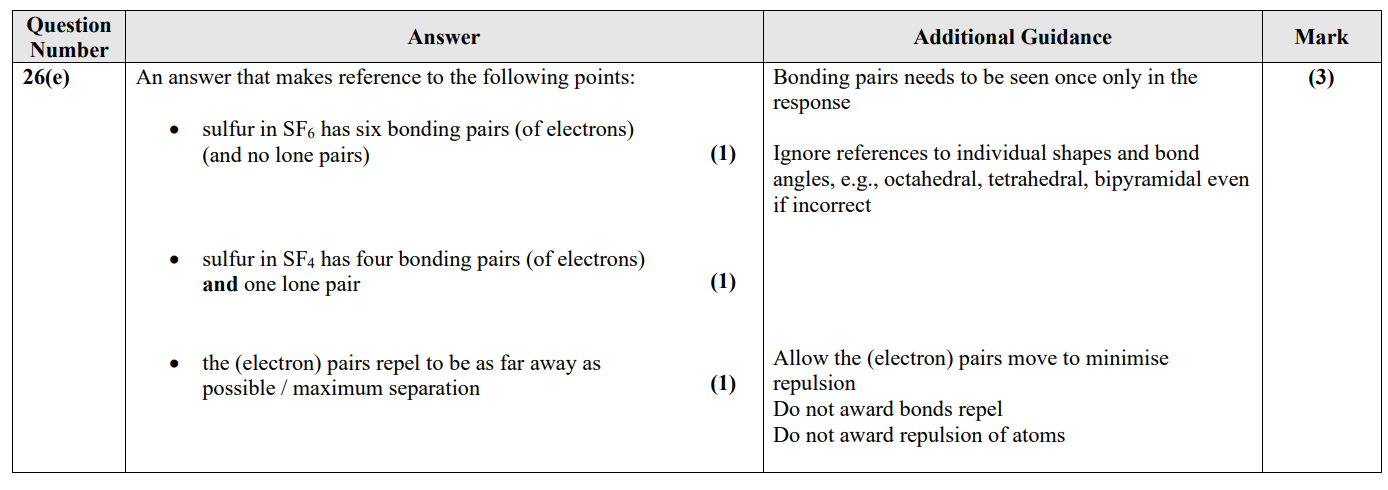
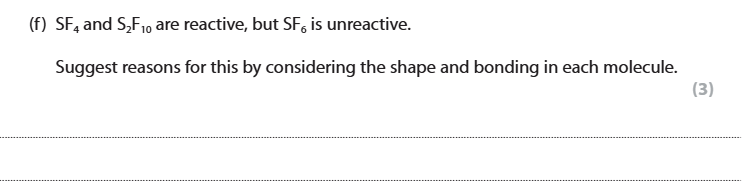
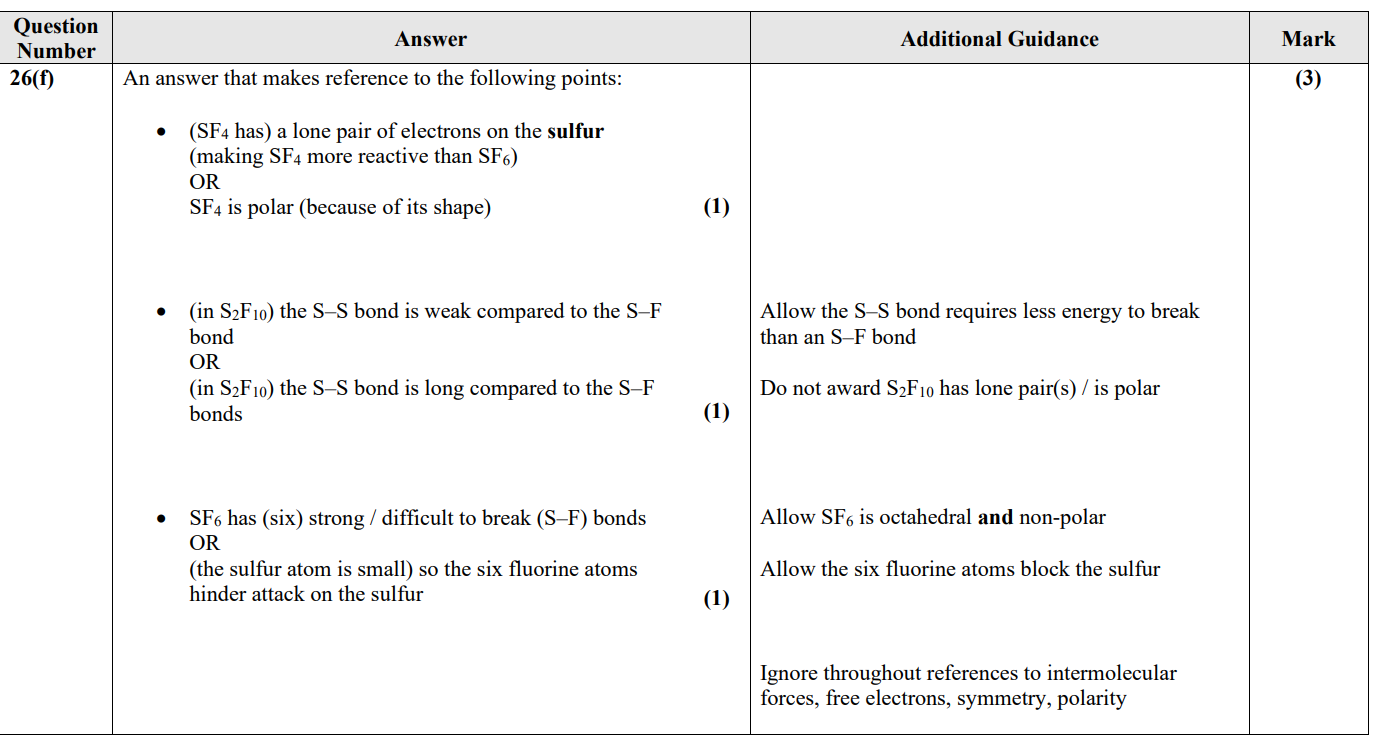
  • Look at SF₆ vs SF₄: One has 6 fluorines packed all around the sulfur; the other only has 4 fluorines and a gap (lone pair). You don't need fancy terms—just describing what you see ("SF₆ is surrounded by 6 F atoms so nothing can get in, while SF₄ has space/a lone pair") gets you 2 out of 3 marks!

  • Look at S₂F₁₀ vs SF₆: What is the only new bond in S₂F₁₀ that wasn't in SF₆? The S–S bond in the middle. Saying "the S–S bond is weaker than the S–F bond" gets the 3rd mark.

<ul><li><p><span><strong>Look at SF₆ vs SF₄:</strong> One has 6 fluorines packed all around the sulfur; the other only has 4 fluorines and a gap (lone pair). You don't need fancy terms—just describing what you see ("SF₆ is surrounded by 6 F atoms so nothing can get in, while SF₄ has space/a lone pair") gets you 2 out of 3 marks!</span></p></li><li><p><span><strong>Look at S₂F₁₀ vs SF₆:</strong> What is the only new bond in S₂F₁₀ that wasn't in SF₆? The S–S bond in the middle. Saying "the S–S bond is weaker than the S–F bond" gets the 3rd mark.</span></p></li></ul><p></p>
45
New cards
term image
knowt flashcard image
46
New cards

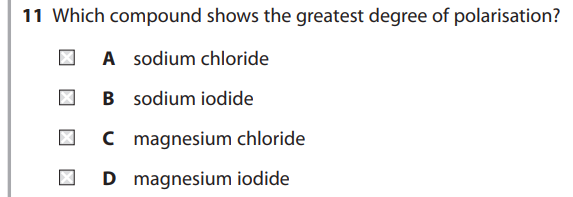
polarisation

knowt flashcard image
47
New cards
term image
knowt flashcard image
48
New cards
term image
knowt flashcard image
49
New cards
term image
knowt flashcard image
50
New cards
term image
knowt flashcard image
51
New cards
term image

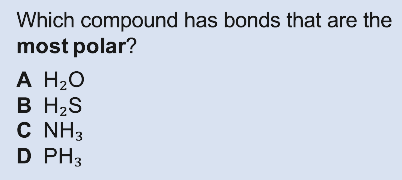
A bond is more polar when the two bonded atoms have a larger difference in electronegativity. Because every option bonds hydrogen (H) to another nonmetal, the most polar bond belongs to the atom with the highest electronegativity:

  1. Remember the trend: Electronegativity increases as you go up and to the right on the periodic table (toward Fluorine, F, the most electronegative element).

  2. Compare the atoms bonded to H:

    • Look at Oxygen (O), Sulfur (S), Nitrogen (N), and Phosphorus (P).

    • O and N are higher up on the periodic table than S and P, so they are more electronegative.

    • Between N and O, Oxygen (O) is further to the right (closer to Fluorine).

Since Oxygen (O) sits highest and furthest to the right among the choices, the O–H bonds in A (H₂O) have the largest electronegativity difference and are the most polar.

(Tip: A quick shortcut to remember the top four most electronegative elements in order is F > O > N > Cl, often remembered as "FONCl".)


<p><span>A bond is more polar when the two bonded atoms have a larger difference in electronegativity. Because every option bonds hydrogen (H) to another nonmetal, the most polar bond belongs to the atom with the highest electronegativity:</span></p><ol><li><p><span><strong>Remember the trend:</strong> Electronegativity increases as you go up and to the right on the periodic table (toward Fluorine, F, the most electronegative element).</span></p></li><li><p><span><strong>Compare the atoms bonded to H:</strong></span></p><ul><li><p><span>Look at Oxygen (O), Sulfur (S), Nitrogen (N), and Phosphorus (P).</span></p></li><li><p><span>O and N are higher up on the periodic table than S and P, so they are more electronegative.</span></p></li><li><p><span>Between N and O, Oxygen (O) is further to the right (closer to Fluorine).</span></p></li></ul></li></ol><p>Since Oxygen (O) sits highest and furthest to the right among the choices, the O–H bonds in <strong>A (H₂O)</strong> have the largest electronegativity difference and are the most polar.</p><p><em>(Tip: A quick shortcut to remember the top four most electronegative elements in order is </em><strong><em>F &gt; O &gt; N &gt; Cl</em></strong><em>, often remembered as "FONCl".)</em></p>
52
New cards
term image
knowt flashcard image
53
New cards
term image
knowt flashcard image
54
New cards
term image
knowt flashcard image