Judgement and Decision Making
 Call Kai
 Learn
Learn Practice Test
 Spaced Repetition
 Match
Match Flashcards
 Knowt Play
1/77

There's no tags or description
Looks like no tags are added yet.
Name | Mastery | Learn | Test | Matching | Spaced | Call with Kai | Chat |
|---|
No analytics yet
Send a link to your students to track their progress
78 Terms
Reference point dependence
from which point the options are evaluated
Expected utility theory
probability p & value v EV=pxv
Axioms
Dominance Principle (ranked best to worst)
Cancellation (depends on outcome)
Transitivity (A to B and B to C then → A to C
Invariance (stable, no matter how decribed
Framing effect
different decision if information presented diferently (Asian Desease Problem)
Prospect Theory
value function
loss aversion (gain>loss)
gains-risk averse
losses- risk seeking

Normative decision analysis
prescribe how people are ought to make decisions in a rational way (expected utiity theory)
descriptive decision analysis
Describe how people actually make decisions (prospect theory)
Certainty effect
big impact if certain outcome switches to merely probable
Pseudocertainty effect
potential of certainty still better than none (overvalue protective measures)
Status quo
want to keep things the way they are, even if we didnt originally choose them, avoid potential losses of change
Mental accounting
construct mental accounts where expenditure is matched with consumption
to simplify financial decisions
(>< moneys fungibility)
Components
decison making - evaluate transactions& outcomes
budgeting- categorize into dif accounts
choice bracketing and dynamic - which evaluated together and when (disposition effect)
dispostition effect
predisposed to holding losers too long an selling winners too soon
Framing outcomes account types
minimal account (2 options)
topical account (comparing to reference point)
comprehensive account (all factors, current, future, possible)
1 acquisition utility
=value - price paid
1 transaction utility
= price paid - internal reference price
🍺
beer on the beach
1sunk cost
current balance is negativ does not linger idenfinitely
1payment depreciation
prior expenditures become less relevant over time
1payment decouples
prepayment - decouples purchachse from consumption (seems to reduce perceived cost)
piece rating policy- link btw payment and consumption are very noticeable
2 budgeting
dividing into categories, facilitates rational trade-offs, self control within not fungible across accounts, small routine expenses not booked
2 gift giving
bigt budget is best when higher than what the person would get themselves
gift cards can change what people spend it on
2 income accounting
match seriousness of source of income to use of it
2 money categories
current assets - money routinely spent
current wealth - designated for saving, less tempting, range of liquidty
home equity
future income
3 Prior losses
do not stimulate risk seeking unless chance to break even
house money effect- prior gain can stimulate risk taking in same account
3 Narrow framing and short term loss aversion
excessive risk aversion
taki driver on rainy day with daily income targets
equity premium puzzle (stocks > government long term
3 diversification heuristics
different decision when making a lot decisions at the same time or one by one over time (which candy bar for the day)
System 1
Accessiblility, operates automatically & quickly
little effort
System 2
effortful activieties, choice, concentration, logically thinking
identify with this
Cognitive reflection task
test to show how often people use system 1 with 3 questions
inituitively wrong, corrected after some thinking
Confirmation Trap
searching for data that supports instead of disconfirming
Natural Assessment
competence based on facial appearance
Interplay System 1&2
1 quickly processes
2 monitors and endorse, correct or override
heuristics
simplifying strategies, in some cases backfire → biases
representativeness
availability
anchoring
biases
systematic errors of judgement
Representativeness heuristic
tendency to judge an event as likely if it represents the typical features of its category → prototype
+ typical features often the most frequent ones
- does not account for : prior odds (insensitivity to base rates, conjuction fallacy), random process (regression to the mean, law of large numbers)
Base Rate Neglect (representativeness)
tendency to ignore/underweight statistical base rates in favor of specific diagnostic case info
Insensitivity to sample size (representativeness)
assume sample size doesnt matter
Misconception of chance (representativeness)
having a forth girl
Inattention to Mean Regression (representativeness)
mistake of expecting extreme past results to continue, while forgetting that naturally moves back toward the average over time
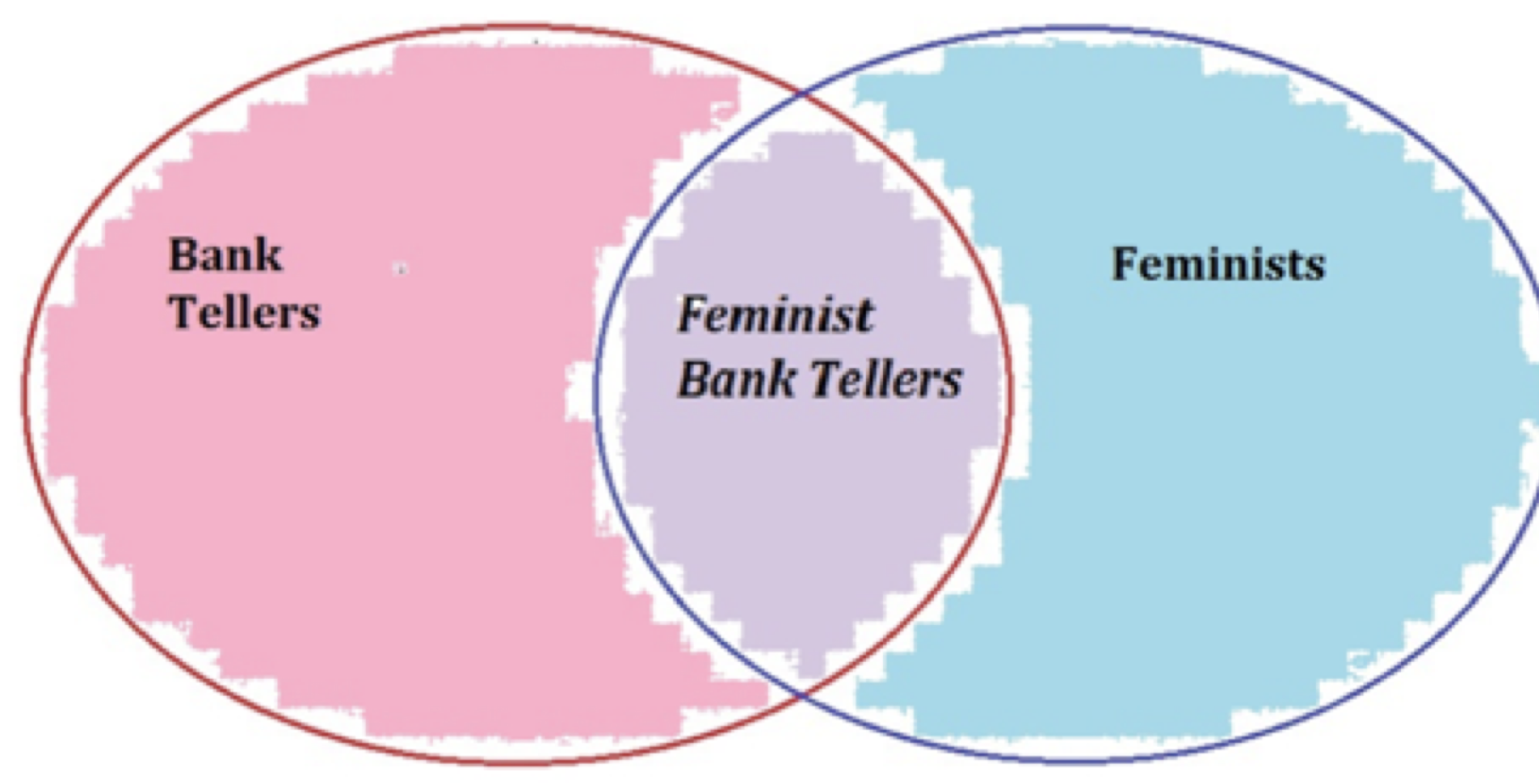
Conjunction Fallacy (representativeness)
judge conjunction of two events (A and B) more probable than one alone (A)
Availability heuristic
ease of recall
+ events that occur more often should be more accessible
- vividness (big events), recency, repetition (oft discussed)
model of Judgment Heuristics
attribute substitution (unconsciously answers an easier, more accessible question in place of a complex)
affect heurisics (emotional reactions 20 vs 200 no effect, only emotion)
Anchoring heuristics
insufficient adjustment (develop estimates by starting with an initial anchor based on available info and adjust from there, bad if from irrelevant anchor)
hindsight bias (obvious in hindsight that an unpredictable event would happen)
Overconfidence
subjective confidence > objective accurcy of those judgements
optimistic biases (overestimate likelihood of experiencing positive events)
overplacement (better than average)
dunning kruger effect (unskilled and unaware of it)
meta knowledge (how much we know about how much we know > actual)
money value
medium of exchange, unit comparison
more than nominal value tho
medium maximization
maximize medium than final outcome (loyalty card, work metrics, grades, miles)
Qualities of money
pain of paying
pain of holding (annoyance)
dirty money
denomination effect
denomination effect
more readily to give smaller denominations
>< tipping self consciousness, presence of others
ultimat egame
2 players, on decides how to split money the other accets (both get that amount) or rejects (non get anything)
compare relative, quality matters, harm when from human, less when from machine
Willingness to punish
3rd party in utlimate game paid 1 to reward even divider and punish uneven
Cost plus myth
respondents did not demand that firms lower prices input cost dropped
unless there was exploiting market power at expense of customer / workers
Superforecasting
(good judgement project) elite teams of forecasters
with a proven, consistently high level of accuracy at predicting future global and geopolitical events, typically using rigorous probabilistic thinking, open-mindedness, and frequent belief updating
Aggregation effectiveness
aggregating many opinions leads to the right one as myths &mistakes cancel each other out
Brier scores
measure accuracy of probability judgements
distance btw forecaster and what happend, lower is better
cognitive abilities & styles of a forecaster
above average fluid intelligence
cometitive, appetite for challenges, willingness to change mind, open mind thinking, embrace secular worldview like math & hypothesis
task specific skills for superforecasters

enriched environments for superforcasters

Motivated reasoning
more likely to believe things that want to believe but constraint by objective evidence & ability
seeing what we and to see, avoiding facts → motivated ignorance
confirmation bias (seeking info that reinforces)
disconfirmation bias (counterargue info that contradicts)
prior attitude affect (previous info more convincing)
recruiting evidence (can i belive this vs. must i /high threshold)
evaluating (using higer/lower contruals)
Dishonesty
fail to judge oneself for unethical behavior, reinterpret benefits as own ability
desire to see themselves as moral, yet bend rules for personal gain
standard economicus dishonesty
trade off external benefits & cost of dishonest acts
linear line
Behavioral Economics dishonesty
linear line, with cutoff to straight line
not cheating to maximum
up to the point where they can still rationalize it
Justifications
moral self kept by making self serving justifications
pre violation (alturism/helping others, moral liscensing/past events) excusable
post violations (cleansing, partial confession, moral distancing) compensate
Wiggle room
exploiting ambuigity to stay moral
shifts graph upwards
Visceral inluences
wants and schoulds
visceral factors (hunger, thirst, sexual desire, moods, emotions, physical pain)
Akrasia
irrational state of mind in which we wittingly throw caution, reason, consequences away to succumbing temptation we know is bad (>< Enkrateia)
Motivational Myopia
focus on goal alleviating visceral state at suspense of other important goals
Restraint bias
tendency to overestimate their ability to control impulsive behavior
Temporal proximity
time, more likely to choose wants the sooner the choice will take effect
sensory proximity
directy / vividly perceived through physical senses
Hot & Cold empathy gaps
hot- short term preferences
cold- long term, no appreciation for behavior in hot states, failure to take measures to avoid future
interpersonal empathy gaps
cold- stigmatize impulsive behavior of others as they fail to appreciate the influences impulses
Visceral fit effect
stimulation fluency influence beliefs (availabiltiy) world associated with current visceral experience more likely
peak-end rule
judge an experience largely based on how they felt at its peak and its end (recency bias) while ignoring duration
AI as supplement
offloading, adds to our thinking, we check it
AI as supplant
surrender, replaces us
Moral AI aversion
dislike AI as moral advisor, has no mind and maximises outcomes
Sycophancy
AI flatters users, so seems more effective &return
Headwind Teilwind Asymmetry
notive headwinds immediately, tailwinds unnoticed after brief adaption
less gratitude, higher resentment, false belieft´ others have it easier (beyond self handicapping, genuine perception)
Associative Priming & Word Availability
Heightened mental accessibility of semantically related concepts within associative memory triggered involuntarily by antecedent stimuli. (e.g., exposure to disgust words sharply lowers recognition threshold for 'stink', 'smell', 'nausea')