BIOC*2580 Midterm
 Call Kai
 Learn
 Practice Test
 Spaced Repetition
 Match
 Flashcards
 Knowt Play
1/42

There's no tags or description
Looks like no tags are added yet.
43 Terms
What does vmax reveal about enzymes?
The upper limit for rate, aka the catalytic rate, which is the rate when 100% of the enzyme is occupied. Higher Vmax means better catalysis.
What does Km tell you about enzymes?
The concentration of substrate (s) at which the rate is equal to 50% of Vmax. A low Km indicates that substrate binds well and that less is needed to occupy the enzyme. A high Km indicates the enzyme binds and used substrate poorly and more is needed to occupy the enzyme.
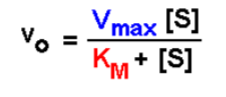
What is the michaelis- menton equation?
What is the y intercept on a Lineweaver Burke plot?
1/Vmax
What is the X- intercept on a Lineweaver Burke plot?
-1/Km
What is the difference between inhibition and inactivation?
Inactivation is usually irreversible because it involves covalent chemical reactions with the enzyme. It has a stoichiometric relationship between the inactivator and the enzyme. Inhibition is typically more reversible because it involves non- covalent binding. Because it is reversible, the degree of inhibition is governed by a binding equilibrium.
What is the difference between competitive and non- competitive binding?
Competitive inhibition affects the ability to bind to substrate, arises when the inhibitor can only bind to unoccupied enzyme. Non- competitive inhibition affects catalytic rate because the inhibitor binding site differs from the substrate binding site, meaning the substrate can still bind to the enzyme, however product yield could be impacted, or the nature of the binding site COULD be changed, preventing substrate from binding.
Why are inhibitors produced in a cell?
To regulate enzyme activity in a cell because it is more economical to make/ destroy an inhibitor than a large enzyme.
What effect does a competitive inhibitor have on enzyme behaviour with increasing S when I is held constant?
Does not affect Vmax but increases Km.
What effect does a non competitive enzyme have on enzyme behaviour?
Vmax decreases, Km remains unchanged.
What is the general description of the 2 steps of the chymotrypsin mechanism?
Chymotrypsin uses nucleophilic Ser-195 to attack the carbonyl in the peptide bond, breaking the peptide in half and releasing the C- terminal end. The N- terminal end remains covalently bound to the enzyme group, forming an acyl- enzyme intermediate.
H2O has it’s proton removed by His- 57, and attacks the acyl- enzyme C=O. His then donates H+ to ser-195, breaking the acyl- enzyme bond and regenerating the enzyme.
What amino acids does chymotrypsin target?
Phe, Tyr and Trp
What are the 3 levels of protein structure?
Primary: linear sequence of amino acids. Secondary: Different segments form into the alpha helix, B sheet. Tertiary: 3D folding of whole polypeptide.
How does protein sequencing with fluorodinitrobenzene work?
At high Ph, the N-terminus denatures, forming a nucleophilic group that reacts with fluorodinitrobenzene. Hydrolysis releases N-terminal amino acid with fluorodinitrobenzene attached, can then be identified via chromatography. The rest of the peptide gets destroyed.
What are the 2 steps of Edman degradation?
Coupling: uses base to label N- terminal amino acid with PITC. Must be finished before next step can proceed.
Cyclization: uses acid to cleave first peptide bond
cycle can be repeatd
How can peptides longer than 50 AAs be studied?
Via selective hydrolysis- cuts the peptide at specific locations, yielding a limited number of chains.
Where does Trypsin act in selective Hydrolysis?
It acts on Arg and Lys, cleaving after the C- terminus, except when they are immediately followed by Pro. All amino acid fragments will have Arg or Lys at the C- terminal end EXCEPT the C- terminus.
Where does Chymotrypsin act in selective hydrolysis?
Acts on Phe, Trp, Tyr, except when followed by proline, and cleaves at their C- terminus. All amino acid fragments will have Trp, Tyr, or Phe at their C end EXCEPT C- terminus.
How does cyanogen bromide act in selective hydrolysis?
It attacks at Met side chains and converts Met into HSE, so all fragments except C terminus have HSA at c- terminus.
How are amino acid sequences usually figured out now?
Determining the DNA sequence and using it to predict the protein sequence.
Why doesn’t edman degradation happen continuously?
Because the protein has to be moved back to basic phase for cyclization to occur.
Where do H bonds form in the alpha helix?
Between the C=O of an amino acid and the H-N 4 AAs later. (ex. AA1 and AA5)
What makes the A helix form vs the B sheet?
A helix when amino acids all have the same orientation. B sheet when AAs have alternating orientation.
What amino acids tend towards the B-sheet?
WYF VIT C
Does F choose between B or A?
No- can fold either way.
What are the secondary structure breakers?
GPSND
What quantity of structure breakers is required to disrupt the structure and form a loop/ turn?
2 in a sequence of 4
What is the simplest tertiary structure?
continuous secondary structures, ex. alpha keratin, beta keratin.
What structure does a sequence with mainly alpha helix groups form?
An alpha helix bundle
non polar AAs every 3-4 places form a non polar patch/stripe, folding to the inside of the bundle.
What tertiary structure is formed by an AA sequence with mostly B sheet groups form?
An antiparallel B sheet, which is stable because H- bonds are arranged in a straight line, side chains project out of the sheet with odd on one side and even on the other, sheet can be polar on one side and non polar on the other side. the sheet then wraps around itself to enclose the non polar face.
What tertiary structure do alternating A-B-A-B segments form?
A parallel B-sheet. Helical sections connect the B strands, which all run in the same direction, meaning they are less stable and must be sequestered from H2O, buried in center of protein.
if all helices lie on the same side of the sheet, it wraps around itself to form a parallel Alpha- beta barrel with the B sheet inside.
What are the 6 Very non polar amino acids?
Alanine, Valine, Leucine, Isoleucine, phenylalanine, methionine
What are the 5 moderately non polar amino acids?
Glycine, cysteine, proline, tryptophan, tyrosine
What are the 4 polar uncharged amino acids?
Serine, threonine, asparagine, glutamine
What are the 3 positively charged amino acids?
Histidine, lysine, and arginine
What are the 2 negatively charged amino acids?
Aspartate and glutamate
What are the enzyme equations in order?
Rate of reaction, enzyme activity, specific activity, molar activity
How long is one AA in an alpha helix
1.5 A
How long is one turn of the alpha helix?
5.4 A
How many amino acids make up one turn of the alpha helix?
3.6
What binds to an anion exchange column?
negatively charged molecules
What do two dimensional gels allow the separation of?
Proteins with similar isoelectric points but different molecular weight.
What does adding SDS do during gel electrophoresis?
Unfolds proteins giving them a uniform charge based on size and allowing separation based only on size