DBMS unit 1
 Call Kai
 Learn
 Practice Test
 Spaced Repetition
 Match
 Flashcards
 Knowt Play
1/43

There's no tags or description
Looks like no tags are added yet.
44 Terms
what is data? What is it in the form of? give example
raw unprocessed facts or figures that do not carry any specific meaning by themselves
in the form of numbers, characters ,words, text, images etc
data has no context on it’s own until it is processed
ex→
Marks: 85, 90 78
Names→ A, B, C
what is information?
Data that has been processed and presented with a context so as to make it meaningful
Information answers questions such as what, who where and when
ex→ ravi scored 85 marks in maths
differentiate between data and information

what is database?
Organised, structured and persistent collection of related data.
List key features of database
Data is logically related and organised
Data is stored in a structured format ( tables, documents, objects, etc)
data can be created, read, updated and deleted efficiently
data can be shared among multiple used and applications
what is DBMS
Database management system is a software that enabled us to create, read, update, delete, and control access to a database
it acts as interface between the database and the end users/application program( that uses database)
what are functions of DBMS?
defining structure(schema) of database
CRUD operations on data
access control
maintaining data integrity and consistency
supporting concurrent access
name a few dbms software
MySQL, PostgreSQL, MongoDB etc
What is Metadata
“data about data”, describes the content,structure, constraints and other features of the actual data stored in a database
where is metadata stored
data dictionary ( special part of database , aka, system catalog)
problems with file system approach→
data redundancy→ same data is stored in multiples files, wasting space
data inconsistency→ if data gets updated in one file and not in the other, data inconsistency may arise
security problems→ difficult to enforce security restrictions
difficulty in accessing data→ no general purpose way to retrieve data
what are advantages of DBMS→
no data redundancy
no data inconsistency
security mechanisms
concurrent access
crash recovery
disadvantages of DBMS→
single point of failure, requires trained staff,
characteristics of db→
data redundancy control
data consistency
security mechanisms
crash recovery mechanisms
concurrent access of data
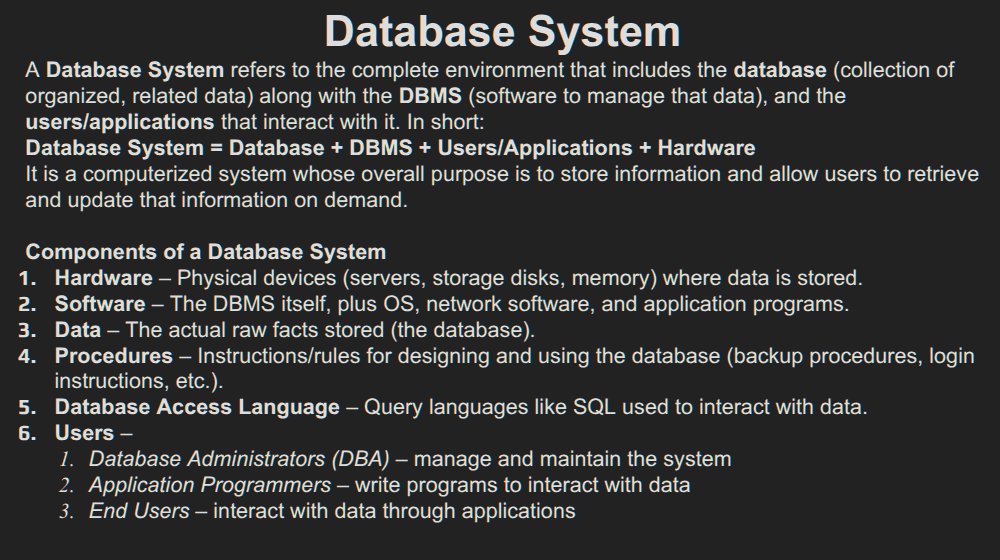
what is database system→
database + dbms + users/applications + hardware
what is schema, what are it’s three parts
blueprint that defines how data is organized and stored in a database.
three parts→ conceptual database schema, physical database schema, logical database schema
what is conceptual database schema
describes database on a theoretical level.
modeled using ER diagram
consists of→
entities (real world objects→ customer, student etc)
attributes(features of entities ex→ name, age,address)
relationshiops→ (connection between entities
what is physical database schema
how data is stored on disk physically
determines physical layout of tables and indexes
designed by the DBA( database admin)
logical database schema
describes the logical structure of data
defines tables, columns, primary keys, foreign keys, relationships and integrity rules
this schema is built from the conceptual schema using ER modeling
what is database instance
snapshot of database at a specific moment in time
What are the users of database→
DBA( database admin)→
creates and manages database
controls user access
ensure securityNaive user→
user without technical knowledge, they view/enter data through ready-made interfacesapplication programmer→
dev who creates applications that use database as one of the componentsSophisticated user→
users with technical knowledge who study and analyze data in the database
ex→ data analyst, researcher etcdatabase designer→ designs structure of database before it is implemented,
knowledge user→ user who uses database to support decision making and analysis
ex→ engineer, doctor, researcher etc
what are the components of DBMS architecture→
Disk Storage
Storage manager
Query processor

wdym by disk storage?
all info stored on physical disk, comprises of
data→ record/info itself
data directory → metadata
indices→Shortcuts that let the system look up specific values quickly
statistical data → statistical data about data
wdym by storage manager→
acts as bridge between data stored on disk and user applications/queries
responsible for creating, reading, updating and deleting data
translates DML commands into low level commands
wdym by query processor? what are it’s three parts
turns query commands into machine readable instructions. comprises of→
1. DDL interpreter
DML compiler
query evaluation engine → executes low level instr generated by DML compiler
there are three architectures of application using database, what are they, pros and cons
1-tier architecture→ client, server and database are all in one machine, common in standalone applications
pros→ simple, cost effective, easy
cons → single user only, no scalability, hard to share data, poor security
2-tier architecture → basic client server architecture, clients accesses data via server only, server processes queries and returns to the user
pros → easier and cheaper than 3 tier mode
cons → server can get overloaded with requests,
3-tier architecture → an intermediate layer is present between client and database server, the application server,which processes and relays data
pros → scalability and security increases
cons → complex and more costly, slower response time
what is the 3 schema architecture? who was it propsoed by? what was it’s aim? what are the three levels, draw diagram
the three schema architecture of DBMS , proposed by ANSI/SPARC,
aim → to achieve data abstraction and independence (change in one level does not affect the layers above it)
External level, conceptual level, internal level

tell about external schema/view level→
layer closest to end users, users only see customized views of the database
tell about conceptual schema/logical level
what data is stored and the relationship between them. simple data structures are used
tell about physical level/physical schema
the raw data sitting on the physical storage device, how data is arranged physically
advantages of ANSI/SPARC, 3 tier model→
data abstraction (unnecessary details hidden), data independence(change in one level does not affect the higher levels), multiple user views, improved security, flexibility, and performance
what is data independence? what is it’s importance
ability to modify the schema at one level without affecting the schema at the next higher level
importance→
reduces maintenance
increased flexibility
supports long-term growth
what is logical data independence
ability to modify logical level without changes being reflected in the view level.
ex→ add a column (email id) in the employees table
what is physical data independence
ability to modify physical level without changes being reflected in the conceptual/logical level
ex→ change file location, change disk(HDD to SSD), adding indexes
what’s a data model
A Data Model in a Database Management System (DBMS) is an abstract framework that defines the logical structure, relationships, constraints, and flow of data within a system.
It provides the blueprint for how data is stored, organized, accessed, and manipulated.
what are the types of data models?
Conceptual data model, representational data model, physical data model
what is conceptual data model?
defn → it is a high level model that defines what the database will store and how it will be structured. representation using ER( enttity relationshiop model) is highly used
focus on real-world entities, their attributes and relationship between them
useful for non-technical personnel, database designers etc
what is representational model
only logical part of database is defined
how data will be stored physically on disk is not defiend
Relational model(along with relational algebra and relational calculus) is used to represent this type of data mode
Relational model consists of tables
what is physical data model
Used for implementation of representational data model on physical storage devices
data is stored in memory
SQL is used to implement the physical data model
what are the four types of database languages
DDL, DCL, DML, TCL
what is DDL
Data definition language,
define and alter database schema and structure →
5 DDL commands→
CREATE → create database object
ALTER → modify structure of existing database object, such as adding a col to a table
DROP→ delete database objects
TRUNCATE → remove all rows from a table
RENAME → change the name of a database object
database object→ table, index, view
acronym→ DACTR
what is DML
data manipulation language
retrieval and modification of data records within tables
DML commands →
SELECT → retrieve data from table
INSERT → add new rows of data into an existing table
UPDATE → modify existing data in a table
DELETE → removes data from a table
what is DCL
Data control language
manage user permissions, access privileges and security controls
GRANT - give access to user
REVOKE - remove access from user
what is TCL
Transactional control language
manage database transactions
COMMIT → save all changes made during the current transaction to the database
ROLLBACK → restore database to it’s original state from the last commit