Motor Dev Exam IV
 Call Kai
 Learn
 Practice Test
 Spaced Repetition
 Match
 Flashcards
 Knowt Play
1/34

There's no tags or description
Looks like no tags are added yet.
35 Terms
Highlights from OPTIMAL
motor learning CANNOT be understood without considering motivation and attentional influences
specifically the motivational factors that underlie intrinsic motivation
Intrinsic motivation
the learners internalized drive. determined by 3 basic needs: autonomy, competence, relatedness
Motivation: enhancing expectancies
Self-efficacy. an individual situation-specific confidence or prospective sense that he or she will be able to affect the actions that bring about task outcomes→ leads to improved performance
How to enhance self efficacy (enhance expectancies)
1.provide positive feedback: emphasize successful trials, ignore less successful attempts (do it genuinely)
2. social-comparative feedback: false positive feedback compared to group norms (learner must be blind to group performance)
3. butter up with language (good people like yourself)
4. give them a easy goal to achieve
5. use tricks (illusions, superstitions) to enhance beliefs
Incremental vs fixed entity theorists
Incremental- people that believe abilities can change
Fixed- people that believe abilities are immutable
Motivation, autonomy
belief that the learner is the agent bringing about positive changes
Biggest ways to enhance autonomy:
give the learner control over something (even if its incidental to the task), use autonomy supportive language
Motivation, external focus of attention
drive learner focus externally- leading to increased effectiveness and efficiency of movement
promote automaticity
Skill acquisition- specificity of learning
you learn what you practice
consider environment and sensory feedback
Skill acquisition- learning vs performance in practice
emphasize learning not performance. you want to emphasize discovery and experimentation in practice
Benefits of practice
improve perceptual skills
improve attention- reduced capacity demands (don’t need as much attention to complete task)
improve attention- reduced effector competition (execute multiple motor programs same time)
reduce the # of motor programs required to perform a task
error detection- increase ability to detect and correct errors, self sufficient learners
Part vs whole practice
Part often chosen when whole is too complex
Whole is always > part
Massed vs distributed practice
Massed- relatively little or no rest between trials
Distributed- much more rest between trials
Organizing practice & rest periods- discrete & continuous
massed is better than distribution
*assuming no negative effects of fatigue
continuous- fatigue is significant variable (like real life)
Variable vs Constant practice- schema theory
learner acquires a set of rules '“schema” that relate to surface features of the action to parameter values necessary for actions
doing lots of variable reps- create flexible rules that cover a wide range
predictions become more accurate
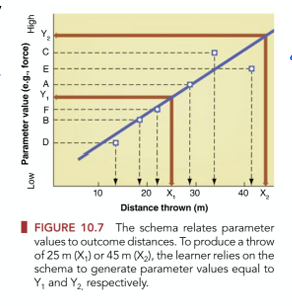
Variable vs constant practice
Variable- variability of environment (dirt field, different pitches).
Variable practice is better
Blocked vs random practice
Random- variability of task (different throws)
increases retention long term
Elaboration hypothesis
Random practice=made tasks distinct=more elaborate memory
task B has an arm movement that looks like “Z”
random- make distinctions between tasks
Forgetting hypothesis
short term memory storage is limited, thus switching tasks= forgetting - re-generating solution
“forgetting begets remembering”
better solution generating later
Feedback classifications
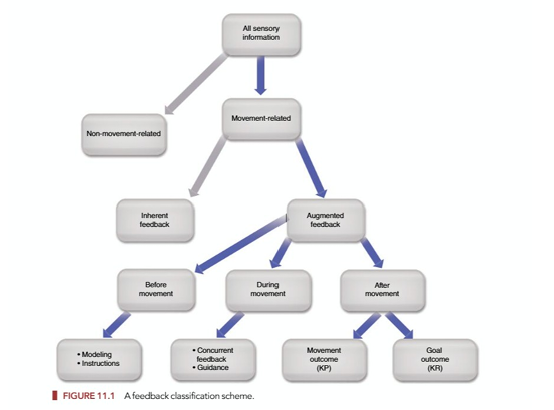
Inherent vs augmented feedback
Inherent/intrinsic= naturally available from environment, available to learner without special methods or devices
Augmented/extrinsic= provided in addition to inherent feedback (provided before, after, or during)
Augmented before, during, after
Before: not really feedback. Develop predictive modeling, cognitive processes about task
During: during a continuous task, allow to alter in real time
After: knowledge or performance or knowledge of results
Augmented after feedback (results vs performance)
Knowledge of results: verbalize info about success of action with respect to environment goal
Without KR→ no learning will occur→ important (you need to know if what you did was right)
Knowledge of performance: kinematic feedback, no necessarily about success of movement
Functions of Augmented feedback
motivates or discourages the learner
learners who are given feedback say they like the task more (unless its overdone)
directs the learners focus of attention
KR=external. KP=internal
provides info about errors to be corrected
creates a dependency, potentially leading to problems
Augmented feedback, dependency producing properties
Guidance hypothesis: learner can become dependent on external feedback rather than internal
Feedback precision
level of precision to provide depends on the learners skill
early: making large errors, give large corrections
higher skill: precise feedback can be effective
Video feedback
shown to be helpful! even if no cues are given

Absolute vs relative feedback
Absolute frequency: total # of feedbacks given (100 comments)
Relative frequency: # of feedbacks given as percentage of total trials (100 of 400= 25%)
faded feedback is best
Bandwidth feedback
Based on present acceptability of performance. Feedback only provided when outside of this bandwidth of acceptability.
learner must know that no feedback=good!
naturally builds in faded feedback and reduces overall feedback
Summary feedback
Feedback is withheld for a number of trials, and then provided for the set of trials rather than each rep
how many do you summarize? depends on the learner ability (elite=larger. novice=smaller)
Average feedback
same as summary, get an average of scores/results instead of a trial by trial breakdown
Feedback timing- concurrent
helps during practice, but once removed performance suffers (AI math tutors)
Physical guidance-
learners rely to heavily on it. leaner doesn’t experience errors and doesn’t learn

Feedback timing- after movement
instantaneous is detrimental to learning, blocks learner from processing
filling the feedback-delay with a different task is also bad
Filling it with more trials of the same task, increases learning
Subjective estimates (have the person say what they think)- improve performance. You can negate the effects of KP by using subjective estimates.
Constraints led approach
realize that the athlete is operating within a specific environment, you must take into consideration- body size, strength, amount of practice, task, ect
and then CHANGE the task so the correct solution flows from the athlete
CLA broad applications
de-stabilize the existing movement solution/attractor
make it impossible
encourage self organization and exploration
let them do it awhile
amplify info and invite affordances
change the task such that certain info is increased or athletes perceived differently
provide transition feedback about effectiveness of the search
EX: direction of connection ball, not the pitch
Differential learning