PSYC C1000 Exam #2
 Call Kai
 Learn
 Practice Test
 Spaced Repetition
 Match
 Flashcards
 Knowt Play
1/127

Earn XP
Description and Tags
All vocabulary
128 Terms
Associative learning
learning that certain events occur together
Habituation
a form of non-associative learning in which an organism decreases or stops its response to a repeated stimulus over time
Stimulus
any event, object, or environmental change that causes a reaction, activity, or response
Classical conditioning
an organism pairs a neutral signal with a natural, automatic reflex to create a learned response
Russian physiologist, Ivan Pavlov
Unconditioned stimulus (US), Unconditioned response (UR), Neutral stimulus (NS), Conditioned stimulus (CS), Conditioned response (CR), Acquisition, Extinction, Spontaneous recovery
Unconditioned stimulus (US)
stimulus that normally triggers a response
EX: dog food
Unconditioned response (UR)
natural, unlearned response to the unconditioned stimulus (US)
EX: dog salivates
Neutral stimulus (NS)
stimulus that elicts no response before conditioning
Conditioned stimulus (CS)
an originally neutral stimulus (NS) that after pairing with unconditioned stimulus (US), it triggers a conditioned response (CR)
EX: dog food bowl
Conditioned response (CR)
learned response to a previously neutral conditioned stimulus (CS)
EX: dog salivates when bowl is present
Acquisition
learning association between unconditioned stimulus (US) and conditioned stimulus (CS)
Extinction
conditioned stimulus (CS) and unconditioned stimulus (US) are no longer paired, organism becomes less likely to perform conditioned response (CR)
does not eliminate CS-US association, only suppresses it
Spontaneous recovery
reappearance of conditioned response (CR) after a time delay post-extinction
Operant conditioning
voluntary behavior is modified by its consequences, such as rewards or punishments
American psychologist Edward Thorndike and B.F. Skinner
Law of Effect, Reinforcement, Punishment, Positive reinforcement, Negative reinforcement, Positive punishment, Negative punishment
Edward Thorndike
introduced Operant conditioning, tested animal learning with puzzle boxes
Law of Effect
explained by Edward Thorndike, behaviors that have positive/negative outcomes are strengthened/weakened (more/less likely to be repeated)
B.F. Skinner
formalized Operant conditioning, studied how behaviors are learned, Skinner box
Reinforcement
any event that increases how often a specific behavior is performed
Punishment
any event that decreases how often a specific behavior is performed
if you do not do what I want, I will give you a negative stimulus (positive punishment) or take away a good thing (negative punishment)
Positive reinforcement
present a desired stimulus after a response
EX: work hard at your job, earn a promotion
Negative reinforcement
remove an unpleasant stimulus after a response
EX: hit snooze on an alarm clock to stop annoying noise
organism likes it
if you do what I want, I will eliminate a negative stimulus
Positive punishment
present an unpleasant stimulus after a response
EX: after you tease your brother, mom makes you do his chores as well
organism dislikes it
Negative punishment
remove a desired stimulus after a response
EX: if you are caught drunk driving, your driver’s license will be suspended
Primary reinforcers
positive on own merits
EX: watching a movie, headache going away
Secondary reinforcers
positive because they become associated with a primary reinforcer
EX: movie ticket, aspirin
Continuous reinforcement
get the reward everytime you do the behavior
Partial reinforcement
get the reward some of the time you do the behavior
Ratio schedules, Fixed ratio, Variable ratio, Interval schedules, Fixed interval, Variable interval
Ratio schedules
rewards are based on how often you do the behavior
Fixed ratio
get a reward after a specific number of behaviors are performed
EX: store loyalty cards, buy 5 and get the 6th one free
Variable ratio
get a reward after a varying amount of behaviors are performed
EX: playing slots (can play as much as you want, but will not know when you will win)
Interval schedules
rewards are based on doing a behavior after some time has passed
Fixed interval
get a reward when you perform the behavior after a specific amount of time has passed
EX: waiting for a restaurant to open so you can order
Variable interval
get a reward when you perform the behavior after a varying amount of time has passed
EX: calling to see if your car is ready
Problems with Punishment
punisher serves as a model
can cause negative emotions
only says what not to do
only suppresses the behavior
can be abusive
Instinctive drift
after conditioning, would reppear and interfere with what had been learned
Motivation
a stimulus or force that directs behavior, thoughts, and persistence
Intrinsic motivation
drive to continue a behavior because of internal motivation
EX: enjoy doing it, want to learn about it
Extrinsic motivation
drive to continue a behavior because of external motivation
EX: do it to get paid, get a good grade
Instincts
fixed, unlearned behavior patterns throughout a species
EX: Imprinting - where an organism learns the features of its parents
Drive-Reduction Theory
behavior is due to drives to fulfill basic biological needs; when unmet, it creates a drive
EX: Need (food, water) → Drive (hunger, thirst) → Drive-reducing behaviors (eating, drinking)
Drives
a state of tension that motivates us to reduce the need
Homeostasis
maintaining a physiological equilibrium, keeping the body’s levels in balance
EX: temperature, blood sugar
Set point
the level at which a physiological state tends to stabilize
EX: body temperature at 98.6°
Incentives
positive or negative environmental stimuli that lure or repel us
EX: smell of churros (positive) vs having to eat soup out of the dog’s food bowl (negative)
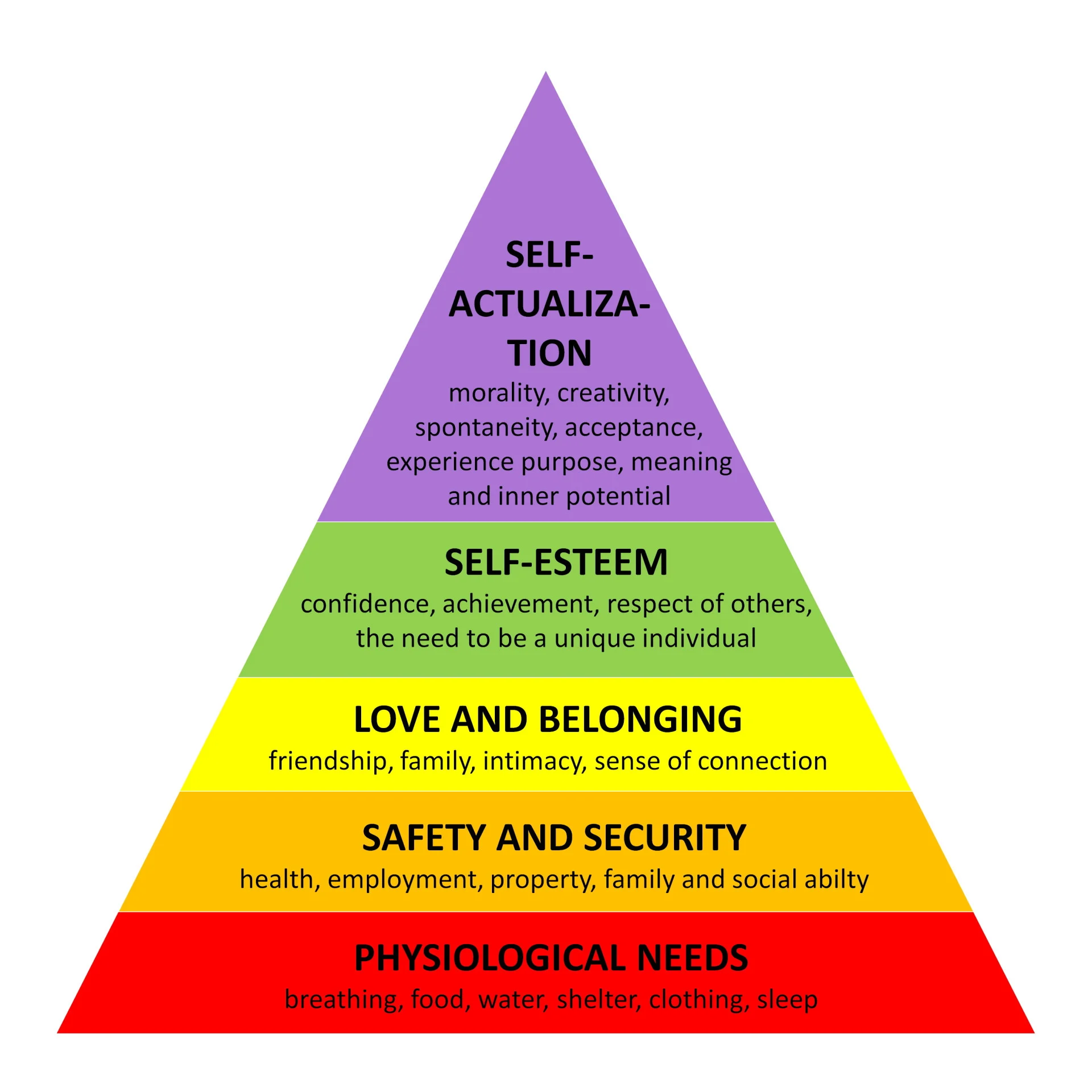
Abraham Maslow’s Hierarchy of Needs
humanisitic perspective where needs at the lower level of the pyramid are the highest priority and must be met first, while the higher level are last needed
Physiological (hunger, thirst, sleep, body temperature)
Safety (to feel safe and secure)
Love and Belongings (to feel part of the group, to have relationships)
Esteem (to achieve, to have self-respect and feelingso of independence)
Self-Actualization (to strive for one’s fullest potential)
Self-Transcedence (to extreme beyond self)
Arousal theory
performance is typically better under moderate arousal
Optimal arousal
varies with task difficulty
high arousal is best for easy tasks
low arousal is best for hard tasks
Hypothalamus
assesses blood glucose (sugar) levels, low blood sugar triggers hunger
Lateral hypothalamus (LH)
increases appetite, starts eating center
Ventromedial hypothalamus (VMH)
decreases appetite, stops eating center
Orexins
hormones produced in lateral hypothalamus (LH) that stimulate hunger
Ghrelin
hormone produced by an empty stomach that stimulates hunger
Insulin
hormone produced by the pancreas in response to food intake, regulates blood sugar levels
Leptin
hormone produced by fat cells that suppresses hunger
Body Mass Index (BMI)
estimates body fat and health risks using height and weight
Overweight Adult: BMI of 25-30
Obesity Adult: BMI of 30+
does not account for differences in density of muscle and fat, would be better to measure waist circumference to height (healthier when waist circumference < half of height)
Causes for Obesity
poor diets
physical inactivity
genetics
family behaviors (eating out frequently, junk food)
socioeconomic factors (lack of good diet, exercise)
psychological factors (stress eating, depression, boredom)
Emotion
a psychological state involving a subjective or inner experience, physiological component and a behavioral expression
Physiological component
bodily arousal, EX: change in heart rate
Subjective experience
your feeling or interpretation of the emotion, EX: I feel happy
Behavioral component
characteristic overt expressions of emotions, EX: smiling
James-Lange Theory of Emotion
emotional feelings follow specific patterns of bodily arousal for each emotion and come from awareness of such arousal
William James & Carl Lange
physiological arousal comes before the subjective emotional experience
each emotion has a distinct physiological fingerprint
Cannon-Bard Theory of Emotion
thalamus causes physiological arousal and emotional feelings at the same time
Walter Cannon & Philip Bard
Schacter and Singer’s Two-Factor Theory
emotions occur when a cognitive label is applied to general physical arousal
Stanley Schacter & Jerome Singer
based off of one’s knowledge of their current situation and their previous experiences in those situation
general arousal + cognitive label = subjective emotional experience
Lazarus’s Theory of Emotion
emotions are based on one’s cognitive appraisal of the situation
Richard Lazarus
does not focus on physiological responses
Cognitive appraisal
emotions created from subliminal priming, signals go directly from thalamus and amygdala
Zajonc, LeDoux
Sympathetic Nervous System
increases heart rate, breathing rate, production of sweat, flow of adrenaline
prepares body for intense activity
fight-or-flight
Parasympathetic Nervous System
decreases heart rate, breathing rate, increases digestion
works to keep organism alive in the long term
Polygraph
assesses sympathetic nerous system arousal (blood pressure, heart rate, respiration, skin conduction
Basic emotions
fear, anger, disgust, happy, sad, surprise
found across cultures
emerge early in life
should have a unique biological basis and a distinct facial expression
babies born blind from birth display the same facial expressions
Predictors of Happiness
genetics, temperament, working toward goals, engaging hobbies, close friendships, satisfying marriage, religious faith, exercise, be nice to others, get enough sleep, optimism, count your blessings, positive experiences
Adaption-level phenomenon
tendency to make judgements relative to our previous experiences, adjust to changes over time (we become habituated to the new situation)
Relative deprivation
perception that we are doing worse than our comparison group, EX: why wealthy people can feel poor
Necessities to Recall Information
exposure to information
attention to information
Encoding, Storage, Retrieval
Encoding
getting the information into the brain
Storage
retaining the information over time
Retrieval
retrieving the information from storage
Recall
requires generation of times and identification of correct items
Recognition
easier once being able to recall
Tip of the Tongue Phenomenon
forgetting due to an error in retrieval of information
Sensory memory
the briefest, initial stage of memory that stores raw, unprocessed environmental data from our senses for a fraction of a second up to a few seconds
Iconic memory & Echoic memory
Iconic memory
visual aspect of sensory memory, lasts about ¼ to ½ a second
Echoic memory
auditory aspect of sensory memory, lasts a few seconds
Short-term memory
what is currently active in memory, lasts about 20 seconds, has a capacity of 7±2 items
can increase the amount of content stored by chunking “items'“ into meaningful units
Long-term memory
capacity can be unlimited (?), duration can be lifetime (?)
most forgetting is in the first six months, then levels off after three years
Storage - items move from STM to LTM through increased processing (“consolidation”)
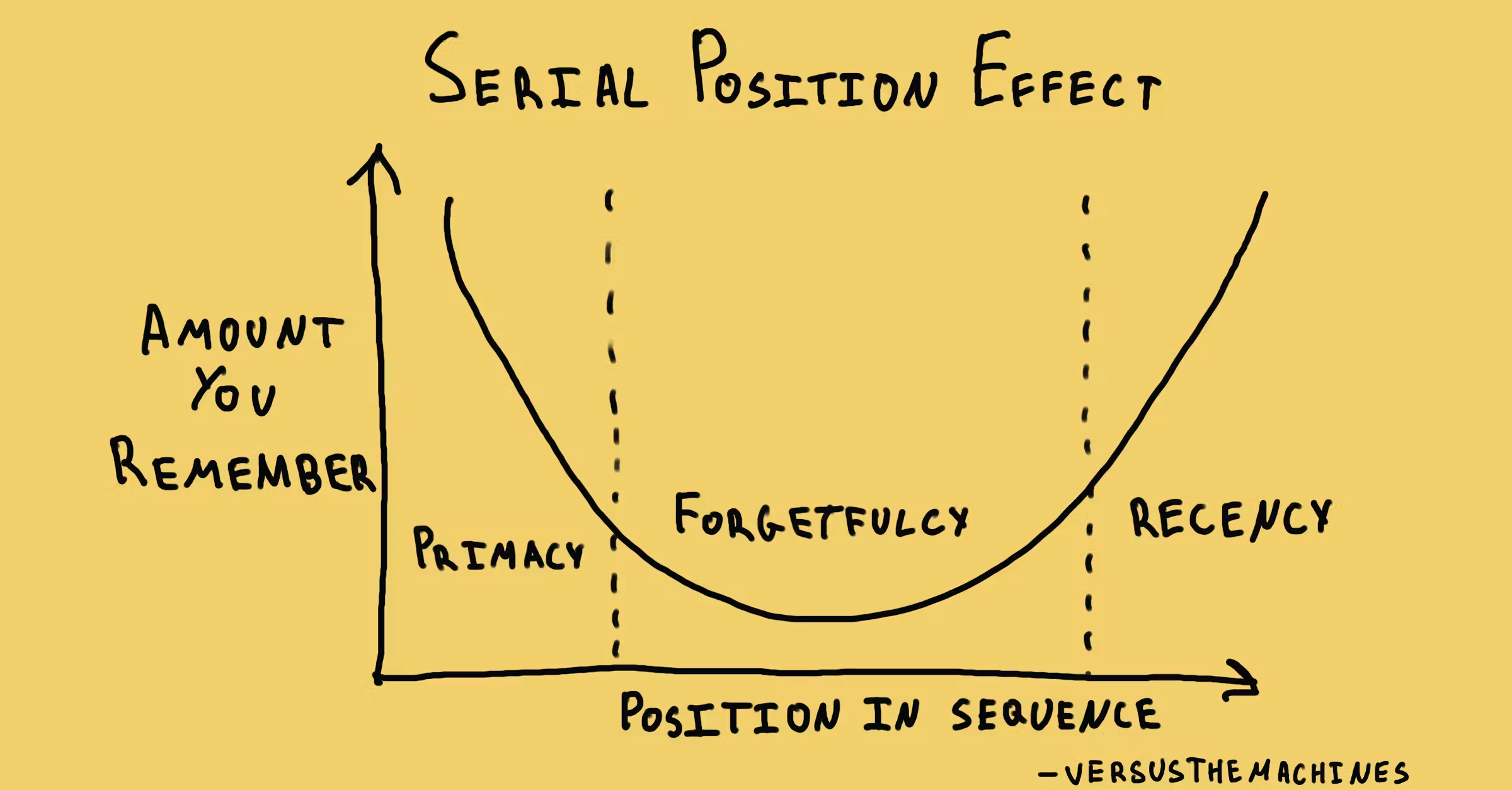
Serial Position Curve
a U-shaped graph showing that people remember the first and last items in a list better than the items in the middle
Primary effect & Recency effect
Primary effect
better recall of the first few items because these are rehearsed more, moving into LTM
Recency effect
better recall of the last few items because these are still active in STM
Explicit memory
memory of which we are consciously aware
Episodic & Semantic
Episodic memory
autobiographical memory, apart of Explicit memory
Semantic memory
abstract, general knowledge, apart of Explicit memory
Implicit memory
unconscious memory
Procedural & Conditioned Learning
Procedural Memories
how to do a task
Encoding Specificity Principle
memories are more easily recalled when the cues and context at the time of retrieval are similar to those at the time of encoding
Context Dependent Memory
recall is enhanced when the context at retrieval matches that during encoding
State Dependent Memory
recall is enhanced when your internal state at retrieval matches that during encoding
Mood Congurent Memory
recall is enhanced for information that matches your mood at retrieval
Ways to Improve Recall
organization into hierarchies
Chunking
Acronyms
First-letter technique
Imagery (Method of Loci)
Peg word system
Alex Mullen PAO system (Person, Activity, Object)
Distributed practice
Testing effect
getting enough sleep
Chunking
groups individual pieces of information into larger, meaningful units
First-letter technique
a strategy where you reduce a sentence, passage, or script down to only the initial letter of each word to act as a memory trigger
Method of Loci
a cognitive psychology and mnemonic device (memory technique) that enhances memory recall by mentally associating target information with specific physical locations in a familiar environment
Peg Word system
a memory technique that helps you remember lists in order by linking new information to a pre-memorized set of "peg" anchor words