BIOMG 3310 Quiz 3
 Call Kai
 Learn
Learn Practice Test
 Spaced Repetition
 Match
Match Flashcards
 Knowt Play
1/115

There's no tags or description
Looks like no tags are added yet.
Name | Mastery | Learn | Test | Matching | Spaced | Call with Kai | Chat |
|---|
No analytics yet
Send a link to your students to track their progress
116 Terms
Key experiment in the history of biochemistry:
In a test tube, without any cell components:
-lower pH to 3.5 (protonate Mb His) then Mb comes out
- add 8M urea (complete unfolding)
Dialysis
separation of small, soluble molecules from larger molecules or particles, typically using a membrane having small holes
Amino acid to primary structure
amino acids join on the ribosome to form the protein primary structure
Levinthal's paradox
-it would take super long for proteins to go from primary structure to fully formed 3D structure, how is it so fast? (10^-13 sec)
How many possible phi, psi values for amino acids?
10
How many possible phi, psi values for proteins?
10^100
What can folding not be?
a random search of all phi psi space
Can anything in the cell speed of phi, psi rotations of 10^-13 seconds?
no
What is likely to be going on with protein folding?
AA sequences have codes to select a folding pathway, or we're still missing basic principles of the folding process
Three classes of protein in every cell required for protein folding:
- disulfide isomerases
- prolyl cis-trans isomerases
- chaperones
What does Pro do?
Pro allows population of cis
Prolyl cis-trans isomerases:
accelerate cis-trans isomerization
Disulfide isomerase:
speeds up disulfied bond breaking/reforming, is found in every cell!
Prolyl isomerase:
speeds us cis-trans interchange, found in every cell!
How many Pro are cis?
7%
All proteins are formed with which bonds?
trans peptide bonds
Rate of reaction equation:
Rate = (kT)e^-deltaG0/RT
Rate = (kT)e^-deltaG0/RT
probability to have extra energy beyond ground state
What is there a debate about?
Whether there's one or multiple pathways for protein folding
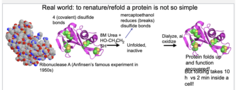
Anfinsen's Experiment w/ribonuclease A
4 covalent disulfide bonds -- 8M Urea -- mercaptoethanol (breaks disulfide bonds) -- unfolded, active -- dialyze, oxidize, protein folds up and function is recovered
Insulin Steps (no folding)
8M urea --- unfolded active -- dialyze, air -- no folding
How many chains does insulin have?
2
Insulin Steps (folding)
107 AA pre-insulin -- 84 AA proinsulin -- 51 AA insulin but we're missing a piece of informaton
How to calculate delta delta G given the rate?
delta delta G = RTln (r1/r2)
Role of Molecular Chaperones (1)
prevent protein aggregation
Role of Molecular Chaperones (2)
prevent/correct mutli-fold proteins (because proteins make mistakes)
Role of Molecular Chaperones (3)
to deliberately unfold protein to stop its activity
Role of Molecular Chaperones (4)
to make proteins molten for transport through membranes
How were molecular proteins discovered?
it was noticed that if temperature increases, so does the unfolded state
Heat shock proteins:
are induced when bacteria are warmed (42 degrees Celsius)
When are proteins especially susceptible to unwanted aggregation?
when coming off of the ribosome - folding not complete, nonpolar still exposed
Two types of chaperones:
-hsp 70
-hsp 60
hsp 70:
likes to bind early in protein synthesis to exposed molecular patches
hsp 60:
likes to bind misfolded proteins
What is the eukaryotic protein synthesis rate?
~ 4AA per second
How do molecular chaperones work (hsp60)
binds misfolded proteins and creates a barrel (formed from 2 rings of 7 subunits)
nonpolar helices bind misfolded proteins and release into more polar cavity inside barrel
What are proteins (state)
proteins are soft solids with a range of inside motions possible
How many stable structures does HIV protease have?
Two
Hexokinase (what does it do)
changes its structure upon binding its first substrate which is glucose
The unfolded protein and the native (folded_ protein are in:
equilibrium
Chaperones help to prevent:
protein misfolding
Misfolding can cause:
disease-causing amyloid fibril formation (Alzheimer's Disease + Mad Cow Disease)
folding and unfolding measures:
protein stabillity
Ring stacking occurs only in:
folded proteins
Water entropy is:
favorable (esp when protein folds)
Protein conformational entropy is:
unfavorable
Free energy of folding is:
favorable (maybe)
What kind of delta G is more stable?
negative delta G
When a protein is folding in water, you must keep track of both:
protein and water
The entropy of the protein itself always ___________________ upon folding
A. increases
B. decreases
decreases
Enthalpy of combined protein and water interactions is:
favorable (-)
Which interaction is the largest type of favorable interaction that drives proteins to fold in water?
The hydrophobic interaction?
Protein stability of Glu at pH 3
(uncharged at pH 3): parabola

Protein stability of Glu at pH 7
(negatively charged at ph 7)

denature:
to modify such that natural properties are lost
renature:
to recover natural properties
Compared with other familiar molecules, proteins are:
not very stable
What does H-bonding of urea with water do?
destroys normal water structure and eliminates the hydrophobic effect (unfolding)
What happens when you remove urea?
protein folding becomes reversible (folding)
Reversible binding (1)
forward and reverse reactions occur multiple times during the observation
Reversible binding (2)
appreciable concentrations of both reactants and products are present at equilibrium i.e the reaction does not go completely far to the left or right
Reversible binding (3)
not covalent bonding
Reversible binding (4)
remove additive -- return to original state
Reversible binding (5)
reversible phosphorylation: there is covalent bonding but the protein can be phosphorylated or dephosphorylated multiple times. The protein can therefore cycle between active and inactive
How proteins fold (pathway)
they move from the unfolded state to the molten globule state to the native state
diseases associated with misfolding into insoluble beta sheets:
Alzheimers, Huntingtons, Prion, ALS diseases
How are folding patterns observed?
small proteins might fold by first forming secondary structures
Folding funnel:
native structure has lower free energy, partially folded is higher, and the unfolded structures are at the top
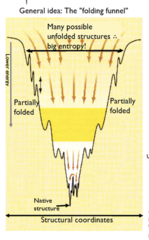
unfolded structures have (entropy):
high entropy
Enzymes:
catalyze a chemical reaction
Transport Proteins:
Hb transports oxygen: numerous ion transport proteins in cell membranes - every ion that crosses a membrane
Regulatory Proteins:
Bind to protein receptors in cell membranes or in aqueous phase. Examples we study are hormones insulin and glucagon
Storage Proteins
serve as biological reserves of metal ions, amino acids, oxygen, etc. - Mb sotres oxygen, Caseins in milk, ovalbumin in eggs, seed proteins: 70% of the world's protein consumption
Contractile and motile Proteins:
involved in movement: myosin and actin in muscle, and motor proteins are examples - convert chemical energy into mechanical work
Structural Proteins:
collagen is in this category: also keratins (skin, hair), elastin (vocal cords, arteries) and silk
Binding/Interaction Proteins:
scaffold proteins: only the completed assembly is functional. A transient IV structure, example of signal complex
Protective Proteins:
immunoglobulins: proteins of blood-clotting system, various venoms
Types of proteins:
enzymes
regulatory
transport
storage
contractile and motile
structural
binding/interaction
protective
Protein classification by complexity:
1) Mb (most simple proteins)
2a) Lysozyme, carbonic anhydratse
2b) Hb
3) Phosphofructokinase, Chymotrypsin
4) Pyruvate dehydrogenase complex, hsp60-like chaperone, proteasome
5) Ribosome, Transcription complex, spliceosome
Simple proteins (1)
they do just one job - specifically bind to some other molecule
Protein classification 2a:
(lysozome): not only bind other molecules, but also catalyze chemical reactions
Protein classification 2b:
Hemoglobin, actin: proteins regulated in a simple way
Protein classification 3:
proteins are regulated in more complex ways, bind specific substrates and also regulatory molecules in order to respond to their environment
Protein classification 4:
Pyruvate dehydrogenase complex: assembled from different units into machines in order to achieve complex tasks
Protein classification 5:
ribosome, transcription complex, spliceosome: assemblies of many different proteins + RNA, highly regulated by many different molecules in their environment
Is hemoglobin an enzyme?
no
Mb is shaped to fit
heme
What does Mb do after fitting heme?
holds heme in crevice
What do cells store O2 as (from Mb)
MbO2
What would be the ideal properties of a molecule designed to pick up O2 in lungs, but deliver it to tissues?
want it saturated with O2 in lungs, but released O2 in tissus
Hemoglobin-Myoglobin curve:
draw:

Hb A (adult) structure:
alpha-2 beta-2
Alpha chain of hemoglobin:
141 AA
Beta chain of hemoglobin:
146 AA
Adult Hb tetramer mw:
65 kD
3D structure of alpha beta of Mb & Hb:
identical, packing of 8 alpha helices
identical, packing of 8 alpha helices is called (MB) ?
globin fold, 8 helices lettered A-H
Amino acid sequence of Hb and Mb:
alpha and beta 50% identical. both 25% identical to Mb
How many AA are conserved in how many different Mb and Hb sequences?
27 AA, in 300 different Mb and Hb sequences
Special properties of Hb:
1) saturated with O2 in the lungs
2) gives up O2 to tissue where pH is low
3) Higher O2 affinity to fetal Hb over adult Hb
4) Transport O2