plate tectonics (mod #3)
 Call Kai
 Learn
 Practice Test
 Spaced Repetition
 Match
 Flashcards
 Knowt Play
1/55

Earn XP
Description and Tags
🍂
56 Terms
Urkontinent
CONTINENTAL DRIFT HYPOTHESIS:
this means “primal continent” in German;
generic name for Pangaea
Eduard Seuss
CONTINENTAL DRIFT HYPOTHESIS:
hypothesized several ancient geographical features such as Gondwana and Tethys Ocean;
Austrian geologist and geographer;
The Faces of the Earth
Panthalassa
ANCIENT LANDMASSES:
superocean surrounding Pangaea during the late Paleozoic to early Mesozoic
Gondwana
ANCIENT LANDMASSES:
region in India;
supercontinent;
southern continents: Australia, India, Africa, South America and Antarctica
ANCIENT LANDMASSES:
global ocean between Laurasia and Gondwana
continental jigsaw fit
CONTINENTAL DRIFT HYPOTHESIS EVIDENCE:
would explain how West Africa and South America fits if Atlantic Ocean is closed

rock type
CONTINENTAL DRIFT HYPOTHESIS EVIDENCE:
similarities of ancient cratons and shields across continents

cratons
UNDER ROCK TYPE EVIDENCE:
stable and coherent continental crust that have undergone little internal deformation
shields
UNDER ROCK TYPE EVIDENCE:
large tectonically inactive block of Precambrian crystalline rocks that are exposed at the surface
platform
UNDER ROCK TYPE EVIDENCE:
underlain by relatively flat or gently tilted sedimentary rocks overlying basement units;
craton covered with sediments
tectonics
CONTINENTAL DRIFT HYPOTHESIS EVIDENCE:
matching rock types and continuous mountain ranges (like the Appalachians and Caledonians) end at one coastline and pick up on another
Central Pangean Mountains
Remnants include Appalachians (USA), Little Atlas (Morocco) & Scottish Highlands (UK)
Formed from the collision of Euramerica and Gondwana
Result of the Caledonian (Ordovician), Acadian (Middle Devonian), Appalachian and Mauritanide (Carboniferous) orogenies

fossil match across continents
CONTINENTAL DRIFT HYPOTHESIS EVIDENCE:
Fossils of animals and plants that could not have travelled through the oceans: Mesosaurus, Glossopteris and Lystrosaurus
paleoclimate, coal deposits, glaciation
CONTINENTAL DRIFT HYPOTHESIS EVIDENCE:
Carboniferous _____ _____: Coal seams in Laurasia and northern Gondwanaland continents;
Carboniferous ______: Glacial till & striations in Southern Africa, South America, Australia and India
tidal forces, continents plowing through ocean crust
CONTINENTAL DRIFT HYPOTHESIS OPPOSITION:
Mechanism for continent movement:
_____ forces (Sun and Moon)
_____ plowing through ocean crust (both continents and ocean floors ride together as parts of larger, moving tectonic plates)
Nature of driving mechanisms
Estimate of continent motion rate: 250 cm/year vs. 2.5 cm/year (Atlantic)
Wegener is not a geologist
Marie Tharp
SEAFLOOR SPREADING:
American geologist and oceanographic cartographer;
First Scientific Map of the Atlantic Ocean seafloor;
Discovery of Rift Valley along Mid-Atlantic Ridge

Harry Hammond Hess
SEAFLOOR SPREADING:
American geologist proposed seafloor spreading;
“History of Ocean Basins”
laid the foundational framework for the theory of seafloor spreading
geologic mechanism: mantle upwelling
seafloor spreading
Seafloor (oceanic crust) moves laterally away from long and volcanic mid-ocean ridges, as new material is being formed along it;
Movement of the continents as a result of this
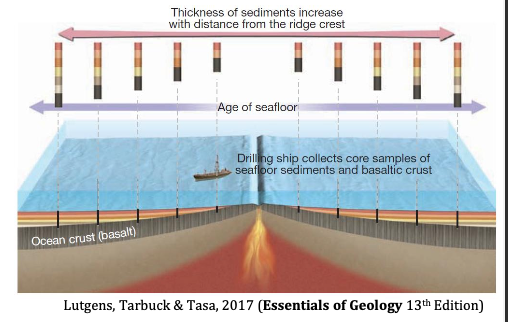
paleomagnetism
apparent polar wander
hot spot volcanism
seismicity
PLATE MOTION EVIDENCE (SEAFLOOR SPREADING):
about earth’s magnetic field
_____ polar _____
_____ spot _____
about earthquakes
paleomagnetism
PLATE MOTION EVIDENCE:
study of Earth’s magnetic field in rocks;
Magnetic minerals retain record of direction & intensity of magnetic field during their formation
True
TRUE OR FALSE (PALEOMAGNETISM):
The direction of magnetic north is not fixed as it constantly shifts over time due to the movement of molten iron in Earth's outer core.
normal polarity (compass points north) vs. reverse polarity (points south)
magnetic stripes
UNDER PLATE MOTION EVIDENCE (PALEOMAGNETISM):
these are alternating bands of normal and reversed magnetic polarity preserved in the oceanic crust;
as the magma cools, iron-rich minerals inside the rock align with Earth's magnetic field, locking in that specific direction like a tiny compass
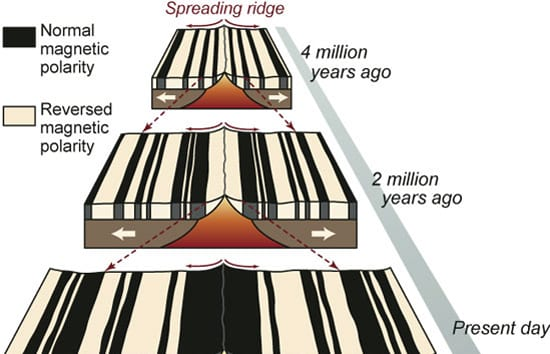
True
TRUE OR FALSE (PALEOMAGNETISM):
By combining the data from the direction of magnetic north and seafloor magnetic stripes, scientists can calculate the paleoposition (ancient position) of Earth's tectonic plates.
apparent polar wander
UNDER PLATE MOTION EVIDENCE (PALEOMAGNETISM):
apparent movement of the paleomagnetic poles with respect to continents (fixed in position);
Dependent on: Real Polar Wander & Continental drift
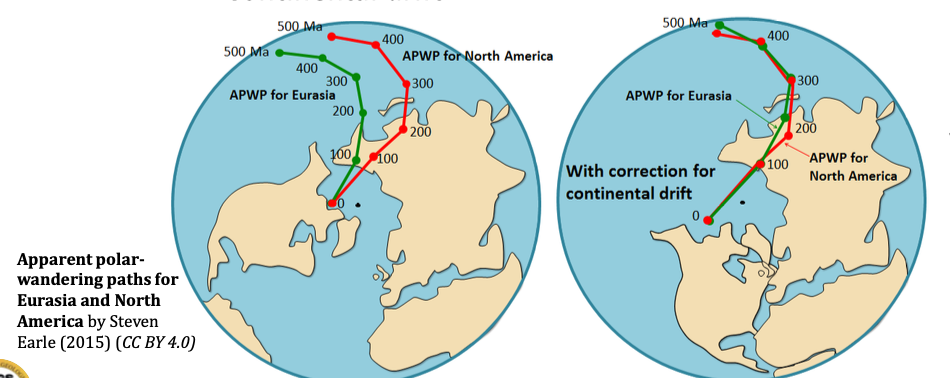
real polar wander & continental drift
UNDER PLATE MOTION EVIDENCE:
2 things apparent polar wander depends on
actual geographic crust and mantle move relative to the spin axis over millions of years
_____ ____
hot spot volcanism
UNDER PLATE MOTION EVIDENCE :
Localized and long-lasting hot regions below the lithosphere;
Frame of reference for tracking plate motion;
Age of volcanism corresponds to the time elapsed since it was on top of the hotspot/mantle plume
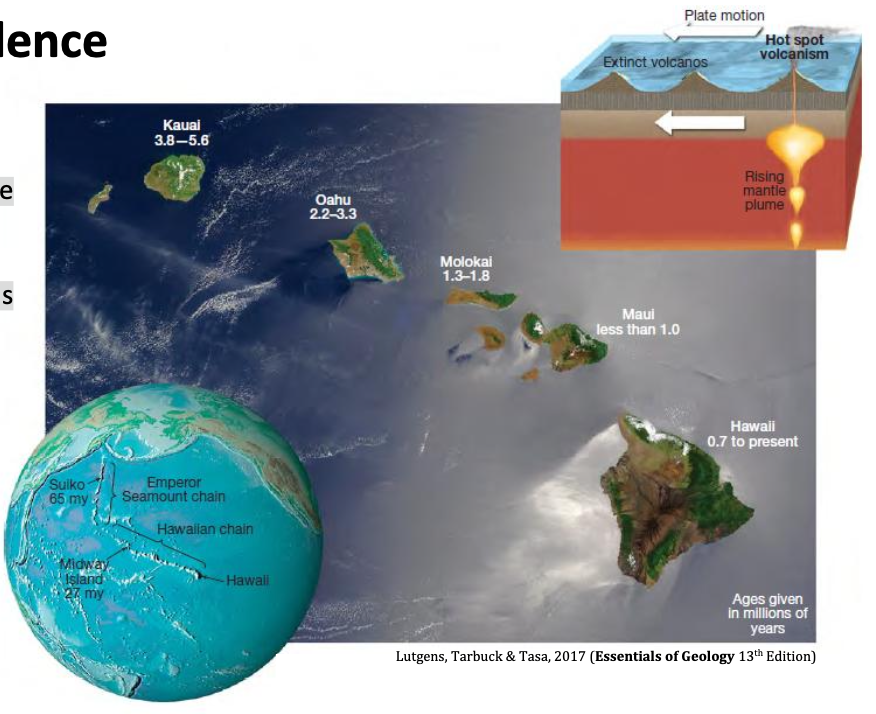
seismicity
UNDER PLATE MOTION EVIDENCE:
relates to earthquakes;
deep earthquakes (>150km): location of subducting slabs;
shallow earthquakes: regions of rifting
subducting slabs, rifting
UNDER PLATE MOTION EVIDENCE:
deep earthquakes (>150km): location of ______ _____;
shallow earthquakes: regions of ______
plate tectonics theory
this is the unifying theory of geology;
Crust + Uppermost Mantle constitutes the rigid and outer layer (Lithosphere) which overlies the weak/ductile and flowing asthenosphere
plate tectonics theory
states that the lithosphere broken into slabs or tectonic (lithospheric) plates;
tectonic plates may be composed entirely of oceanic crust or continental + oceanic crust
tectonic plates are in constant motion relative to one another
Wilson Cycle
UNDER PLATE TECTONICS THEORY:
John Wilson proposes this model, which describes the continuous opening, evolution, and closing of ocean basins in the formation & breakup of supercontinents;
driven by plate tectonics
William Jason Morgan
UNDER PLATE TECTONICS
he proposed that the Earth's outer shell is broken into roughly a dozen rigid, moving blocks or plates floating on the mantle;
American geologist who has seminal work on plate tectonics
Pacific
North American
Eurasian
African
Antarctic
Indo-Australian
South American
7 major plates (hint: continents of the world)
Somali
Nazca
Amurian
Sunda
Philippine Sea Plate
Okhotsk
Arabian
Yangtze
Caribbean
Cocos
10 minor plates

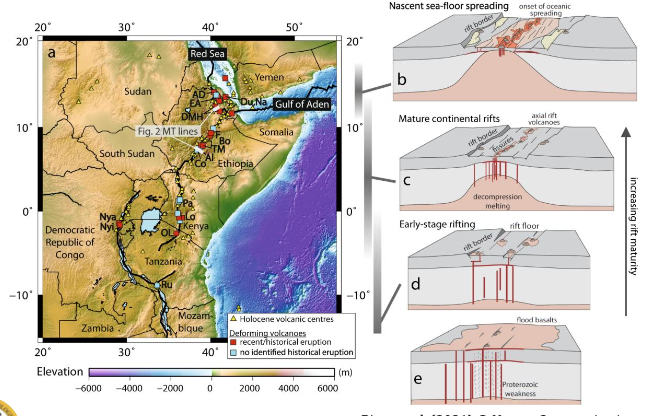
divergent plate boundaries
TYPES OF PLATE BOUNDARIES:
adjacent plates move away from each other;
Spreading centers: oceanic ridges (oceanic) and rift valleys (continental);
constructive plate margin
oceanic ridges, rift valleys (East Pacific Rise)
UNDER DIVERGENT BOUNDARIES:
Spreading centers: _____ _____(oceanic) and _____ ____ (continental);
ex. East African Rift, ____ ____ _____, Cocos–Nazca spreading centre, Iceland (Mid-Atlantic Ridge)
(answer: type of spreading centers, examples)
convergent plate boundaries
TYPES OF PLATE BOUNDARIES:
Plates move towards each other forming subduction or collision zones;
destructive plate margin;
subduction zone: oceanic-continental, oceanic-oceanic, continental-continental

oceanic-continental convergence, continental volcanic arc
UNDER CONVERGENT SUBDUCTION ZONES:
denser oceanic lithosphere subducts beneath the lighter continental lithosphere;
_____ _____:
arcuate volcanic chain running parallel to a subduction zone
ex. Cascades Volcanic Arc, Andes Volcanic Belt, Aleutian Range
oceanic-oceanic convergence, oceanic island arc
UNDER CONVERGENT SUBDUCTION ZONES:
older, cooler and denser oceanic lithosphere subducts beneath the younger, hotter and less dense oceanic lithosphere;
_____ _____:
Arcuate volcanic chain in an oceanic lithosphere, parallel to a subduction zone
Attain thickness of ~20km
Izu-Bonin-Mariana Arc, Philippine Arcs
2 examples of oceanic island arcs
(hint: one has Luzon, Sierra Madre, East Philippine, Negros, Sulu-Zamboanga)
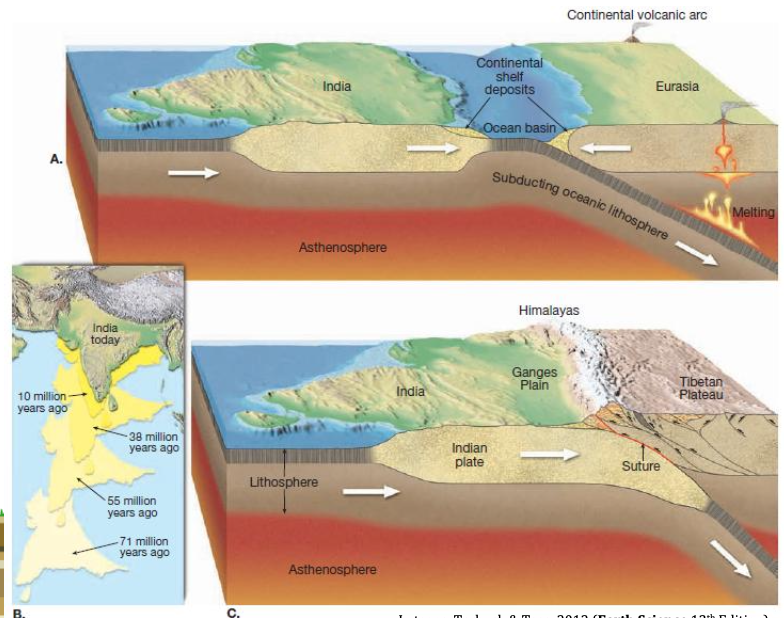
continental-continental convergence
UNDER CONVERGENT COLLISION ZONE:
buoyant continental lithosphere doesn’t allow it to be subducted;
Destruction of subduction followed by orogeny;
Continents sutured together
ex. Himalayas, Appalachian Mountians, the Alps
transform plate boundaries
TYPES OF PLATE BOUNDARIES:
Plates slide past each other horizontally;
Occurs in conjunction with other plate boundaries
(Transform) Strike-slip fault
Conservative plate margin
ex. San Andreas Fault, Alpine Fault, North Anatolian Fault (Turkey)
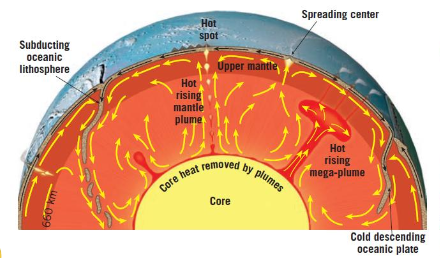
mantle convection
PLATE TECTONICS MECHANISM:
slow creeping motion of the solid mantle;
_____ ____ & plate tectonics as part of the same system;
convective flow
warm, buoyant mantle rocks rise while cool, dense lithospheric plates sink
convective flow
UNDER MANTLE CONVECTION:
mechanism of transporting heat away from Earth’s interior into the surface to be radiated into space;
whole-mantle/plum model
2 MANTLE CONVECTION MODELS:
cold oceanic lithosphere sinks into great depths stirring the mantle;
subducting lithospheric slab graveyard at the core-mantle boundary and plumes from D” layer;
False; should be whole-mantle/plum model
TRUE OR FALSE:
The Layer Cake Model describes a continuous convective system where heat and material circulate through both the upper and lower mantle.
layer cake model
2 zones of convection: Dynamic Upper Mantle & sluggish Lower Mantle;
slabs only reach into the Transition Zone

slab pull
PLATE TECTONICS MECHANISM (GRAVITY):
this is caused by subduction (downward pulling of subducting slab);
results from the sinking of a cold, dense slab
strongest driving force

ridge push / gravitational sliding
PLATE TECTONICS MECHANISM (GRAVITY):
occurs in mid-oceanic ridges;
sliding of cooling rigid lithosphere down the hot and weak asthenosphere
Eurasian (Sundaland) & Philippine Sea Plates
PHILIPPINE TECTONICS:
Ph situated between these two regions;
2 tectonostratigraphic blocks:
Philippine Mobile Belt
Palawan-Mindoro Continental Block

Philippine Mobile Belt
2 TECTONOSTRATIGRAPHIC BLOCKS:
seismically active;
Includes most of the Philippines
Composed of accreted island arc and ophiolitic terranes
Relatively young (basement at Late Jurassic to Early Cretaceous)
Palawan-Mindoro Continental Block
2 TECTONOSTRATIGRAPHIC BLOCKS:
relatively aseismic (free from earthquakes);
Includes Palawan, Mindoro, Romblon, Buruanga Peninsula (Panay) & Zamboanga Peninsula
Rifted continental terranes
Old (up to Permian)
Philippine Trench-East Luzon Through system
PH TECTONICS SUBDUCTION ZONES:
west-dipping subduction of Eocene West Philippine Basin-Philippine Sea Plate
Manila Trench
PH TECTONICS SUBDUCTION ZONES:
East-dipping subduction of Early Oligocene to Early Miocene South China Sea
Negros-Sulu Trenches
PH TECTONICS SUBDUCTION ZONES:
East-dipping subduction of Early to Middle Miocene Sulu Sea
Cotabato Trench
PH TECTONICS SUBDUCTION ZONES:
West-dipping subduction of Eocene Celebes Sea Basin
Philippine Fault Zone
PH TECTONICS SUBDUCTION ZONES:
Pliocene age, 1200-km long, NW-SE-trending, active left-lateral strike-slip fault;
Accommodate oblique convergence