Nutrition, Digestion, & Absorption
 Call Kai
 Learn
Learn Practice Test
 Spaced Repetition
 Match
Match Flashcards
 Knowt Play
1/133

Earn XP
Description and Tags
Harper's Biochemistry 32nd Edition; Special Topics A
Name | Mastery | Learn | Test | Matching | Spaced | Call with Kai | Chat |
|---|
No analytics yet
Send a link to your students to track their progress
134 Terms
Glycemic Index
The increase in blood glucose after a test dose of a carbohydrate compared with that after an equivalent amount of glucose is known as
1 or 100%
Glucose, galactose, lactose, maltose, isomaltose, and trehalose have an index of ?
Hydrolysis
The digestion of carbohydrates to oligo, mono, and disaccharides is through a process called
Fructose, sugar alcohols, sucrose
Sugars that are absorbed less rapidly and have lower glycemic index
between near 1 or 0
glycemic index of starch
insulin
Foods that have a low glycemic index are beneficial since they cause less fluctuation in _______ secretion
salivary and pancreatic amylases
The hydrolysis of starch is catalyzed by
dextrins
(then a mixture of glucose, maltose, and maltotriose and small branched dextrins)
The hydrolysis of starch yields ?
α(1 → 4) glycoside bonds
salivary and pancreatic amylases catalyze random hydrolysis of ? *what bonds?
sucrase-isomaltase
a bifunctional enzyme catalyzing hydrolysis of sucrose and isomaltose
disaccharidases
maltase
sucrase-isomaltase
lactase
trehalase
located on the brush border of the intestinal mucosal cells, where the resultant monosaccharides and those directly ingested are absorbed
TRUE
TRUE OR FALSE: Congenital deficiency of lactase occurs rarely in infants
Inuit
Congenital deficiency of sucrase-isomaltase occurs among the ______, leading to sucrose intolerance, with persistent diarrhea and failure to thrive when the diet contains sucrose
Lactose Intolerance
lactase activity begins to fall after weaning and is almost completely lost by late adolescence, leading to what condition?
SGLT 1
Glucose and galactose transport protein
sodium-dependent process
Glucose and galactose are absorbed through what process?
carrier-facilitated diffusion
Other monosaccharides are absorbed by what type of diffusion?
FALSE (down)
TRUE OR FALSE: Because they are not actively transported, fructose and sugar alcohols are only absorbed up their concentration gradient
osmotic diarrhea
Large intakes of fructose and sugar alcohols can lead to ?
triacylglycerols and phospholipids(less)
The major lipids in the diet are ?
micelles (4-6 nm)
These lipids are hydrophobic molecules and are hydrolyzed into small droplets called ______ before they can be absorbed
A, D, E, and K
fat-soluble vitamins
lingual and gastric lipases
Hydrolysis of triacylglycerols is initiated by?
sn-3 ester bond
lingual and gastric lipases attack what type of bond
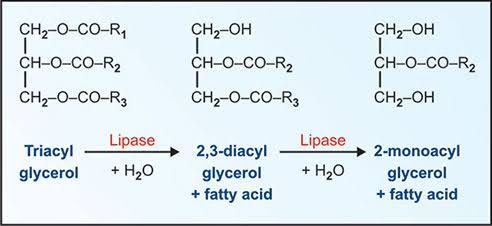
1,2-diacylglycerols and free fatty acids
Hydrolysis of triacylglycerols forms?
emulsyfying agents
1,2-diacylglycerols and free fatty acids can act as?
Colipase
Pancreatic lipase requires this protein for activity

2-monoacylglycerols and free fatty acids
major end products of luminal triacylglycerol digestion
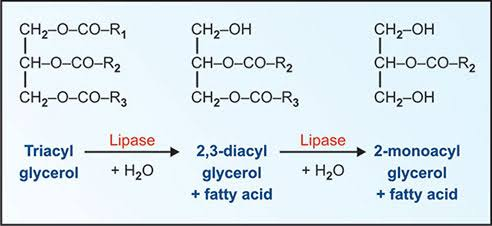
primary ester links
Pancreatic lipase is specific in targeting what kind of bond?

1 and 3
Pancreatic lipase targets what positions in triacylglycerols?
TRUE
TRUE OR FALSE: Inhibitors of pancreatic lipase are used to inhibit triacylglycerol hydrolysis in the treatment of severe obesity.

25%
Pancreatic esterase only allows approximately _____% of ingested triacylglycerol to be hydrolyzed to glycerol and fatty acids before absorption
Bile salts
What permits emulsification of the products of lipid digestion into micelles together with dietary phospholipids and cholesterol
enterohepatic circulation
bile salts remain in the intestinal lumen, where most are absorbed from the ileum into the ?
Fatty acid and glycerol
triacylglycerols
Monoacylglycerol pathway
Within the intestinal epithelium:
1-monoacyglycerols are hydrolyzed to ?
2-monoacylglycerols are reacylated to ?
VIA WHAT PATHWAY?
hepatic portal vein
Glycerol released in the intestinal lumen is absorbed into the ?
triacylglycerol
glycerol released within the epithelium is reutilized for the synthesis of?
Normal Phosphatidic acid pathway
glycerol is synthesized into triacylglycerol in the epithelium through what pathway?
Chylomicrons; lymphatics → bloodstream
Long-chain fatty acids are esterified to triacylglycerol in the mucosal cells and secreted as _______ into _________
hepatic portal vein; free fatty acids
Short and medium chain fatty acids are mainly absorbed into the ________ as _________?
Cholesterol
________ is absorbed dissolved in lipid micelles and is mainly esterified in the intestinal mucosa before being incorporated into chylomicrons
Plant sterols and stenols
What competes with cholesterol for esterification, but are poor substrates, resulting to an increased amount of unesterified cholesterol in the mucosal cells
Denaturation
Process of breaking down protein
TRUE
TRUE OR FALSE: Native proteins are resistant to digestion because few peptide bonds are accessible to the proteolytic enzymes without prior denaturation by heat in cooking and by the action of gastric acid.
72%
22%
6%
Percentage of each pathway:
monoacylglycerol pathway
phosphatidic acid pathway
hepatic portal vein (free glycerol)
Endopeptidases and Exopeptidases
two main classes of proteolytic digestive enzymes
Endopeptidases
hydrolyze peptide bonds between specific amino acids through out the molecule
Endopeptidases
First enzymes to act to proteins, yielding a larger number of smaller fragments
Pepsin
what type of endopeptidase catalyzes hydrolysis of peptide bonds adjacent to amino acids with bulky side-chains
*it is present in the gastric juice
Trypsin
What type of endopeptidase catalyzes hydrolysis of lysine and arginine amides
*it is present in the pancreas
Chymotrypsin
What type of endopeptidase catalyzes hydrolysis of amides of aromatic amino acids (phenylalanine, tyrosine, and tryptophan)
*it is present in the pancreas
Elastase
What type of endopeptidase catalyzes hydrolysis of amides of small neutral aliphatic amino acids (ex. Glycine, Alanine, Valine)
*it is present in the pancreas
Exopeptidases
What catalyzes the hydrolysis of peptide bonds, one at a time, from the ends of peptides.
Carboxypeptidases
A type of Exopeptidase that is secreted in the pancreatic juice, release amino acids from the free carboxyl terminal
Aminopeptidases
A type of Exopeptidase that is secreted by the intestinal mucosal cells, release amino acids from the amino terminal
Dipeptidases & tripeptidases
type of Exopeptidases that are seen in the brush border of intestinal mucosal cells catalyze the hydrolysis of di- and tripeptides

zymogens
The proteases are secreted as inactive ________
gastric acid and activated pepsin
Pepsinogen is activated to pepsin by?
enteropeptidase
In the small intestine, trypsinogen, the precursor of trypsin, is activated by ___________, which is secreted by the duodenal epithelial cells
Trypsin
What can activate chymotrypsinogen to chymotrypsin, proelastase to elastase, procarboxypeptidase to carboxypeptidase, and proaminopeptidase to aminopeptidase
free amino acids, di- and tripeptides, and oligopeptide
The end product of the action of endopeptidases and exopeptidases is a mixture of ?
sodium-dependent active transport
Free amino acids are absorbed across the intestinal mucosa by what type of transport
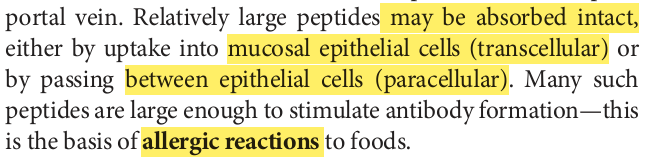
FALSE
TRUE OR FALSE: Relatively large peptides cannot be absorbed intact
Calbindin
intracellular calcium-binding protein required for calcium absorption
Vitamin D
acts to recruit calcium transporters to the cell surface which increases calcium absorption rapidly
Phytic acid (inositol hexaphosphate) or phytate
plant compound seen in cereals; binds calcium in the intestinal lumen, preventing its absorption
Phenylalanine
Valine
Threonine
Tryptophan
Isoleucine
Methionine
Histidine
Leucine
Lysine
9 ESSENTIAL AMINO ACIDS
calcium oxalate (insoluble)
a high intake of oxalate can sometimes cause calcium deficiency due to the formation of ________
phytase
yeast contains an enzyme, ______ , that dephosphorylates phytate, so rendering it inactive
ferritin
Inorganic iron is transported into the mucosal cell by a proton-linked divalent metal ion transporter, and accumulated intracellularly by binding to ________
Ferroportin
Iron leaves the mucosal cell via a transport protein called

FALSE; free transferrin
TRUE OR FALSE: Iron can only leave the mucosal cell if there is free transthyretin in the plasma to bind to.
Hepcidin
a peptide secreted by the liver when body iron reserves are adequate
it downregulates the expression of the ferroportin gene

FALSE; decreased
TRUE OR FALSE: In response to hypoxia, anemia, or hemorrhage, the synthesis of hepcidin is increased
approximately 10%
Because of the mucosal barrier, what is the percentage of the dietary iron that is actually absorbed in the body?
Fe2+ (reduced)
Inorganic iron is absorbed in the ____________ state
Vitamin C
most effective compound/reducing agent that enhances iron absorption
Calcium
the absorption of both inorganic and heme iron is impaired by ?
TRUE
TRUE OR FALSE: Alcohol and Fructose also enhance iron absorption

FALSE
TRUE OR FALSE: Heme iron from meat is absorbed separately and less available than inorganic iron
OBESITY
Food intake in excess of energy expenditure leads to

body mass index = weight (in kg)/height2
commonly used as a way of expressing relative obesity

20 to 25
desirable range of BMI

heat output
consumption of oxygen
Energy expenditure can be determined by two ways:
directly by measuring ________
indirectly by measuring ____________
~20 kJ/L
Value of energy expenditure per liter oxygen consumed, regardless of whether the fuel being metabolized is carbohydrate, fat, or protein
respiratory quotient [RQ]
an indication of the mixture of metabolic fuels being oxidized
ratio of the volume of carbon dioxide produced: volume of oxygen consumed
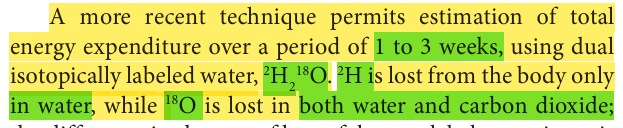
2H2 18O
dual isotopically labeled water that permits estimation of total energy expenditure over a period of 1 to 3 weeks
Basal metabolic rate (BMR)
the energy expenditure by the body when at rest, but not asleep, under controlled conditions of thermal neutrality
12 hours
Basal metabolic rate (BMR) is measured about how many hours after the last meal?
weight, age, and gender
BMR depends on what 3 aspects
Total energy expenditure (TEE)
This depends on the BMR, the energy required for physical activity, and the energy cost of synthesizing reserves in the fed state.
TRUE
TRUE OR FALSE: It is possible to estimate an individual’s energy requirement from body weight, age, gender, and level of physical activity
Adipose Tissue
The decrease in BMR with increasing age, even when body weight remains constant, is the result of muscle tissue replacement by ?
FALSE
TRUE OR FALSE: women have a significantly higher BMR than men of the same body weight and age because women’s bodies contain proportionally less adipose tissue
Physical activity ratio (PAR) or metabolic equivalent of the task (MET)
The most useful way of expressing the energy cost of physical activities is as a multiple of BMR also known as ?
Physical activity level (PAL)
the sum of the PAR of different activities, multiplied by the time taken for that activity, divided by 24 hours
diet-induced thermogenesis
considerable increase in metabolic rate after a meal
synthesizing reserves of glycogen, triacylglycerol, and protein
the major part of diet-induced thermogenesis is the energy cost of ?
secreting digestive enzymes and of active transport of the products of digestion
the minor part of diet-induced thermogenesis is the energy cost of ?
both adults and children
Marasmus can occur in what population