Midterm 3: Lecture 15 - disease ecology and biocontrol
 Call Kai
 Learn
 Practice Test
 Spaced Repetition
 Match
 Flashcards
 Knowt Play
1/21

There's no tags or description
Looks like no tags are added yet.
22 Terms
Community ecology includes interactions between species
Level of 2 interacting species within a community !!
Types of interactions between species
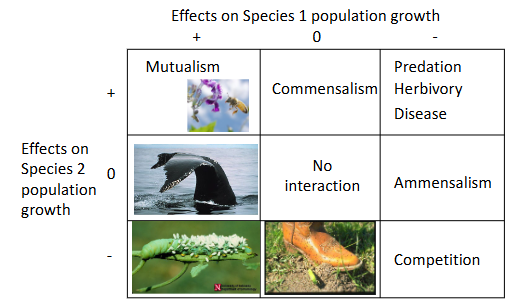
Why study infectious disease in ecology?
>25% of annual human deaths worldwide are the direct result of infectious disease
What is infectious disease?
A condition that’s harmful to the host, caused by a parasite or pathogen
What is a parasite or pathogen?
An organism that exploits a single host individual per life-history stage, causing disease
What is an infection?
The process by which a parasite exploits its host by its presence in the host signified (but may or may not cause disease)
What is a host?
Just about any living organism
Examples of infectious diseases and pathogens

What organisms cause diseases?
West Nile virus.
Chytrid fungus.
Effects of Chytrid on amphibians ripple through food webs.
Disease triangle
Pathogen, host, and environment
Disease - misc. point
Number of diseases shared by bats and humans. Suspected origin of Ebola and rabies
What infectious disease is NOT…
Non-infectious disease
Asthma
Heart disease
Skin cancer
Bulimia
Predation
Doesn’t necessarily kill its victim
After infection, victim often becomes immune
Disease organism is much smaller than its victim
Disease organism is often not independently mobile
How do we study infectious disease?
SIR models
S = susceptible individuals
I = infected individuals
R = recovered individuals

SIR Models (continued)

Rate of transmission
The process by which a pathogen passes from a source of infection to a new host and infects that host
Dependent on rate of contact and probability of infection given contact
Why is it important?
Individuals are spatially discrete
Hosts defend themselves (resistance)
Modes of transportation
Direct contact (e.g., handshake)
Common cold
Indirect contact (e.g., sneezing)
Measles
Sex
AIDS
Vector (species that transmits pathogen without experiencing disease; usually arthropods)
Malaria
Trophic (from prey to predator)
Trichinosis
Environmental reservoir (free-living stage)
Cholera
Vertical (from parent to offspring)
Syphilis
R0 - the basic reproductive ratio
# secondary infections produced by a single infected host in a susceptible population
Depends on
Rate of transmission (b)
Rate of recovery (g)
Number of susceptible individuals (S)
R0 = (b/g)S
R0 - Must be >1 for Invasion
R0>1 then pathogen invades
When R0<1 then pathogen no invasion
R0 is key to understanding disease dynamics
The Basic Reproductive Ratio
Number of new cases that become infectious in a population of susceptibles. R0 = 5
The five secondary infecteds can infect others
But R0 is lower because S is smaller
R0 gets lower and lower as number remaining susceptible shrinks
Observations
In many organisms, higher population growth rate leads to higher fitness
Diseases are dependent on the host for their transmission
Behaviors or modifications induced in host that cause transmission
Sneezing and coughing
Rubbing sore eyes
Biting (rabies)
Scratching pustules
Induced excretion
Etc.
*Parasites manipulate host behavior
How does HIV work?
Attacks CD4 cells, or T-helper cells that initiate the immune response
Doesn’t kill host directly, but by weakening immune system
Doesn’t kill host quickly
Evolution of HIV
Prone to error in transcription – 1 every 1000 base pairs (10^7 times typical mutation rates in humans)
Mutations provide variability within hosts
Drugs provide a selective force
Some virions are better able to survive and reproduce
Large numbers, fast population growth rate, and high mutation rate lead to rapid evolution
Why is HIV fatal?
Assumption 1: More virulent strains have higher population sizes and kill host faster
Assumption 2: More virulent strains are more likely to be transmitted
Transmission rate related to virulence
More virulent strains transmit faster, but die sooner
Less virulent strains transmit slower, but die later
Note: an evolutionary tradeoff