L14 - The Adaptive Immune Response - Antibodies, Lymphocytes, and the MHC
 Call Kai
 Learn
 Practice Test
 Spaced Repetition
 Match
 Flashcards
 Knowt Play
1/41

There's no tags or description
Looks like no tags are added yet.
42 Terms
What are the two types of immune system?
The two types of immune system are:
Innate
Adaptive
What is the innate immune system?
The innate immune system:
Has limited specificity
Found in all tissues especially at barrier sites
Act quickly following infection.
Have a limited memory.
What is the adaptive immune system?
The adaptive immune system:
Is specific for particular proteins and antigens.
Mainly found in lymphoid organs.
Takes 5-10 days to get going.
Long lived immune memory.
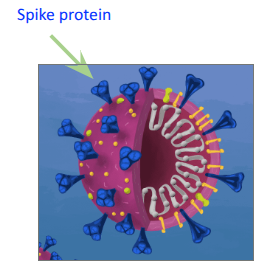
What is a spike protein?
A spike protein is an example of an antigen.
What can protein antigens be broken down to form?
Protien antigens can be broken down to form peptide chains: we also call this the antigen or epitope.
What are B and T cells?
B and T cells are adaptive immune cells that specifically recognise antigens via specialised surface receptors.
How many different types of B cell receptors are there?
There are up to 1012 different B cell receptors. For example, B cell receptor (BCR)
How many different types of T cell receptors are there?
There are around 108 different T cell receptors. For example CD4 and CD8.
What does the B cell receptor do?
The B cell receptor binds to native proteins/antigens. No accessory cells are required.

What do T cells do?
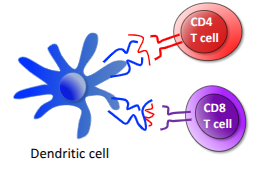
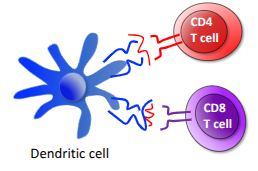
T cells recognise processed antigens presented on MHC molecules on the surface of antigen presneting cells.
What do CD4 T cells do?
CD4 T cells see longer peptides in MHC class II molecules. MHCII is mainly expressed by Professional Antigen Presenting Cells: B cells, macrophages and DCs.
What do CD8 T cells do?
CD8 T cells see short peptides in class I molecules. MHCI is expressed by all nucleated cells: e.g. B cells, macrophages, DCs, epithelial cells and fibroblasts.
What animals have no T or B cells (sort of)?
Examples of animals with no T or B cells (sort of) are:
Butterflies
Ants
Mayfly
Frogs as tadpoles. These have T and B cells following metamorphosis.
What are examples of animals with T and B cells?
Examples of animals with T and B cells are:
Mice
Elephants
Killifish
Great White Shark
Where are adaptive immune cells generated?
Adaptive immune system cells are generated in the primary lymphoid organs - the thymus and bone marrow.
Where are adaptive immune cells activated?
Adaptive immune cells are activated in the secondary lymphoid organs - the lymph nodes and spleen.
What are the different stages of the adaptive immune response?
The different stages of the adaptive immune response are:
T cell activation - Finding the right T and B cells.
T cell differentiation - Deciding how to respond
T cell effector stage
What is happening in the innate immune response?
In the innate immune response, something dangerous is happening. Macrophages, monocytes, neutrophils, and dendritic cells are present. This happens from Day 0-5.
What is happening in the adaptive immune response?
In the adaptive immune response, specific recognition of the pathogen and pathogen control is occuring. CD4 and CD8 T cells, and B cells are present. This happens from Day 3-15.
What is happening in long-lived immune protection?
In long-lived immune protection is what vaccines need to achieve. Long lived plasma cells, CD4 and CD8 T cells, and B cells are present. This happens over months to years.
What is the process of information transfer in the immune system?
The process of information transfer in the immune system is Pathogens → Dendritic cells and other innate cells (Macrophages and neutrophils) → Adaptive immune cells (CD4+, CD8+, and B cell.)
Pathogens, their products and the damage they cause are recognised by innate cells. These innate cells ‘pass’ this information onto cells of the adaptive immune system.
If the infection is mild, the innate immune cells may be able to clear the pathogen themselves. If not, they alert the adaptive immune cells.
What do CD4+ cells do?
CD4+ T cells coordinate immune response.
What do CD8+ T cells do?
CD8+ T cells kill infected cells.
What do B cells do?
B cells make antibodies to clear up pathogens.
What are antibodies made by, and what are they?
Antibodies are made by plasma cells. Plasma cells are terminally differentiated B cells.
What is the IgM antibody?
The IgM antibody is antibody that has low affinity and high avidity.

What is the IgG antibody?
The IgG antibody is an antibody that is the most abundant in serum.

What is the IgE antibody?
The IgE antibody is an antibody that is involved in allergy and anti-helminth worm responses.

What is the IgA antibody?
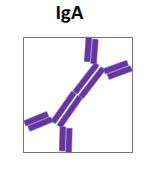
The IgA antibody is an antibody found at mucosal sites.
Aside from IgM, IgG, IgE, and IgA antibodies, what is another antibody found in the body?
Aside from IgM, IgG, IgE, and IgA antibodies, another antibody is IgD, but these are present at low concentrations in the serum.
What are the different ways antibodies act to protect the host?
The different ways antibodies act to protect the host are:
They neutralise the pathogen to stop it infecting host cells.
They activate complement to enhance the immune response.
They enhance phagocytosis (opsonisation) by binding to receptors on phagocytes.

What type of T cell are CD4 T cells?
CD4 T cells are helper cells that support other immune cells.
What are the different ways CD4 T cells support other immune cells?
The different ways CD4 T cells support other immune cells are:
Helping CD8 T cells make strong responses via DCs and soluble molecules.
Help B cells generate high affinity antibodies via direct interactions and via soluble molecules.
Activate macrophages to kill phagocyted pathogens more effectively/
What quality do CD8 T cells have?
CD8 T cells are cytotoxic and kill infected cells at the site of infection. They can release toxic granules. They find infected cells and trigger apoptosis. They are also important to kill tumour cells.
What does immunological memory enable?
Immunological memory enables rapid control of pathogens met previously. In the naive immune response, there is lots to learn. In the memory immune response, learn lots. What on earth does this mean?
What can memory T and B cells do and not do?
Memory T and B cells can perform the same functions as newly activated cells but they remember the training they received during the first immune response. This enables them to respond more quickly, thus stopping the growth of the pathogen and reducing the chances that the host will become unwell.
What do memory cells act at different sites to do?
Memory cells act at different sites to protect the host.
In lymphoid organs, what do T and B cells communicate more effectively to make?
In lymphoid organs, T and B cells communicate more effectively to make antibodies.
In blood vessels, what do antibodies help to do?
In blood vessels, antibodies help speed up memory T and B cell activation.
In the lungs, what do memory T and B cells at infection sites do?
In the lungs, memory T and B cells at infection site provide rapid protection.
What do B and T cells have on their plasma membrane?
B and T cells have specialised proteins on their plasma membrane that enable them to recognise antigens, these are called B and T cell receptors.
What do memory T and B cells do?
Memory T and B cells act rapidly to prevent or rapidly control a previously met pathogen or one the host has been vaccinated against