ECON 1103 Test #2 Chapters 4,5, & 7
 Call Kai
 Learn
Learn Practice Test
 Spaced Repetition
 Match
Match Flashcards
 Knowt Play
1/49

There's no tags or description
Looks like no tags are added yet.
Name | Mastery | Learn | Test | Matching | Spaced | Call with Kai | Chat |
|---|
No analytics yet
Send a link to your students to track their progress
50 Terms
The Demand Curve Represents:
Marginal Benefit
The Supply Curve Represents:
Marginal Costs

Consumer Surplus
The area below the demand curve and above price
Marginal Cost
The additional cost to a firm of producing one more unit of a good or service

Producer Surplus
The area above supply curve and below price
Economic Surplus
The sum of Consumer Surplus and Producer Surplus
Price Floor
• Price ABOVE equilibrium price
• The legal minimum price
Price Ceiling
• Price BELOW equilibrium price
• The legal maximum price
Deadweight Loss
Reduction in Economic surplus resulting from a market not being in competitive equilibrium
Economic Surplus Maximized
When the market is in competitive equilibrium
Area of a triangle
½ X Base X Height
Area of a rectangle
Base X Height
Consumption Tax
A non-price factor of supply as the supplier bears the legal incidence of the tax

Excise Tax
A per-unit tax and shifts the supply curve vertically (parallel).
Sales Tax
A percent-of-value tax and results in a non-parallel shift

Forward Shifting
Passing the tax along in the form of a higher product
Backward shifting
Passing the tax along in the form of lower income
Economic Burden Of Tax
The dollar amount that has been shifted forward or backward
Excess Burden of the tax
The deadweight loss from the tax
Externality
• A benefit or cost that affects someone who is not directly involved in the production or consumption of a good or service
• Arthur Cecil Pigou introduced this concept, famous for Economics of Welfare
Private Cost
The cost borne by the producer of the good or service
Social Cost
The total cost of producing a good or service, equal to the private cost PLUS and external cost from an externality
Private Benefit
The benefit received by the consumer of a good or service
Social Benefit
The total benefit from consuming a good or service including both the private benefits and the benefits resulting from the externality
Transactions Costs
The costs in time and other resources that parties incur in the process of agreeing to and carrying out an exchange of goods or services.
Command and Control Approach
A policy that involves the government imposing quantitative limits on the amount of pollution firms are allowed to emit or requiring firms to install specific pollution control devices.
Rival
When one person consumes a unit of that good no one else can consume that specific unit. Any good which is exhausted in benefit after the consumer has it.
Nonrival
Good exchanged in the market but one person’s purchase does not “use up” the good so another cannot receive benefit from it.
Excludable
A restricting mechanism to allow only some people to have access to the good.
Nonexcludable
It is impossible to restrict another from consuming the good whether they have paid for it or not
Private Good
Both Rival and Excludable
Common Resource
• Rival but Nonexcludable
• Free riding and Tragedy of the commons exists here
Quasi Public Good
Excludable and Nonrival
Public Good
Both Nonrival and Nonexcludable
Free Riding
Benefiting from a good without paying for it
Single-payer health care system
• Health Care is provided by private firms, but paid for by the government. Individuals pay nothing out of pocket.
• Canada runs this system
Universal Health Insurance
• Every resident is required to enroll in a non-profit health insurance society, or in the government’s program
• Individuals have a substantial co-payments
Socialized Medicine
• A health care system under which the government owns most of the hospitals and employs most of the doctors
• The UK runs this system
United States Healthcare
• Health Care Service provided primarily from private firms
• Payment to those firms generally comes through health insurance
Fee-for-service
Where doctors and hospitals receive a payment from insurance/individuals for each service they provide
Health Maintenance Organizations
Where doctors receive a flat fee per patient
Affordable Care Act
Health care legislation passed by congress and signed by Obama in 2010
Adverse Selection
One party does not fully disclose information leading the second party to make an adverse choice based on the limited information
Moral Hazard
Refers to actions people take after entering a contract, that make the other party of the transaction worse off
Principal Agent Problem
Arises when a principal hires an agent to carry out business but there may be conflicting goals or interests. This can lead to suboptimal outcomes.

Positive Externality on Graph
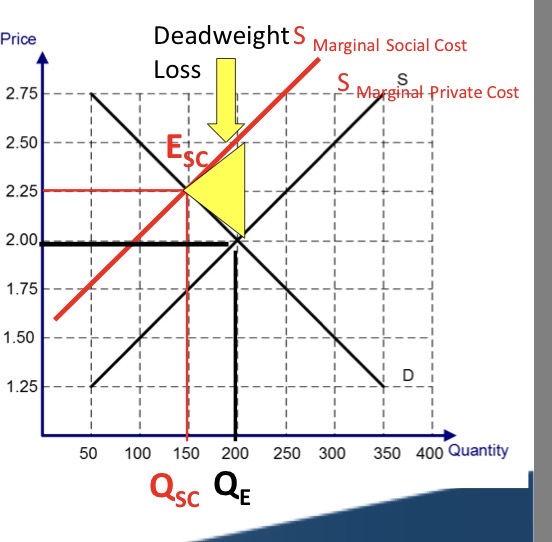
Negative Externality on Graph
Pigovian Tax
A tax imposed on activities that generate negative externalities, designed to make producers and consumers bear the full social cost of their actions
Property Rights
Legal and social constructs that define ownership and control over resources, providing incentives for investment, innovation, and efficient resource allocations
Asymmetric Info
One party to an economic transaction has less information than the other party