Special Sense Organs: Anatomy and Function of the Eye, Ear, and Olfaction
 Call Kai
 Learn
 Practice Test
 Spaced Repetition
 Match
 Flashcards
 Knowt Play
1/40

There's no tags or description
Looks like no tags are added yet.
41 Terms
What is the primitive organ for smell in Amphioxus?
Kölliker's Pit
How did the nasal cavity evolve in land vertebrates?
Kölliker's Pit extended down to the mouth, allowing inhalation of odorants.
What is the function of the palate in mammals?
It separates the nasal and oral cavities, allowing simultaneous breathing and suckling/chewing.
What are the components of the nasal septum?
Vomer, Ethmoid, Maxilla, and Cartilages.
What is the role of turbinates in the nasal cavity?
They increase surface area for olfaction and temperature regulation.
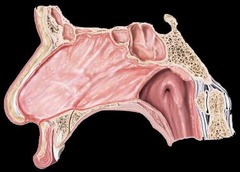
What do the paranasal sinuses do?
They lighten the skull and are lined with mucosa to prevent pathogens from entering.
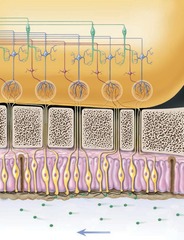
How do odorants reach the olfactory bulb?
They are captured by olfactory cells in the olfactory mucosa and transmitted to the olfactory bulb.
How many different smells can most people reliably distinguish?
Between 2,000 to 4,000 different smells.
What is the lifespan of olfactory receptor cells?
60-90 days before they are replaced.
What is the typical number of olfactory receptor cells in humans?
Approximately 12 million.
What is the significance of the human nasal cycle?
It alternates swelling in the nostrils to allow each to rest and capture different types of odorants.

How does the eye develop from the brain?
The optic stalk grows from the diencephalon and invaginates the surface ectoderm to form the eye.
What are the two types of light-detecting receptor cells in the retina?
Rods and cones.
What is the function of the iris?
It controls the size of the pupil and regulates the amount of light entering the eye.
What is the role of the ciliary body?
It contains smooth muscle that controls the shape of the lens for focusing.
What is the difference between sphincter pupillae and dilator pupillae muscles?
Sphincter pupillae shrinks the pupil under parasympathetic control, while dilator pupillae opens the pupil under sympathetic control.
What is the function of the choroid layer in the eye?
It absorbs light to create a clearer image.
What is the optic disc?
The point where the optic nerve exits the eye, lacking photoreceptors, creating a blind spot.

What is the fovea centralis?
The area of the retina with the highest concentration of cones, responsible for sharp central vision.
What structure in the eye is responsible for focusing light onto the retina?
The lens
What are the two types of muscles that control pupil size?
Sphincter pupillae (constricts pupil) and dilator pupillae (dilates pupil).
Which cranial nerve controls the constriction of the pupil?
Oculomotor nerve (CN III)
What is the role of the vitreous body?
To maintain the shape of the eye and support the retina.
What is the function of the retina?
To convert light into neural signals for vision.
What are rods and cones?
Rods detect light intensity and work in low light; cones detect color and require bright light.

What is the primary difference between rods and cones?
Rods are sensitive to light intensity, while cones are sensitive to specific wavelengths of light.
What causes blue and lighter colored eyes?
Lower levels of melanin in the iris' stroma, allowing light to scatter.
What is hyperopia?
A condition where distant objects are seen clearly, but close objects appear blurry (farsightedness).
What is myopia?
A condition where close objects are seen clearly, but distant objects appear blurry (nearsightedness).
What happens to the lens during near vision?
The lens thickens to bend light more sharply.
What is the function of the extraocular muscles?
To control eye movement.
Which cranial nerve innervates the lateral rectus muscle?
Abducens nerve (CN VI)
What is the function of the levator palpebrae superioris?
To elevate the upper eyelid.
What is the significance of the ophthalmic artery?
It supplies blood to the eye and its surrounding structures.
What is the primary function of the choroid layer?
To provide nourishment to the retina and absorb excess light.
What is the Tyndall effect in relation to eye color?
The scattering of light by the collagen fibers in the stroma, causing blue eye color.
How do sympathetic and parasympathetic systems affect pupil size?
Sympathetic activation dilates the pupil; parasympathetic activation constricts the pupil.
What is the role of retinal arteries?
To supply blood to the retina.
What is the function of the sclera?
To provide structural support and protection for the eye.
What is the difference in color vision between males and females?
Females are less likely to be color blind due to having two copies of long-wave cone genes.
What is emmetropia?
The condition of normal vision where light is properly focused on the retina.