Energy and enzymes
 Call Kai
 Learn
 Practice Test
 Spaced Repetition
 Match
 Flashcards
 Knowt Play
1/22

There's no tags or description
Looks like no tags are added yet.
23 Terms
First law of thermodynamics
Energy can be transferred or transformed but not created or destroyed
Second law of thermodynamics
The entropy of the universe increases overtime
The cell keeps its entropy low but transformation of energy increases entropy via removal of heat & waste products
Molecules only react if..
They have more energy than the product energy
ΔG < 0
Exergonic reaction
Favourable
ΔG > 0
Endergonic reaction
Enzymes
Proteins, RNA, or a mix of both
Lower the activation energy of a reaction

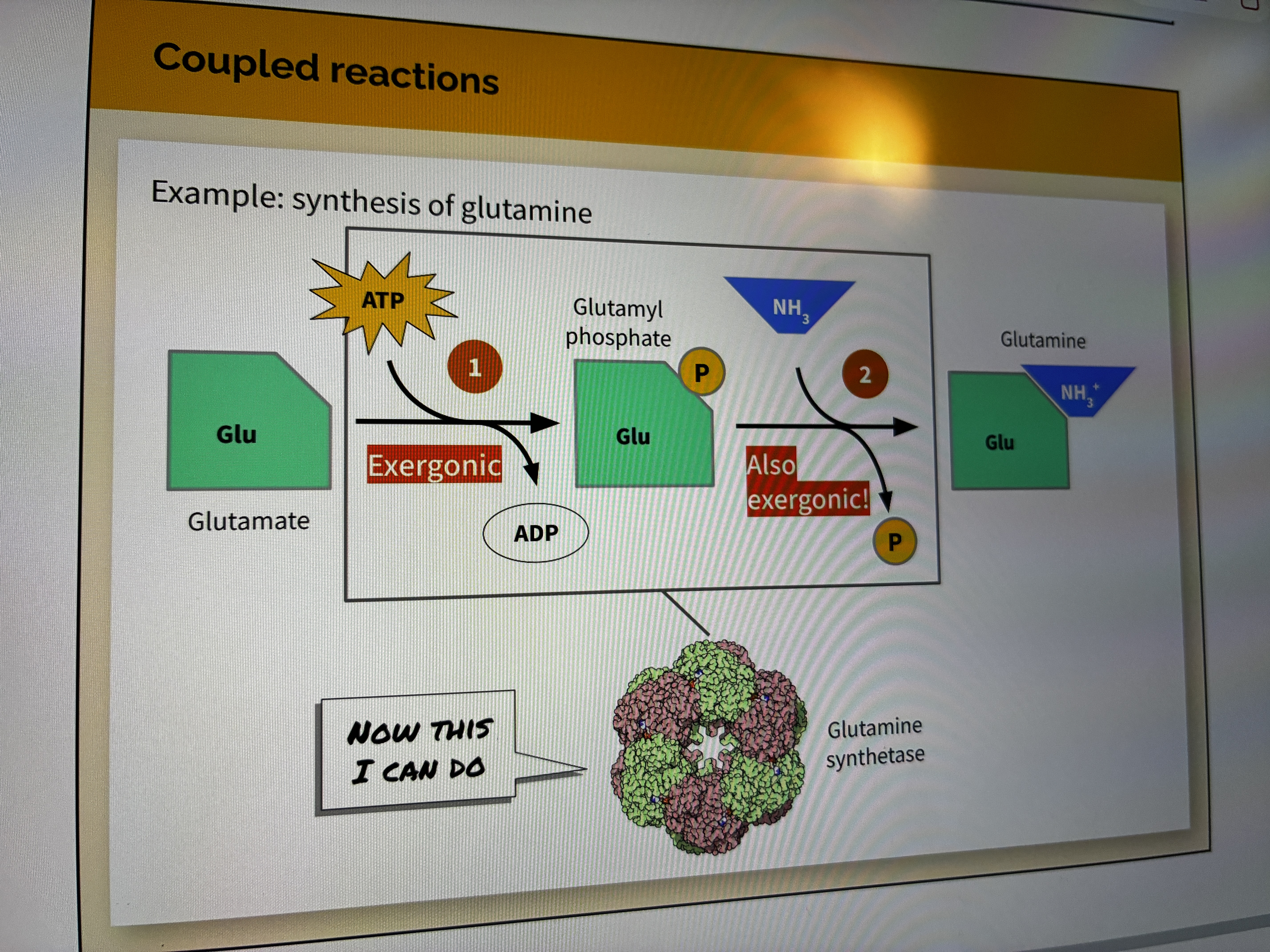
Glutamine synthesis
Glutamic acid + NH3 → ΔG= +14.2 kJ/mol
Products have more energy than the reactants
Can endergonic reactions take place, even with enzymes?
No. We need to couple the reactions with ATP so they become exergonic, eventually we can get the same products as the endergonic reaction
Electron “shuttles”
Coenzymes involved in redox reactions
NAD(H), NADP(H), FAD(H2)
Redox of NAD(H) and NADP(H)
NAD+ + H+ + 2e- → NADH
NAD+ redox reaction
NAD+ + 2e- + H+ → NADH
NADP+ redox reaction
NADP+ + 2e- + H+ → NADPH
FAD redox reaction
FAD + 2e- + 2H+ → FADH2
Alcohol dehydrogenase (ADH)
Uses NAD+ as a cofactor so instead of acetalaldehyde (poison that causes hangover) acetic acid will be the product
Allosteric regulator
Can be positive (activator) or negative (inhibitor)
Inhibitor
Acts as a fasle substrate and fits in the active site of the enzyme
Penicillin with a broken B-lactam ring
Non-competitive inhibitors
Use a binding site on the enzyme different from the substrate binding site
Work independent of [enzyme] & can saturate enzyme
Used to regulate reactions
Non-competitive inhibition reaction regulation example
Alanine (ALA) synthesis regulation
Inhibits pyruvate kinase (makes pyruvate)
Less pyruvate available to ALT
ALT
Cytosolic enzyme
ALT in the blood means trouble with liver
Do enzymes make reactions kinetically favourable?
Yes, but they don’t change ΔG
Does ATP hydrolysis have a lot of energy?
No, it’s useless on it’s own. However coupling it with reactions is what makes it useful!
Do bonds store energy?
NO! The configuration of the molecule is what has energy