Psychology Chapter 1
 Call Kai
 Learn
Learn Practice Test
 Spaced Repetition
 Match
Match Flashcards
 Knowt Play
1/31

Earn XP
Description and Tags
Yesterday and Today
Name | Mastery | Learn | Test | Matching | Spaced | Call with Kai | Chat |
|---|
No analytics yet
Send a link to your students to track their progress
32 Terms
What is Psychology?
The scientific study of mental processes and behavior
Levels of Analysis
Study influences of the brain (neural activity), the person (emotions, ideas, thoughts), and the group (friends, family, culture)
Psychology’s Roots
Myths and ceremonies developed as a way to describe, explain, predict, and control our reality
Philosophy
The study of knowledge and reality
Socrates, Plato, and Aristotle posed questions and discussed solutions, beginning modern processes of scientific enquiry
ancient Greek
Hippocrates argued the brain is the organ of mental life
Rene Descartes (1593-1650)
Thought the brain controlled the body by movement of fluids within tubes that ran throughout the body
Johannes Muller (1801-1858)
Advocated for scientists to study the relationship between physical stimuli and their psychological effects
Herman von Helmholtz (1821-1858)
Measured the speed of neural impulses and discovered neural impulses were not instantaneous
Charles Darwin (1809-1882)
All life on earth comes from one common ancestor, a radical idea
Natural selection
Willhelm Wundt (1832-1920)
Father of psychology (voluntarism)
Established first psychology lab in 1879 Leipzig, Germany
Focused on study of consciousness
Edward Titchener (1867-1927)
Developed Structuralism to try to identify all the elements of consciousness
Introspection, careful reflection and systematic observation of details of mental processes and how simple thoughts combine into complex ideas
Goal of Structuralism was to describe observable mental processes rather than explain, predict, or control
William James (1842-1910)
Set up first psychology lab at Harvard
Wrote Principals of Psychology
Believed mental processes were fluid, “stream of consciousness” instead of fixed elements
Studied animals, children, and individuals with mental disorders
Gestalt Psychologists
Said consciousness cant be broken down into elements, we perceive things as whole perceptual units
Whole>sum of its parts
Learning is tied to what we perceive
Sigmund Freud (1856-1939)
Belief that peoples behaviors are based on unconscious desires and conflicts
Developed a form of therapy, psychoanalysis, that aimed to resolve unconscious conflicts
Behaviorism
Psychological research should only focus on behavior you can observe
Edward Thorndike (1874-1949)
Study of animals could help explain human behavior
Ivan Pavlov (1849-1936)
Classical conditioning, dogs could learn to associate a bell with an automatic behavior, salivating for food
John B. Watson (1878-1958)
Conducted “little albert” experiment showing children/people could be classically conditioned
B.F Skinner 91904-1990)
Developed operant conditioning to shape behavior
Used reinforcement to change the frequency of the expression of a behavior
Positive reinforcement=increases negative reinforcement=decrease likelihood of behavior occurring
Albert Bandura (1925-)
Described learning by social observation in children
Can be observed in several species of primates
Humanistic Psychologists
Believed a person has a capacity for personal growth and the freedom to choose their destiny and positive qualities
Subjective perceptions of the world are unique and more important than behavior
Carl Rogers (1902-1987)
Developed “client centered therapy’’ people are innately good
Abraham Maslow (1908-1970)
Developed theory of motivation, hierarchy of needs
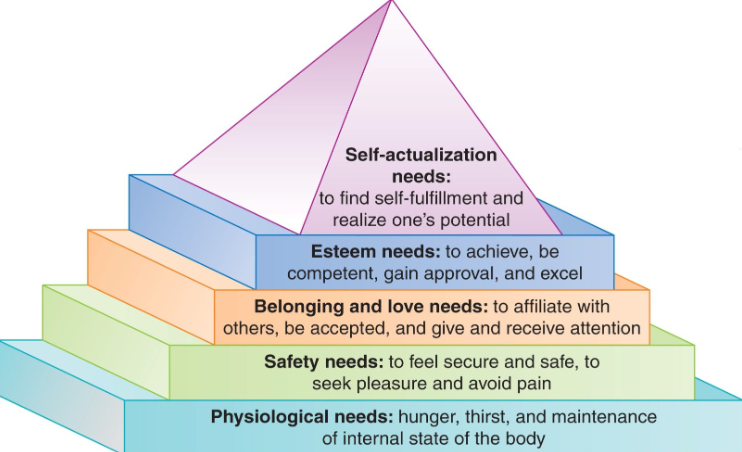
Ulric Neisser (1928-2012)
Cognitive psychology, study of information processing
How people process information, develop language, solve problems, and think
Compared human mind to computer
Cultural Psychology
Study of how cognitive processes vary across different populations
Cross-Cultural Psychology
Study of the cognitive processes that are universal regardless of culture
Karl Lashley (1890-1958)
Tried to determine which areas of the brain are responsible for memory, leaning, and other functions
Donald Hebb (1904-1985)
Canadian scientist
developed concept of cell assembly
Cell Assembly
Neurons develop connection networks based off our experiences as we develop and interact with our environments
Behavioral Genetics
Study of how gene expression influences development of the brain and control of human behavior
Evolutionary genetics
study of how evolution has shaped our brain and behavior
3 main branches of psychology
Clinical and couseling (therapists)
Academic (professors, teaching and research)
Applied (schools, etc)