Chapter 16 The Autonomic Nervous System
 Call Kai
 Learn
 Practice Test
 Spaced Repetition
 Match
 Flashcards
 Knowt Play
1/112

There's no tags or description
Looks like no tags are added yet.
113 Terms
Visceral Effectors in Skin
blood vessels, sweat glands, arrector pili muscles in skin, and adipocytes
autonomic/visceral sensory receptors
baroreceptors, chemoreceptors, stretch receptors, visceral nocieptors
the autonomic motor pathway always start at the-
hypothalamus
the autonomic motor pathway has __ neurons
3
what is the first neuron of the autonomic motor pathway that descends from the hypothalamis
visceral motor neuron
what is the neuron that synapses will visceral motor neuron (second neuron)
preganglionic neuron
the preganglionic neuron cell body is located where
brainstem or lateral gray horn of the spinal cord
what is the neuron that synapses with a preganglionic neuron?
postganglionic neuron
postganglionic neuron cell body is usually located where?
outside the CNS in a autonomic ganglion
are axons of autonomic neurons in the peripheral nervous system myelinated?
preganglionic neurons are lightly myelinated and postganglionic neurons are not
sympathetic nervous system is generally known as the...
"fight or flight" system
decreasing heart rate and contractibility is a ______ response
parasympathetic
parasympathetic nervous system is generally known as the...
"rest and digest" system
Dilation of the pupils is a ______ response
sympathetic
increasing heart rate and contractibility is a ______ response
sympathetic
constriction of the pupils is a ______ response
parasympathetic
constriction of blood vessels is a ______ response
sympathetic
constriction of brochi (decrease airflow) is a ______ response
parasympathetic
dialation of blood vessels is a ______ response
parasympathetic
redirection of blood flow to muscles is a ______ response
sympathetic
dilation of brochi (increase airflow) is a ______ response
sympathetic
decrease of BP is a ______ response
parasympathetic
the decrease of mobility and secretions of the GI tract is a ______ response
sympathetic
redirection of blood flow to gi tract, skin and genitalia, is a ______ response
parasympathetic
contraction of the bladder wall is a ______ response
parasympathetic
increased sweating is a ______ response
sympathetic
the increase of mobility and secretions of the GI tract is a ______ response
parasympathetic
the increase of glucose release in the liver is a ______ response
sympathetic
Increase Epinephrine & Norepinephrine in the adrenal medulla is a ______ response
sympathetic
relaxation of the bladder wall (retention of urine) is a ______ response
sympathetic
increase of BP is a ______ response
sympathetic
activation of the arrector pili muscle is a ______ response
sympathetic
decreased sweating is a ______ response
parasympathetic
the decrease of glucose release and promotion of storage of glycogen in the liver is a ______ response
parasympathetic
the sympathetic nervous system is also called the _____________ division of the autonomic nervous system.
thoracolumbar
Thoracolumbar division
where Sympathetic neuron fibers arise only from the T1 through L2 segments of spinal cord
the thoracolumbar division contain ______ preganglionic fibers and ______ Postganglionic fibers
short; long
white ramus communicantes contain -
myelinated preganglionic fibers that carry sympathetic signals from the spinal cord to the sympathetic ganglia.
gray ramus communicantes contain
unmyelinated postganglionic fibers that carry sympathetic signals from the ganglia back to the spinal nerves.
relaxation of the arrector pili muscle is a ______ response
parasympathetic

what is #1?
the ventral root
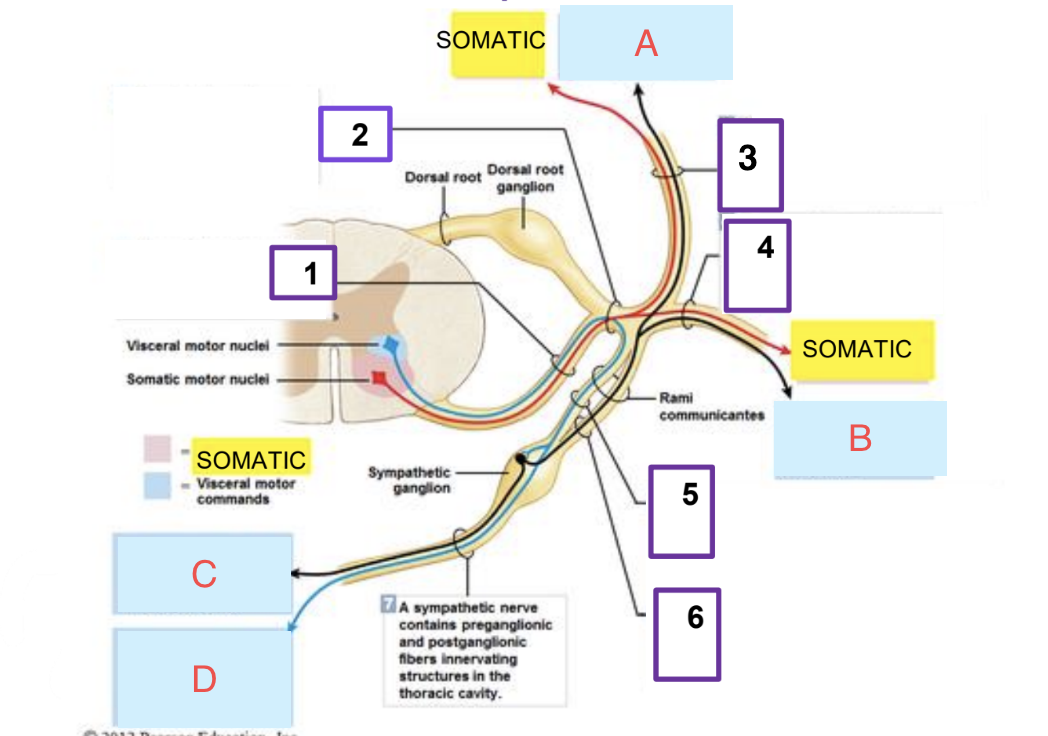
what is #2?
spinal nerve

what is #3?
dorsal ramus

what is #4?
ventral ramus

what is #5?
white rami communicantes

what is #6?
gray rami communicantes

what is A?
postganglionic fibers to smooth muscles, glands, and blood vessels in the back

what is B?
postganglionic fibers to smooth muscles, glands, and blood vessels of the body wall and limbs

what is C?
postganglionic fibers to smooth muscles, glands, and visceral organ in the thoracic cavity

what is D?
preganglionic fibers to sympathetic ganglia innervating abdominopelvic viscera
what are the three locations that the preganglionic fiber synapse with the cell body of the postganglionic fiber in the sympathetic nervous system?
Paravertebral ( Sympathetic chain/ trunk Ganglia), Prevertebral (Collateral Ganglia), and In Adrenal gland medulla

identify A
sympathetic chain ganglion or paravertebral ganglia

identify B
collateral ganglia or prevertebral ganglia
what does postganglionic fibers from sympathetic chain ganglia control overall?
visceral efectors in the skin, eyes, salivary glands, heart, lungs, Rectum, Kidneys, urinary bladder, Uterus, and genitals.
cervical ganglions of the sympathetic chain ganglia innervate what?
eyes and salivary glands
thoracic ganglions of the sympathetic chain ganglia innervate what?
heart and lungs
inferior lumbar and sacral sympathetic chain ganglia innervate what?
Rectum, Kidneys, urinary bladder, Uterus, and genitals.
1. During a stressful event, a patient’s pupils dilate. Which pathway most accurately describes how this response occurs?
A. Parasympathetic fibers from CN III → ciliary ganglion → iris sphincter
B. Sympathetic fibers from T1–T2 → superior cervical ganglion → dilator pupillae
C. Somatic fibers from T5–T6 → celiac ganglion → iris dilator
D. Sympathetic fibers from T10–T12 → lumbar plexus → iris dilator
B
A patient has unilateral sympathetic trunk damage. Why might the skin on that side feel warmer and appear redder?
A. Increased skeletal muscle activity
B. Reduced sympathetic vasoconstrictor activity in cutaneous blood vessels
C. Increased parasympathetic activity in the skin
D. Complete interruption of sensory nerves
B
2. A lesion interrupts sympathetic outflow at L1–L2. Which function is most likely affected?
A. Bronchodilation
B. Control of sweat glands in lower limbs
C. Salivary gland secretion
D. Heart
B
what are the 3 collateral ganglia?
celiac ganglia, superior mesenteric ganglion, and inferior mesenteric ganglion
overall what does the collateral ganglia innervate?
liver, gallbladder, stomach, spleen, pancreas, kidneys, urinary bladder, genitals, and the large and small intestines
what are the specific target organs of the celiac ganglion?
liver, gallbladder, stomach, spleen, and pancreas
what are the specific target organs of the superior mesenteric ganglion?
the large and small intestines
what are the specific target organs of the inferior mesenteric ganglion?
kidneys, urinary bladder, and genitals
the collateral ganglia is where preganglionic fibers _____ synapse with postganglionic fibers within the sympathetic chain
dont
adrenal medulla
Modified sympathetic ganglion at center of each adrenal gland that directly receives a preganglionic fiber that synapse on medullary cells
what type of hormones does the adrenal medulla secrete?
Epinephrine and Norepinephrine
the ______ _______ is the only target organ in the thoracolumbar division where the preganglionic fiber directly synapses on it
adrenal medulla
what is the effect of Adrenal Medulla Stimulation?
releases its hormones directly onto the bloodstream and the Effects last much longer and widespread than those produced by direct sympathetic innervation
What would be the effects of damage to the cervical and thoracic sympathetic trunk?
Vision, Salivation, Thermoregulation of the face, neck, and upper upper body/chest, and Ability to respond to stress
What would be the effects of Damage to the lumbar portion of the sympathetic trunk?
Bladder, Genitals, Lower limbs blood flow
3.A student claims the thoracolumbar division innervates the adrenal cortex directly. What is the most accurate correction?
A. It innervates the adrenal cortex via the vagus nerve
B. Preganglionic sympathetic fibers synapse directly on adrenal medulla cells
C. It uses postganglionic fibers to stimulate the adrenal cortex
D. It does not control adrenal function at all
B
4. A tumor damages the sympathetic trunk in the thoracic region. Which function may be impaired?
A. Voluntary movement of the arm
B. Sensation from the skin
C. Sympathetic regulation of the heart and sweat glands
D. Sympathetic regulation of the heart only
C
5. Damage interrupts sympathetic fibers traveling through the lumbar sympathetic trunk to the lower limb. What is a likely result?
A. Reduced sweating and impaired vasoconstriction in the affected limb
B. Loss of voluntary leg movement
C. Increased secretion from salivary glands
D. Loss of intestinal parasympathetic activity
A
what hormone does Sympathetic preganglionic neurons release in autonomic ganglionic neurons
ACh
what hormone does Sympathetic preganglionic neurons release in adrenal medulla cells
ACh
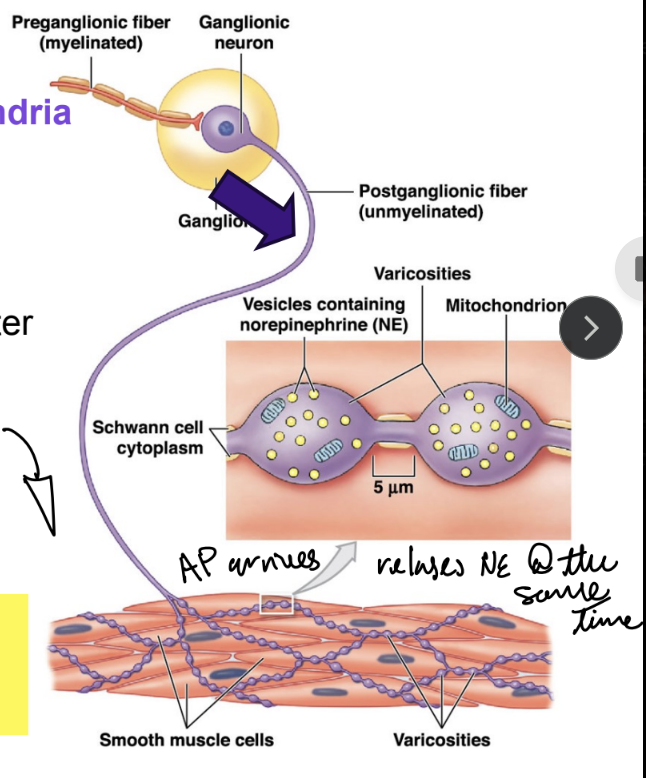
what hormone does sympathetic postganglionic neurons release mostly?
norepinephrine
what target tissues does a sympathetic postganglionic neuron release ACh?
sweat glands and Skeletal muscle blood vessels
what does a Post Ganglionic neurons telodendria (fine terminal extensions) look like
is branched has swollen segments called varicosities that are packed with neurotransmitter vesicles
What membrane Receptors do Norepinephrine and Epinephrine bind to?
adrenergic receptors
The same neurotransmitter type binds to different receptors in
different organs and produces ______ effects.
different
adrenergic agonist
chemicals that stimulate the sympathetic nervous system by binding to and activating adrenergic receptors (alpha and beta receptors)
adrenergic antagonist
medications that bind to alpha (α) or beta (β) adrenergic receptors and block the actions of primarily epinephrine and norepinephrine
an asthma inhaler dilates the bronchioles therefore it is a adrenergic _________
agonist (beta 2)
epinephrine causes _________ of the blood vessels
constriction
the parasympathetic nervous system is also referred to as the -
craniosacral division
the craniosacral division extends from what areas of the spinal cord and brainstem?
pons, medulla, and S2 - S4
the parasympathetic division has ____ preganglionic fibers and ____ postganglionic fibers
long, short
what are the two types of parasympathetic ganglia?
terminal and intramural ganglia

what are the 4 terminal ganglia?
ciliary, pterygopalatine, submandibular, and otic

what parasympathetic ganglia Control visceral structures in head?
terminal ganglia
the preganglionic fiber coming CN III innervates what? what is the effects?
it innervates the eye and will constrict the pupils and allow the eye to focus on nearby objects
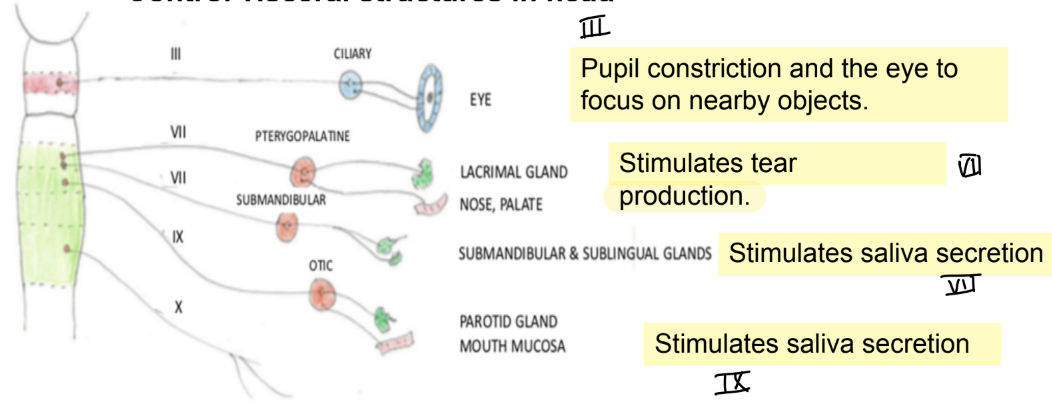
the preganglionic fiber coming CN VII and synapsing in the pterygopalatine ganglion innervates what? what is the effects?
lacrimal gland, nose, and palate and will stimulate tear production

the preganglionic fiber coming CN VII and synapsing in the submandibular ganglion innervates what? what is the effects?
submandibular and sublingual glands and will stimulate saliva secretion

the preganglionic fiber coming CN IX and synapsing in the otic ganglion innervates what? what is the effects?
the parotid gland and mouth mucosa and will stimulate salvia secretion
for terminal ganglia, the Parasympathetic preganglionic fibers leave the ____ and ______ in cranial nerves ___, ___, and ___
pons; medulla; III (oculomotor), VII (facial), IX (glossopharyngeal)
the preganglionic fibers that synapse in intramural ganglia of the parasympathetic division originate where in the CNS?
The vagus nerve (CN X) that extends from the lower medulla and S2 - S4
where are intramural ganglia of the craniosacral division located?
within the target organ
what structures are innervated from intramural ganglia?
Innervates structures in, Neck, Thoracic cavity, Abdominopelvic cavities
