Week 7 Ch 19&20- The Musculoskeletal System
 Call Kai
 Learn
 Practice Test
 Spaced Repetition
 Match
 Flashcards
 Knowt Play
1/48

Earn XP
Description and Tags
Material covered that pertains to the musculoskeletal system medical terminology.
49 Terms
What are the primary functions of the musculoskeletal system?
To provide support for the body.
To allow motion.
To protect vital organs.
What are the primary structures that make up the musculoskeletal system?
Bones
Muscles
Cartilage
Tendons
Ligaments
Joints
Other connective tissues
Define the term “rhabdomyo.”
Meaning “striated muscle.”
Define the term “leiomyo.”
Meaning “smooth muscle.”
Define the term “cardiomyo.”
Meaning “heart muscle.”
Define the term “myopathy.”
Means “disease of any muscle.”
Define the term “cardiomyopathy.”
Meaning “disease of the heart muscle.”
True or false: the “point of origin,” is the attachment site that moves during muscle contraction and proximal to the body.
False: the point of origin does not move but yes is proximal to the body.
True or false” the “point of insertion,” is the attachment site that does not move and is proximal to the body.
False: the point of insertion is the attachment site that moves when muscles are contracted and is distal to the body and further away than the point of origin.
Define the term “orthopedics.”
Meaning a medical specialty concerned with the correction or prevention of deformities, disorders or injuries of the skeletal and associated structures such as ligaments and tendons.
Define the term “orthopnea.”
Meaning shortness of breath or difficulty breathing when lying flat or in the recumbent position.
What are common causes of “orthopnea.”
Heart failure
Pulmonary disease
Define the term “osteoporosis.”
Meaning deterioration of the bone matrix that results in a reduction in bone density and bone weakness.
Define the term “osteopenia.”
Meaning low bone mass or bone density.
What is the functional unit of bone?
The osteon.
Define the term “myelocyte.”
Meaning immature white blood cell, normally found in bone marrow.
What are the different components of bone marrow?
Red blood cells
White blood cells
Lymphocytes
Monocytes
Eosinophils
Basophils
Neutrophils
Platelets
How many types of spine curvatures are there?
There are 3.
True or false: Posterior curvature of the thoracic spine is called “kyphosis.”
True
True or false: Anterior curvature of the lumbar spine is called “lordosis.”
True
True or false: anterior curvature of the lumbar spine is called “scoliosis.”
False: This is the lateral curvature of the spine.
What does the fracture term “complete“ mean?
Meaning a break through the entire width of a bone.
What are the different types of joints?
Ball and socket
Hinge
Condyloid
Plane
Saddle
Pivot
Bands of tissue that help hold bones, joints and organs in place are known as what?
Ligaments
Which tissue structure attached bones to bones?
Ligaments
The sheath of stringy connective tissue that surrounds the muscle is known as what?
Fascia
What tissue structure attaches muscle to muscle?
Fascia
What does the fracture term “incomplete“ mean?
Meaning a break not through the entire width of a bone.
What does the fracture term “closed or simple fracture“ mean?
Meaning the skin is not broken.
What does the fracture term “open or compounded fracture“ mean?
Meaning bone ends protrude through skin.
What does the fracture term “pathologic fracture“ mean?
Meaning caused by diseased-weakened bone.
What does the fracture term “fracture reduction“ mean?
Meaning the realignment and stabilization of broken bones.
What does the fracture term “closed manipulation“ mean?
Meaning the realignment and stabilization of broken bones.
What does the fracture term “fixation“ mean?
Meaning the realignment and stabilization of broken bones.
A surgical procedure to repair a broken bone by making an incision, realigning or repairing the bone pieces (open reduction), and then stabilizing them with hardware like screws, plates, or rods (internal fixation), abbreviated “ORIF,” is known as what?
An “Open Reduction Internal Fixation.”
“OREF” stands for what procedure? What is the primary difference from the ORIF procedure?
“Open Reduction External Fixation,” and is fixation done externally with metal pins, screws or rods.
What does the fracture type “transverse“ mean?
A break that is perpendicular to the bone and complete.
What does the fracture type “oblique“ mean?
A break that is angular and complete.
What does the fracture type “greenstick“ mean?
A bone bends and cracks but does not break.
What does the fracture type “comminuted“ mean?
When a bone is shattered and fragmented; such as a crush fracture.
What does the fracture type “torus“ mean?
When a bone buckles or bulges; due to compression forces.
What does the fracture type “spiral“ mean?
A break that is due to a twisting motion.
What does the fracture type “segmental“ mean?
When a bone is broken in two or more places; free-floating segments.
What does the fracture type “avulsed“ mean?
When a tendon or ligament pulls off a piece of bone.
What does the fracture type “impacted“ mean?
Is a fracture due to and impact or compression.

Cervical vertebrae (C1-C7)
Thoracic vertebrae (T1-T12)
Lumbar vertebrae (L1-L5)
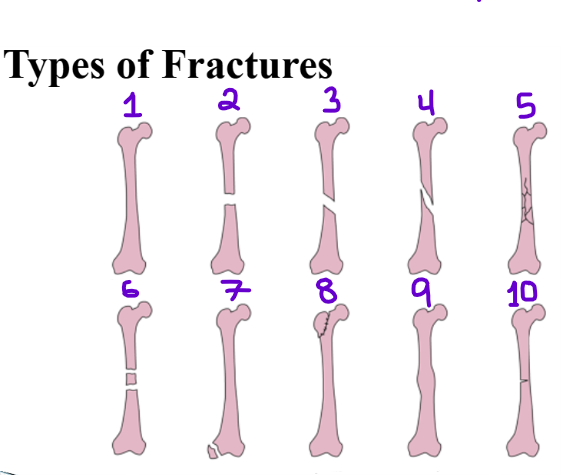
Normal
Transverse
Oblique
Spiral
Comminuted
Segmental
Avulsed
Impacted
Torus
Greenstick

Sacrum
Ilium
Ischium
Coccyx
Ischial spine
Sacroiliac joint
Iliac crest
Anterior superior iliac spine
Acetabulum
Obturator foramen
Symphysis pubis

Parietal bone
Occipital bone
Temporal bone
Mandible
Maxilla
Zygomatic bone
Nasal bone
Ethmoid bone
Frontal bone
Sphenoid bone