W1: A Framework for Understanding Life
 Call Kai
 Learn
Learn Practice Test
 Spaced Repetition
 Match
Match Flashcards
 Knowt Play
1/50

There's no tags or description
Looks like no tags are added yet.
Name | Mastery | Learn | Test | Matching | Spaced | Call with Kai | Chat |
|---|
No analytics yet
Send a link to your students to track their progress
51 Terms
what does it mean to say something is alive
Cellular, Processes Information, Evolves
Cellular
All living organisms are made up of membrane bound cells
Processes Information
Living organsims can process heriditary information encoded by gene and the information of the enviornment
Evolves
Living organisms are continuously evolving
Scientific Theory
an explanation for a broad class of phenomenon or observations, supported by a wide body of evidence.
How does it differ from a normal theory?
Differs from the everyday explanation of a theory where words like “speculation” or “guess” are used.
Life is defined by 3 foundational theories of biology
1) The cell theory, 2) The chromosome theory of inheritance, 3) the theory of evolution
Cell
A cell is a highly organized compartment
bounded by a plasma membrane
Containing concentrated chemicals in an aqueous solution
Hypothesis
A testable statement that explains something being observed.
Experiment
An experiment allows researchers to test the effect of a factor on a particular phenomenon
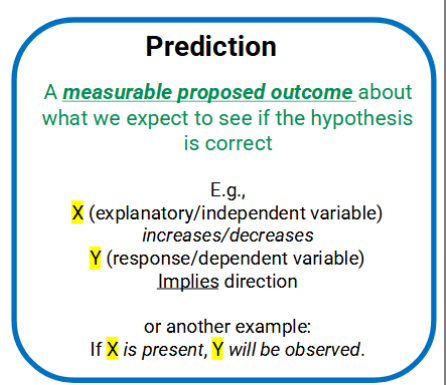
Prediction
A prediction is a measurable proposed outcome result that must be valid if the hypothesis is correct.
Important Distinction of a Hypothesis:

Important Distinction of a Prediction:
Where do cells come from?
There are 2 competing hypothesis as to where cells come from:
1) Spontaneous Generation
2) Cell theory
Spontaneous Generation
Organisms could arise spontaneously under certain conditions
bacteria and fungi that spoil foods such as milk and wine (springing to life from non living materials)
Cell theory
all organisms are made of cells and all cells come from pre-exisiting cells.
What did Louis Pasteur want to prove in his experiment:
Cells arise from cells
Cells do not arise by spontaneous generation
What were his x and y factors:
X: Presence of pre-existing cells
Y: Cell growth
What was his hypothesis?
the presence of pre-existing cells is required for cell growth
What was his null?
The prescence of pre-existing cells is not required for cell growth.
What were his prediction?
Cell growth will be observed if pre existing cells are present
Cell growth will be observed regardless of whether pre existing cells are present.
Louis Pasteur’s Experiment

Life Is Defined by Three Foundational Theories of Biology
2) The chromosomal theory of inheritance
Chromosomal theory of inheritance proposed in 1902 by Walter Sutton and Theodor Boveri
– Hereditary or genetic information is encoded in genes
– Genes are units located on chromosome
What are chromosomes:
Chromosomes are molecules of deoxyribonucleic acids (DNA)
DNA is the hereditary material
Genes are segments of DNA that code for cell products
What is the structure of DNA?
DNA has a double helix structure
Structure of DNA: Double Helix
Each strand of the double helix is made up of four building blocks: A, T, G, and C.
Sequence of this code is like letters in a word (3 letters=one word, this is called a codon)
DNA carries, or encodes, information needed for an organism’s growth and reproduction
How are the strands of the double felix connected?
The two strands of the double helix are held together by connections between the building blocks:
A pairs with T
G pairs with C
This pairing allows DNA to be copied.
Preserves to infromation encoded in the DNA.
James Watson and Francis Crick, along with Rosalind Franklin, proposed that DNA is a double-stranded helix.
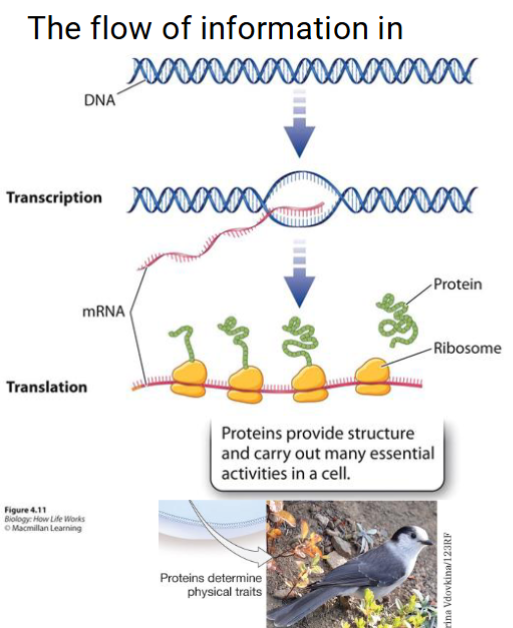
The Central Dogma
Genes in DNA code the information necessary to produce a functional product, often a protein
DNA is transcribed into a RNA message
The RNA message can then be translated into a protein
The Central Dogma: Flow of information diagram
Central Dogma: The copying of DNA
DNA is copied to pass genetic information from cell to cell or from one organism to its
offspring
Copying DNA is highly accurate
What happens when a mistake is made?
DNA sequence changes may lead to changes in proteins
Outward appearance is a product of proteins produced
DNA sequence changes may cause changes in outward appearance
Review - What is life?
Life Processes Information
- Chromosome Theory of Inheritance: Genes are located on chromosomes.
- Chromosomes: A chromosome consists of a molecule of DNA, which is the hereditary material. Genes are located on chromosomes and consist of specific segments of DNA that code for products in the cell.
- Central Dogma: The flow of genetic information from DNA → RNA → protein is called the central dogma.
- Mutation: Imperfect DNA replication (i.e., mutation) provides the source of heritable variation in traits, which fuels evolution.
What is the 3rd factor that describes something as a living organism?
The theory of evolution by natural selection
Before Darwin
Prevailing paradigm Special Creation (aka natural theology):
1) all species were created separately, thus are all unrelated to one another
2) each species is unchanging, and there is little variation within each
Species
a distinct, identifiable type of organisms
Early Paleontologists: Challenges to special creation
The claim that species could go extinct was met with lots of resistance (why would the divine creator “wipe out” its creation?
Challenges to Special Creation: What are the claims Charles Darwin and Alfred Russsel Wallace made?
1) All species are related by common ancestory
2) Characteristics of species can be modified from generation to generation ( descent with modification)
Microevolution
Species changing over time
macroevolution
species splitting and diverging
What is Evolution?
is a change in the characteristics of a population over time
it means that species are related to one another and can change through time
Define a population
a group of individuals of the same species
living in the same area
at the same time
How does evolution occur?
Adaptive selection
Nonadaptive (Genetic drift, gene flow, mutation, non-random mating)
Three conditions of Natural Selection
Three conditions must be met for natural selection to occur in a population:
1) there must be variation in traits
2) that variation must be heritable (can be passed on)
3) In a particular environment, certain versions of these heritable traits must confer differential reproductive success (help individuals reproduce more than other versions)
Natural Selection: Heritable Traits
If certain heritable traits lead to increased success in producing offspring
these traits become more common in the population over time
In this way, the populations characteristics change (evolution) as a result of natural selection acting on individuals
Natural selection acts on individuals
Evolutionary change occurs in populations
Speciation
Speciation occurs when populations diverge to form new species
Fitness
The ability of an individual to produce offspring
Individuals with high fitness produce many surviving offspring
Adaptation
A heritable trait that increases the fitness of an individual in a particular environment.
Example of natural selection
Finches on a Galapagos island:
Variation in finch beak size and shape
When rainfall became consistent, small soft seeds become more abundant
Observed a shift in the proportion of finches with small, pointed beaks
If finches with small, pointed beaks had higher fitness (produced more offspring) AND
Small beak size was heritable (has a genetic basis)
Then, small, pointed beaks can be considered an adaptation that increased finches’ ability to thrive
Resulting in the frequency of finches with small, pointed beaks increasing in the population
Important Characteristics of Good Experimental Design
A well-designed experiment:
1) included one or more control groups to check for other factors that might influence the outcome
2) Experimental conditions were controlled to eliminate other variables (confounding factors)
3) Test were repeated or replicates were included to reduce the effects of distortion due to small sample size
How would you go about testing your hypothesis?
Approaches: Observational vs Manipulative
Treatment vs control groups
randomization
replication
(Review angler fish activity from slides)
Confounding Factors
Confounding Factors: Variable other than the one your testing, which can likely impact the test/results.