W5- Remedies to the myopia issue
 Call Kai
 Learn
 Practice Test
 Spaced Repetition
 Match
 Flashcards
 Knowt Play
1/36

There's no tags or description
Looks like no tags are added yet.
37 Terms
What are the different remedies to the myopia problem?
reduce pressures for short term profit
Control investments with preaction reviews
Extend the measurement horizon
Measure the changes in value directly
Improve the accounting measures
Measure a set of value drivers
How do we reduce pressures for short term profit.
Reduce the weighting on annual or quarterly profit targets- move focus to non financial indicators (long term performance)
To make the profit targets easier to achieve- Creates slack so allows room for manoeuvre and longer term initiatives
What is the risk that comes with making profit targets easier to achieve?
Because this introduces slackness it may trigger slackness without necessarily a sharper long term focus.
Sol: Managers whose pressures are being relaxed must be trusted
What are the 2 ways in which we can separate operating performance from costs of longer term investment?
Financial result controls- Reward short term operating performance
Preaction reviews- Used to monitor the quality of investment ideas
What are the various ways of this approach?
Fund developmental expenses at higher organisation levels until the investments begin to generate revenue
Split into today (tight financial controls) businesses and tomorrow businesses (focus on developing new business opportunities)
What are the limitations?
You have to separate operating expenditures from developing expenditures so the distinction between the two may be blurred
Passing decisions to corporate management means that they may not have the necessary knowledge to make accurate investing decisions
What does it mean when we say accounting measures are lag indicators?
They only capture the value creation years later.
How do we overcome myopia by extending the measurement horizon?
Extending the measurement period gives you a more accurate indication of value creation as accounting measures are lag indicators.
How can we use annual bonuses (long term incentive) to extend the measurement horizon?
We park a fraction of the bonus in a “bonus bank”
It goes up or down based on the performance of the organisation over the next 3-5 years
What are the issues of using long term incentives?
Need to account for mental discount rate
use of numbers in long-term strategic plans as performance targets- drives out creative thinking in the strategic planning process
How do we overcome myopia by measuring changes in value directly?
Value is the present value of future cash flows
Economic income= closing bal- opening bal
What are the issues?
Feasibility- aka precision as different forecasts are produced based on different assumptions. Objectivity, who prepares the forecast?
How do we overcome myopia by improving the accounting measures?
We are changing measurement rules to make accounting profit measures more congruent with economic income.
e.g. choose depreciable lives that are close to useful economic lives, capitalise expenditures made for the generation of future cash flows
What are the issues?
The adjustments differ from the accounting rules so must prepare two sets of accounts
Are non financial measures a lag or lead indicator?
A lead indicator as it tells you what would happen to the financial performance of the organisation going forward.
How do we overcome myopia by measuring a set of value drivers?
Using a basket of measures, not just financial measures but how the organisation has invested in the long term ( non financial measures)
What is the balanced scorecard?
A key framework used to understand the cause and effect linkages that would lead to the achievement of the vision and strategy of the organisation.
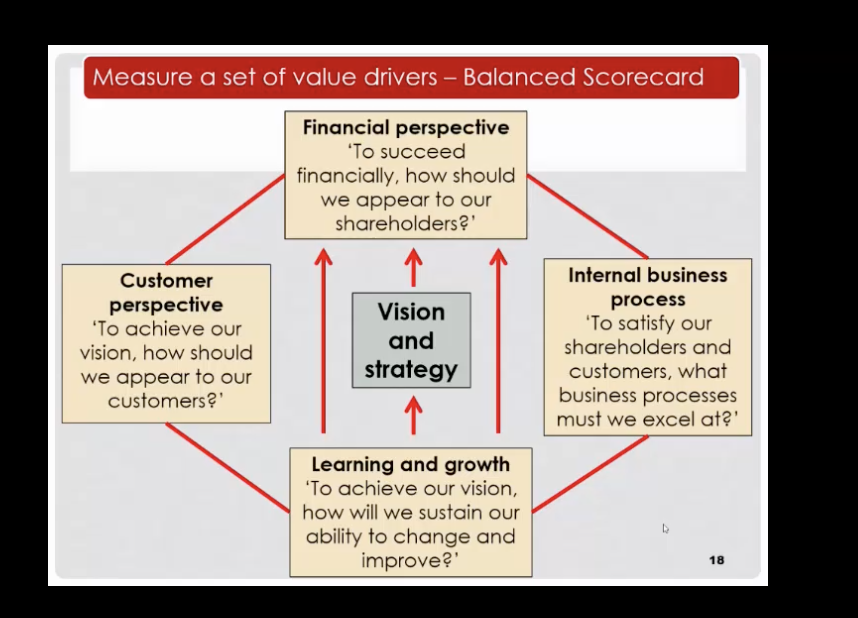
What is the key to effectiveness here?
Picking the right set of leading indicators
Attach the appropriate weightings
What are the benefits?
Provides timely feedback as non financial measures are lead indicators of performance
More complete as measuring performance in many different areas ‘holistic’ framework
Better understandability for employees if you can work out the cause and effect linkages
What are the disadvantages?
Erodes managers sense of decision authority
Not effective if you just blindly implement a set of measures
Too many measures will dilute the importance of each
Weightings would be difficult to set
Which of the following is not a remedy to the myopia problem?
Adopt an easier to achieve profit target
Separate tomorrow businesses from today businesses
Park a fraction of bonus in a “bonus bank”
Use performance bonds
Account for customer acquisition cost as expenses
Account for customer acquisition cost as expenses
What is the controllability principle?
Employees should be held accountable for only what they can control.
What are the arguments for using the controllability principle?
Organisations would incur a lower remuneration cost.
Avoid costs of employees behaviours that seek to lower exposure
Avoid the cost of lost time- e.g. entertaining employee excuses
What are the types of uncontrollable factors?
Economic and competitive factors
Force majeure
Interdependencies
What are economic and competitive factors?
Profit measure can be effected- by numerous economic and competitive factors such as change in consumer demand and product/service prices & change in costs.
Stock prices can be effected- by market cycles
Customer satisfaction measures- affected by shifts in consumer habits
What is force majeure?
Refer to those large unexpected one off events. e.g. earthquakes, hurricanes, terrorist attacks etc.
Organisations are inclined to protect employees from the dwonside risk but only if…?
The events are deemed to be uncontrollable
Steps have been taken to recover from such events
managers are only then relieved from taking responsibility over the impact of those events on the performance of the organisation.
What are interdependencies?
Pooled interdependencies - different business units within the organisation use a centralised service.
Sequential interdependencies- where one division sells to another. Both divisions are dependent on one another
Reciprocal interdependencies- there is trade both ways
What are the methods we can use to control uncontrollable factors before the measurement period?
Insurance - pay a small premium and the insurance company would reimburse the company should those low frequency high impact events occur.
Responsibility structures
What are the benefits of insurance?
Transfer of the risk
Do not have to pay employees a premium for bearing the risk
What are the methods we use to control uncontrollable factors after the measurement period?
Variance analysis
Flexible performance standards
Relative performance evaluations
Subjective performance evaluations
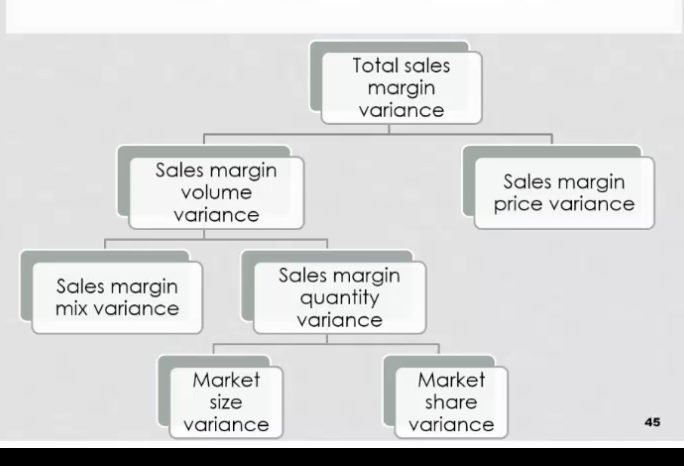
What is variance analysis?
Why your actual performance deviates from the standard.
The purposes are to isolate separate performance factors
Segregate uncontrollable from controllable factors
What are flexible performance standards?
Define performance that employees are expected to achieve given the actual conditions faced during the measurement period.
flexed budgets
Hold managers accountable for operational variances (actual vs flexed standards)
What are relative performance evaluations?
You measure the performance of the organisation against a similar organisation ( gone through the same operating environment)
What are subjective performance evaluations?
You evaluate the performance of your employees subjectively. You use the logic embodied in the objective methods.
Which of the following is false?
Cost of remuneration will be lower if the controllability principle is adopted
Employees may resort to risk averse decision making if the controllability principle is not adopted
Managers will not be able to respond to uncontrollable factors such as changes in economic and competitive factors
Employees will not be penalised for the impact of uncontrollable force majeure events if they have taken steps to recover from the events properly.
Managers will not be able to respond to uncontrollable factors such as changes in economic and competitive factors.
Which of the following is false?
Insurance can be used to address low likelihood events that have significant impacts
Controllable profit is a suitable measure of divisional performance
Managers will be held responsible for operational variances but not planning variances
Relative performance evaluation will work for Dominos
Controllable profit is a suitable measure of divisional performance