CHEM 12A Organic Chemistry
 Call Kai
 Learn
Learn Practice Test
 Spaced Repetition
 Match
Match Flashcards
 Knowt Play
1/99

Earn XP
Description and Tags
brendanmar
Name | Mastery | Learn | Test | Matching | Spaced | Call with Kai | Chat |
|---|
No analytics yet
Send a link to your students to track their progress
100 Terms
Lewis base
An electron pair donor
Lewis acid
An electron pair acceptor
Lewis adduct
The product formed when a Lewis base donates an electron pair to a Lewis acid to make a new bond
Electrophile
A Lewis acid (an electron pair acceptor)
Nucleophile
A Lewis base (an electron pair donor)
Leveling effect
When a very strong acid or base is neutralized by the solvent before it reaches its target
Counterion
An unreactive ion added alongside an ionic species so the overall mixture stays neutral
Chemical equilibrium
The state where forward and reverse reaction rates are equal so there is no net change in concentrations
Equilibrium constant (Keq)
The ratio of product to reactant concentrations at equilibrium
Acid dissociation constant (Ka)
a number that measures how strongly an acid breaks apart (dissociates) in water
pKa
The negative log of Ka; lower values mean stronger acids
Brønsted-Lowry acid-base theory
The idea that an acid-base reaction is a transfer of a proton (H+)
Brønsted-Lowry acid
A species that donates a proton
Brønsted-Lowry base
A species that accepts a proton
Conjugate acid
The species formed when a base accepts a proton
Conjugate base
The species formed when an acid donates a proton
Reaction mechanism
The step-by-step description of how a reaction occurs
Localized electrons
Electrons confined to one or two atoms that cannot take part in resonance or delocalization
Delocalized electrons
Electrons spread over a larger area than two atoms
Vitalism
The disproven theory that substances from living organisms carry a "vital force" and are fundamentally different from other substances

Partially condensed structure
A structure that leaves out the explicit C-H bonds

Condensed structure
A structure that omits bonds entirely with groups written in sequence and branches in parentheses
Bond line structure (skeletal structure)
A drawing where carbons are vertices and hydrogens on carbon are not shown
Wedged and dashed bonds
Bonds that show atoms coming out of the plane (wedge) or going into the plane (dash)
Kinetics
The study of reaction rates
Rate equation
An equation showing how the rate of a reaction depends on reactant concentrations
Order
The power a concentration is raised to in the rate law (for one reactant or overall)
Rate constant
The proportionality constant k in the rate equation that depends on factors like activation energy and temperature
Activation energy (Ea)
The height of the energy barrier that must be crossed for a reaction to occur
Reaction free energy diagram
A plot of free energy versus reaction coordinate showing kinetic and thermodynamic information
Transition state
The highest energy point along the reaction coordinate
Exergonic
A reaction with negative ΔG where products are lower in free energy than reactants (spontaneous)
Endergonic
A reaction with positive ΔG where products are higher in free energy than reactants (nonspontaneous)
Enthalpy diagram
A diagram showing whether a reaction is exothermic or endothermic
Exothermic
A reaction that releases heat (negative ΔH)
Endothermic
A reaction that absorbs heat (positive ΔH)
Thermodynamics
The study of whether a reaction will happen in principle
Equilibrium
The state where there is no net change in reactant and product concentrations
State functions
Properties that depend only on the state of a system (like G or H or S)
Gibbs free energy
The quantity (ΔG) that determines whether a reaction at constant T and P is spontaneous
Spontaneous
A reaction that is thermodynamically favorable (negative ΔG)
Entropy (S)
A measure of how many ways molecules can occupy available states in a statistical distribution
Enthalpy (H)
A measure of heat content related to bond strengths that makes some states more likely than others
Molecular dipole moment
The vector sum of the individual bond dipoles in a molecule
Intermolecular forces
Attractive forces between molecules that determine properties like melting and boiling points
Dipole-dipole interactions
Attractions between the partially charged ends of polar molecules
Hydrogen bonds
Strong attractions that occur when hydrogen is attached to an electronegative element (N or O or F)
London dispersion forces
holds together non polar compounds
strength accumulates with size/surface area
more branched < more linear
in bond strength
VSEPR theory
Valence shell electron pair repulsion theory which predicts molecular geometry because electron pairs repel and spread apart
Steric number
The number of lone pairs plus sigma bonds on an atom
Tetrahedral
The geometry of four groups around an atom (sp3 hybridization)
Trigonal planar
The geometry of three groups around an atom (sp2 hybridization)
Valence bond (VB) theory
A model where a chemical bond is the constructive overlap of exactly two atomic orbitals
Sigma (σ) orbital
A bonding orbital with cylindrical symmetry about the bond axis
Pi (π) orbital
A bonding orbital with a nodal plane along the bond axis
Molecular orbital (MO) theory
A model where atomic orbitals from any number of atoms combine into molecular orbitals
Linear combination of atomic orbitals (LCAO)
Adding atomic orbitals together so they interfere constructively or destructively
Bonding MO
A lower energy molecular orbital formed from more constructive overlap
Antibonding MO
A higher energy molecular orbital formed from more destructive overlap
Highest occupied molecular orbital (HOMO)
The molecular orbital with the highest energy and most reactive electrons
Lowest unoccupied molecular orbital (LUMO)
The most stable empty orbital able to receive additional electrons
Molecular formula
A formula showing which atoms make up a single molecule of a compound
Covalent bonds
Bonds involving the sharing of electrons between atoms
Isomers
Different molecules with the same molecular formula
Lewis structure
A drawing that shows all valence electrons as dots and bonds as lines
Valence electrons
The outer shell electrons of an atom (equal to the group number for a neutral atom)
Octet
A full set of eight valence electrons that atoms form bonds to obtain
Formal charge
The charge from comparing an atom's valence electrons (bonds split in half) to the expected number for that element
Electronegativity
An atom's ability to pull electron density toward itself in a bond
Induction
The pulling of electrons away from the less electronegative atom in a bond
Polar bond
A bond where electrons are unequally shared because of an electronegativity difference
Bond dipole moment
A measure of bond polarity equal to the charge magnitude times the distance between the separated charges
Partial charges
The δ+ and δ- charges on the atoms of a polar bond
Electrostatic potential map
A visual map of the charge distribution in a molecule
Alcohol

Ether

Ketone

Aldehyde

Thiol

Sulfide

Carboxylic acid

Alkyl Halide

Amine

Ester

Amide

Equilibrium will favor the formation of the acid with the…
higher pKa (the weaker acid)
linear

trigonal planar

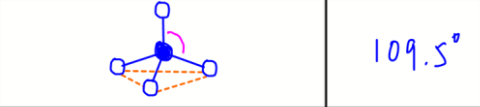
tetrahedral
trigonal bipyramidal

sigma bond

pi bond

Negative Charges are more satisfied/stable when…
in a lower sp orbital than the other because it is closer to the nucleus
Alkane
A compound containing only C & H atoms
Aklene
A compound that contains a C-C double bond
Alkyne
A compound that contains a triple bond
Phenyl group
a six membered ring w/ alternating pi bonds and signals an aromatic compound
Cylic

Acylic

Resonance
the delocalization (spreading out) of pi electrons and lone pairs across multiple atoms in a molecule